Coolant Flush Kits: How to Choose Equipment for a DIY Flush
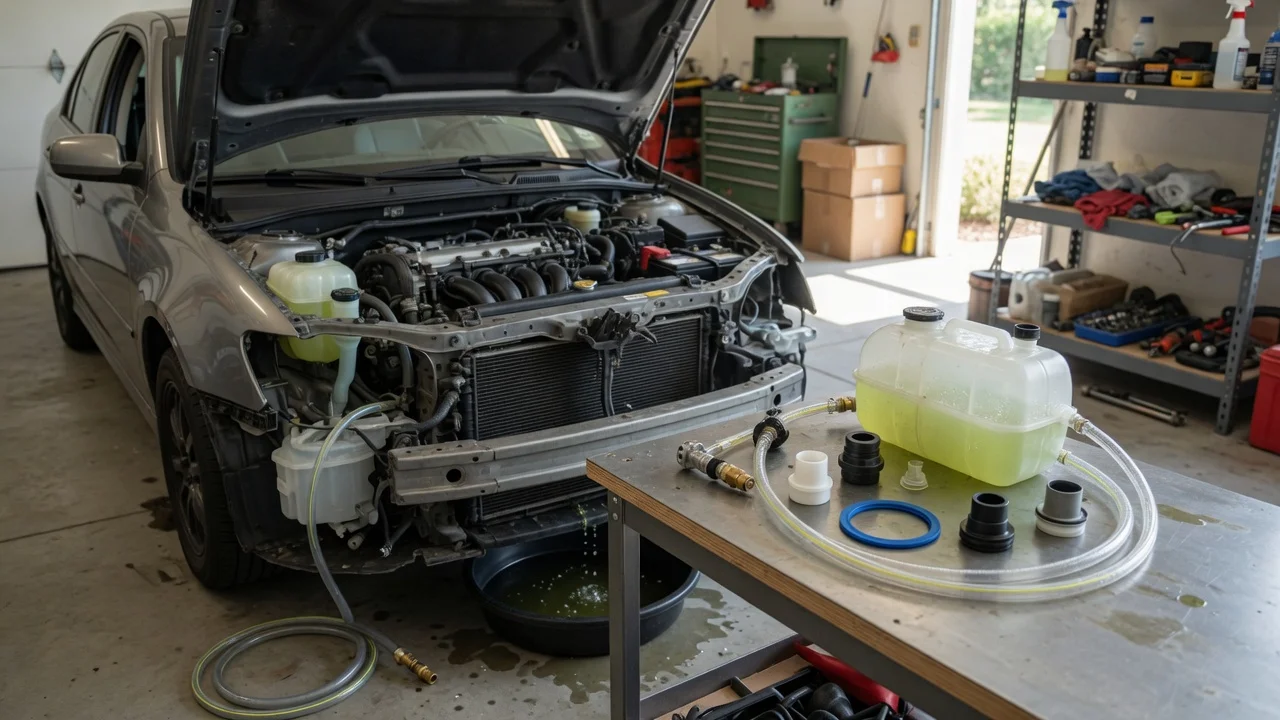
A coolant flush kit is the hardware—and sometimes the cleaner—used to drain old engine coolant, rinse the cooling circuit, and refill it with the mixture the vehicle was designed to use. Coolant is the heat-transfer fluid in the engine’s cooling system, typically a glycol-based concentrate mixed with water and corrosion inhibitors. The kit that fits a DIY flush is the one that matches how that vehicle actually drains, the hose sizes and fittings you can reach, and whether you need a gravity drain, a hose-powered rinse, a chemical cleaner, or a spill-free refill tool. There is no universal kit: layout, coolant chemistry, and fill method vary by model year, market, powertrain, and equipment, and those details must come from the owner’s manual or factory service information for the vehicle on the stand.
What you are choosing between
A drain-and-fill lets gravity empty whatever the radiator, engine, or block drains will release, then you refill. A flush adds a rinse so more of the old fluid, rust, scale, and loose debris leave the engine, radiator, heater core, and hoses. The heater core is the small heat exchanger in the cabin heating circuit. Most home “flush kits” are not shop exchange machines; they are adapters, funnels, pans, and optional cleaners that support one of those two jobs. Compare them on the same criteria: how completely they replace fluid, what they require on the vehicle, what they can damage, and what extra tools you still need.
Equipment Best fit What it does well What limits it; Drain pan, hoses, and a basic funnel Accessible radiator or block drain and a straightforward refill Lowest cost and the fewest parts to mismatch Leaves a large volume of old coolant in the block, heater core, and passages that gravity cannot empty; Garden-hose T-adapter or heater-hose flush kit Vehicles with reachable heater hoses of a matching diameter and a cooling layout that can take a controlled water rinse Moves more old fluid than a gravity drain alone by sending water through the heater circuit Wrong diameter, brittle plastic tees, and household hose pressure can leak or damage a heater core; closed thermostats and one-way valves can block flow; Chemical cooling-system flush kit Systems with oil contamination or heavy scale, and only where the vehicle maker allows a cleaner Attacks deposits a water rinse may not lift Many manufacturers restrict or prohibit chemical flushes; you still need drain and refill hardware and the specified coolant afterward; Spill-free refill funnel kit Vehicles with a compatible radiator or reservoir fill neck after the old fluid is out Cuts spills and gives air a path out while you fill and idle the engine Does not flush anything; useless if the fill opening is the wrong shape or the system is sealed at that neck; Vacuum or air-lift refill tool Hard-to-bleed systems that trap air in the heater core or cylinder head Draws the system down and pulls fresh coolant in, which reduces air locks when the cooling circuit is sound Will not fill correctly if there is a leak; home-grade tools vary widely, and shop tools are a larger purchase; Professional coolant exchanger Workshop fluid exchange when a high replacement fraction is the goal Replaces a large share of the old coolant in one visit Not typical home equipment; the shop must still use the coolant specified for that vehicle
Match the kit to the vehicle, not the other way around
Start with identification, then buy adapters. Confirm engine, model year, and whether the vehicle uses a conventional radiator cap, a pressurized reservoir, dual cooling loops, an electric water pump, or a cabin heater control valve. Hybrids, plug-in hybrids, battery-electric models, and some turbocharged engines often have extra circuits that a single heater-hose kit will not service. If those details are not in the owner’s manual, treat fitment as unknown and do not assume a universal adapter will work.
Read the specified coolant type and any “do not mix” or “do not use tap water / stop-leak / chemical flush” notes before you shop. Inhibitor families (conventional IAT, OAT, HOAT, and related silicate or phosphate formulas) are not interchangeable; mixing can form gel, drop protection, or void coverage where a coolant spec is a warranty condition. Decide whether the job is a drain-and-fill or a true flush. If the maker specifies only a drain-and-fill at a given interval, a pressure-flush kit is extra equipment, not a requirement. Find every drain point you will actually use: radiator petcock, engine-block drain, lower radiator hose, or a combination. A kit that only taps heater hoses is a poor match if those hoses are buried, plastic, or clipped to a valve you cannot isolate. Measure heater-hose inside diameter and note fitting material. Adapter kits are sized; forcing an undersize or oversize tee onto aged rubber or a plastic quick-connect is a leak waiting to happen. Check how the system is filled and bled. If there is no radiator cap, a spill-free funnel that clamps on a cap neck will not fit. Air-prone layouts may need a vacuum refill tool or a factory bleed-screw procedure instead of a funnel. Plan capture volume. Used coolant must go into a closed container, not the ground or a household drain. Capacity is vehicle-specific; size the pan and jugs from the published cooling-system capacity, not from a generic kit claim.
Trade-offs that decide the purchase
Choose a basic drain pan and funnel when the radiator drain works, the coolant is not heavily contaminated, and you accept that a large share of old fluid will remain. That is the least complete service, and it is also the least likely to stress hoses, heater cores, or plastic fittings.
Choose a heater-hose or garden-hose flush kit only when you can identify the correct hose, support both ends so they cannot whip, and control the water so you are rinsing, not pressure-washing the core. Household hose pressure is not a specified cooling-system test; a clogged or aged heater core can burst. Reverse-flushing against a closed thermostat or through an electric pump the maker never intended to run dry or backward is a stop condition: use the service procedure, or stop.
Choose a chemical flush kit only when the contamination (oil in the coolant, heavy rust, stop-leak residue) justifies it and the manufacturer does not forbid the chemistry. A cleaner is not a substitute for the correct coolant. After any cleaner, the system still has to be rinsed and filled with the specified fluid at the specified concentration, usually a premixed 50/50 product or concentrate mixed with distilled or deionized water as the maker directs.
Add a spill-free funnel when the vehicle has a matching fill neck and air must be allowed to escape during refill. Add a vacuum refill tool when bleed screws and idling with the cap off have a poor record on that layout, or when service information calls for a vacuum fill. Those tools complete the refill; they do not choose the coolant or replace a flush you skipped.
What still sits outside the kit
A flush kit rarely includes everything the job needs. You still need the correct coolant, distilled or deionized water if you are mixing concentrate, a drain pan rated for hot liquid, gloves and eye protection, hose-clamp pliers that match the clamps on the car, a container for used fluid, and a way to dispose of that fluid under local rules. Used ethylene glycol coolant is poisonous to people and animals; keep it sealed and out of reach. Legal handling and disposal requirements are set by jurisdiction and are not the same everywhere; treat them as a local check, not a universal rule in this guide.
Safety-critical limits are the same on every kit. Never open a hot, pressurized cooling system; scalding fluid and steam are the hazard, and “warm” is not a reliable substitute for “cool to the touch.” Do not run the engine without coolant. Do not use a kit to bypass a failed water pump, a leaking radiator, a seized thermostat, or a heater core that already weeps. Those are repair jobs, and a flush will not restore them.
When a DIY kit is the wrong next step
Take the vehicle to qualified service when you cannot identify the coolant spec, when hoses or drains are inaccessible without interior or underbody disassembly you are not equipped to reverse, when the system uses multiple loops (hybrid, battery, or auxiliary heater), when the fill method is a vacuum procedure you do not have tools for, or when the cooling system already overheats, leaks, or contaminates oil and coolant into each other. A kit cannot tell you whether a thermostat, pump, radiator cap, or head gasket is the real problem.
Specific hose diameters, cooling-system capacities, bleed-screw locations, torque figures, and chemical-flush approvals are not supplied here because they are vehicle-dependent and were not verified against a named model’s service information. If those values are missing from the owner’s manual, obtain the factory procedure for that exact configuration before buying adapters or cleaners.
A practical way to decide
Buy the smallest set of parts that matches the drains and fill neck you can actually use, plus the coolant the maker names. Use a gravity drain-and-fill with a pan and funnel when that is all the service information calls for. Add a correctly sized heater-hose flush kit only if you need a rinse and the hoses and core can take it. Add a chemical cleaner only if contamination requires it and the maker allows it. Add a spill-free funnel or vacuum refill tool to get the fresh mixture in without air locks. Confirm the coolant type, drain points, and fill method on the vehicle first; the kit is a match for those facts, not a substitute for them.