Choosing an OBD2 Scanner at Walmart
The essential answer
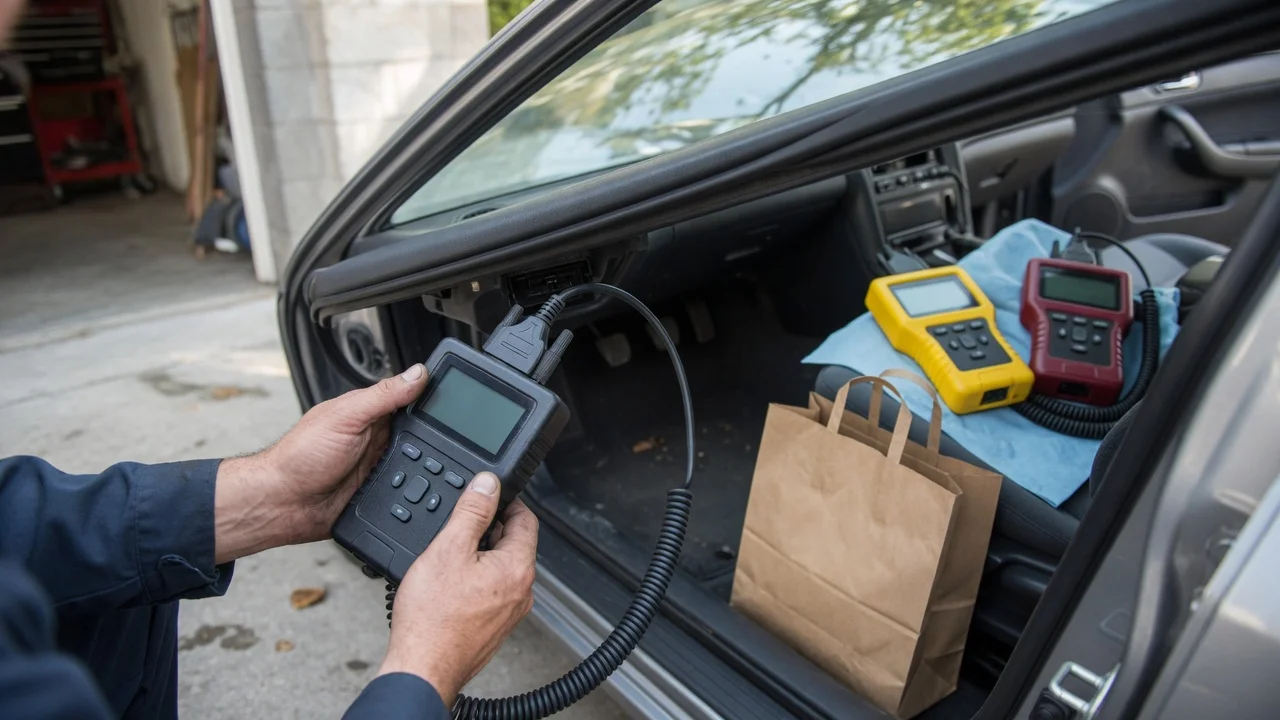
Walmart's OBD2 scanner selection spans three main types: basic code readers, Bluetooth adapters that connect to a phone app, and more capable scan tools with live data and diagnostic information. The best choice depends on what you need to do. A basic OBD2 code reader can retrieve diagnostic trouble codes and clear the check engine light, but it generally cannot show manufacturer-specific data, graph live sensor values, or perform advanced functions. A Bluetooth OBD2 adapter turns your phone or tablet into the display and can run inexpensive or subscription-based apps, although connection quality and app compatibility vary. A standalone scan tool with live data and ABS or manufacturer coverage costs more but is more useful for diagnosis and repair.
Start with compatibility
Any scanner sold as OBD2 or OBDII should work with 1996 and newer gasoline vehicles sold in the United States, but compatibility is not universal in practice. The OBD2 connector is usually under the driver-side dashboard, near the steering column or fuse panel. Before buying, check that the scanner supports your vehicle's model year and the protocol or vehicle type listed on the package or manufacturer documentation. Diesel vehicles, hybrids, and some European models may expose only limited generic data or none at all, especially on entry-level tools. If you need ABS, airbag, transmission, or other system coverage, verify that the specific tool lists those systems rather than assuming the generic OBD2 port will provide them.
Basic OBD2 code readers
An inexpensive handheld code reader is the most straightforward option for checking why the engine light is on. These devices plug into the OBD2 port, read stored and pending trouble codes, and allow you to clear codes after a repair. The code alone is not a diagnosis: a code such as P0420 indicates a catalyst efficiency problem, but the cause could be an oxygen sensor, exhaust leak, failing catalytic converter, or another factor. A basic reader gives you the starting point for that investigation.
Entry-level readers are a sensible choice when you only need to retrieve and clear engine codes and want a device that does not depend on a phone. Their limitations include smaller displays, limited or no live sensor data, and often no coverage for ABS, airbag, or vehicle-specific codes. This can be enough for routine check-engine-light checks on many everyday cars, but it is not a replacement for professional diagnostic equipment.
Bluetooth OBD2 adapters
A Bluetooth adapter is a small device that stays in the OBD2 port and sends data to a smartphone app. The app typically gives you code reading, code clearing, live gauges, and data logging, with a much better interface than a basic handheld unit. The trade-off is that you are depending on the app and the phone connection. Some adapters work best with a specific free or paid app, while others support several common apps. Check the app's operating system support, in-app purchase requirements, and the adapter's known compatibility before buying.
This format is preferable when you want live data, larger readable displays, or the ability to update capabilities through an app. It is also convenient for occasional use because the adapter can remain plugged in or stored in the glovebox. Weak points include occasional pairing problems, slower data refresh on some vehicles, and the fact that an adapter alone cannot access advanced systems unless the paired app and adapter explicitly support them.
Multisystem and professional scan tools
Fuller-featured scan tools combine the convenience of a handheld unit with live data and, on higher-end models, access to ABS, airbag, transmission, and manufacturer-specific systems. They are aimed at home mechanics and small shops that need more than code retrieval. Compared with a basic code reader, these tools can display multiple sensor values at once, support specific vehicle makes, and provide bidirectional tests or service functions on some models.
These are the better option when diagnosis involves intermittent faults, sensor readings, or systems beyond engine management. They cost more, have steeper learning curves, and may require paid updates for newer vehicle coverage. Confirm that the advertised vehicle communication protocols and system coverage match your car before paying for extra capability.
Comparing the main choices
Option | Best for | Typical strengths | Common limits; Basic handheld code reader | Simplest code reading and clearing | No phone required; immediate use; usually inexpensive | Limited live data; often engine-only; Bluetooth OBD2 adapter | Phone display, apps, and live data | Better interface; portable; often low cost | Depends on app and phone; connection variation; Multisystem scan tool | Repair-oriented diagnosis | Live data; ABS or more system coverage | Higher cost; updates may be needed
Choosing by your priorities
If the priority is a no-fuss way to find out why the check engine light came on, a basic code reader is usually enough. If you want a better screen, live gauges, and are comfortable using a phone app, a Bluetooth adapter is often the more flexible value. If you plan to diagnose intermittent problems or work on several modern vehicles, a standalone scan tool with live data and documented system coverage is worth the extra expense.
A code reader and a scan tool can look similar on the shelf, so check the package wording carefully. The presence of live data, manufacturer-specific support, and named systems such as ABS or airbag is a better signal of capability than phrases like "professional" or "works with all cars." Material uncertainty remains around model-specific performance. Even a scanner with broadly compatible hardware may not perform every advertised function on every vehicle and app combination.
Practical buying and use tips
• Match the scanner to your vehicle. Compatibility claims should name your vehicle's year, engine type, and required systems where possible. • Keep the tool's update method in mind. Some scan tools require a cable, memory card, or website download for newer vehicle coverage. • Read whether a Bluetooth adapter relies on a free app or a subscription before comparing prices. • Treat a trouble code as a starting point. Clearing the code may temporarily turn off the warning light, but the underlying condition needs diagnosis and repair.
Final word
Walmart's OBD2 scanner range is broad enough to serve both casual code checks and more involved diagnosis, but the useful choice comes down to compatibility, system coverage, and your willingness to use a phone app. A basic code reader handles simple engine-code checks, a Bluetooth adapter is the flexible low-cost path to a richer display, and a dedicated scan tool is the better investment when live data or non-engine systems matter. Before buying, verify the specific coverage for your vehicle and the tool's update or app requirements so the device does not become a limited code-only accessory.
A noted gap in this guide is specific current pricing, in-stock model names, and retailer inventory, which change by Walmart store and location and were not available as fixed specifications. Use the compatibility and feature checks above against the actual product details shown for any Walmart listing or shelf item.