Choosing a Hatchback: What to Check Before You Buy
The short answer
A hatchback suits you if you want a compact car that is easy to park and drive in town, but you also need to carry bulky items now and then. The key feature is the liftgate, a top-hinged rear door that includes the back window and opens onto a cargo area shared with the cabin. Rear seats that fold down extend that space. A hatchback suits you less well if you regularly need more than five seats, plan to tow, need extra ground clearance for rough roads or deep snow, or want cargo kept out of sight and sealed off from the cabin. Whether a particular hatchback works for you depends on the exact model year, trim and powertrain. Space, equipment and drivetrain options can differ even under the same model name.
Start with how you will use it
Before comparing models, write down what the car has to do every week and what it has to manage a few times a year. These questions narrow the field quickly:
Where will you drive most: city streets, tight parking, long highway commutes, or a mix? How many people ride along regularly, and do you need to fit child car seats? What do you carry: strollers, sports gear, bicycles, pets, tools, luggage? What is your climate like? Many hatchbacks are front-wheel drive only, and all-wheel drive is offered on only some models and trims. Do you have home charging if you are considering a plug-in hybrid or electric hatchback? How long do you plan to keep the car? That affects how much depreciation and long-term maintenance matter.
Check cargo space in person, not just on paper
US cargo figures are usually quoted in cubic feet, often twice: once with the rear seats up and once with them folded. Manufacturers do not always measure the same way, so numbers from different brochures may not compare cleanly. Shape matters as much as volume. A wide, square opening and a low load floor can be more useful than a slightly larger number.
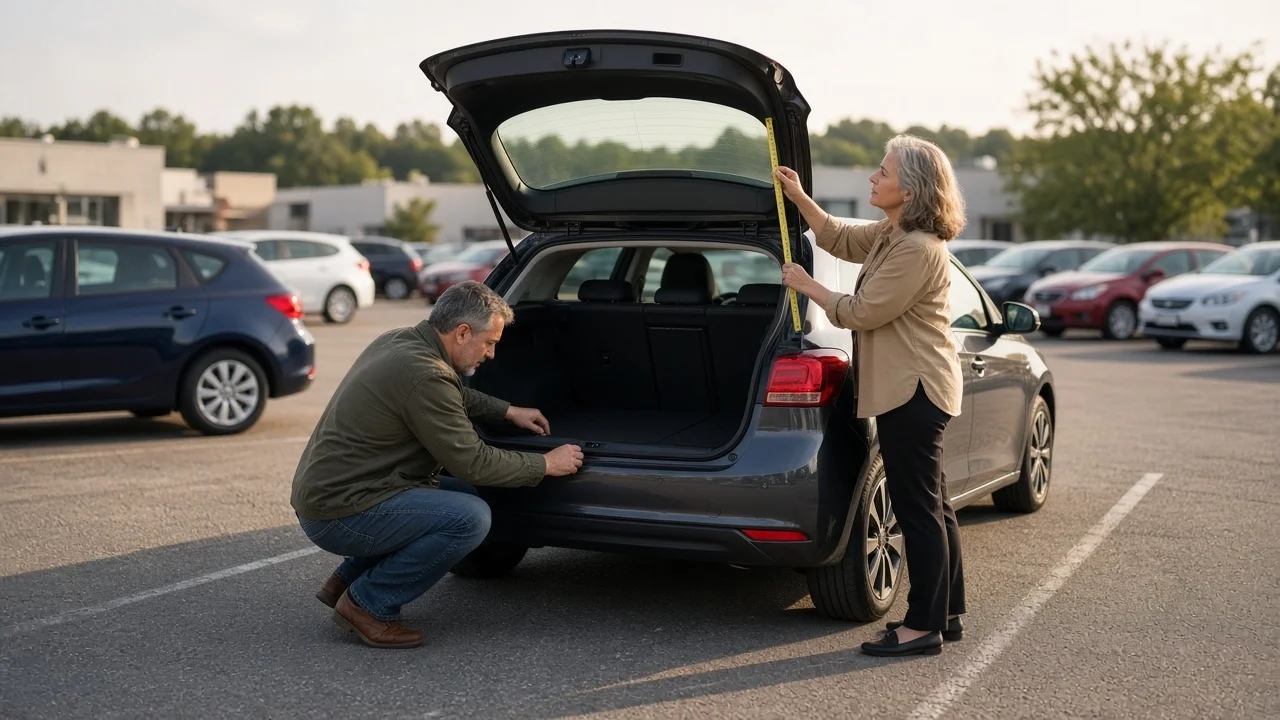
Measure the width and height of the liftgate opening. Check the height of the load floor and whether you have to lift items over a lip. Fold the rear seats and see whether they lie flat or leave a step or slope. Check for an adjustable cargo floor or under-floor storage. Find out whether a spare tire is included, or only a tire inflator kit. If possible, bring the bulky items you carry most often and load them yourself.
Check seating, fit and visibility
Sit in the driver's seat and in the back. Some hatchbacks have a sloping roofline that cuts rear headroom and narrows the rear window. If you use child seats, find the anchor points and install your own seat to check the fit. Look over your shoulder to judge rear visibility, and note whether the trim includes a rear wiper and a rear camera. Equipment like this often varies by trim.
Match the powertrain to your driving
The base engine and the optional engines on the same hatchback can feel very different on the highway and when the car is loaded. Check which transmission comes with each version. Some use a continuously variable transmission (CVT), which changes ratios smoothly with a belt-and-pulley system instead of fixed gears. Manual transmissions are offered on only a few models. Performance versions, often called hot hatches, add power but usually bring a firmer ride and larger wheels. They may also require premium fuel and cost more to insure and to fit with tires. For fuel economy, compare the EPA estimates for the exact engine, transmission and drivetrain combination, not the best figure quoted for the model line.
Confirm the exact version you are looking at
Specifications, safety ratings and features apply to a specific model year, trim and powertrain. A review or rating for one year or one engine may not apply to the car in front of you. On a new car, the window sticker lists the standard and optional equipment. On a used car, use the vehicle identification number (VIN) to confirm the year, trim and factory equipment. Safety ratings from NHTSA and IIHS are issued for particular model years and sometimes depend on specific equipment, so match them to the exact vehicle.
Inspect condition carefully if buying used
Get a vehicle history report and compare it with the seller's account. Run the VIN through NHTSA's recall lookup and ask for proof that open recalls were completed. Ask for service records, especially for transmission and scheduled maintenance. Have an independent mechanic do a pre-purchase inspection before you commit. Open the liftgate and check that its support struts hold it up on their own. Look for water stains, damp carpet or rust in the cargo area and spare-tire well, which can point to worn hatch seals. Test the rear wiper, rear lights and any power liftgate. Wiring that runs through the hatch hinge can wear over time. Fold and unfold the rear seats to check the latches and mechanisms. Test drive on the kinds of roads you use most, including the highway if you commute on one.
Work out the full cost of ownership
The advertised price is a starting point, not what you will pay. Ask for an out-the-door price in writing. On used listings, the asking price is not the same as what similar cars actually sold for. Whenever you compare prices or ownership estimates, note the date, the market or region, the currency, and exactly which costs are included.
Cost item | What to confirm; Purchase price | Out-the-door total, including sales tax, title, registration, dealer fees and any destination charge on new cars; Financing | Interest rate, loan term and total amount repaid, not just the monthly payment; Insurance | Quotes for the specific VIN or trim, since performance trims can cost more to insure; Fuel or charging | EPA estimate for the exact powertrain, applied to your own annual mileage; Tires | Tire size for the trim, since larger wheels on upper trims can mean costlier replacements; Maintenance and repairs | Scheduled service costs and remaining warranty coverage; Depreciation | Resale trends for the specific model and year if you plan to sell or trade it in later
What this guide cannot tell you, and your next step
No verified prices, cargo measurements, fuel economy figures, safety ratings or reliability data were available for this guide, so it does not name or rank specific hatchbacks. You will need to gather those figures for the exact model years, trims and powertrains you are considering, and confirm they apply to the US market. A practical next step: shortlist two or three hatchbacks that fit your use, load your real cargo into each, get written out-the-door and insurance quotes, and, for a used car, book an independent inspection before you sign anything.