Chevy Equinox Check Engine Light: Causes and Next Steps
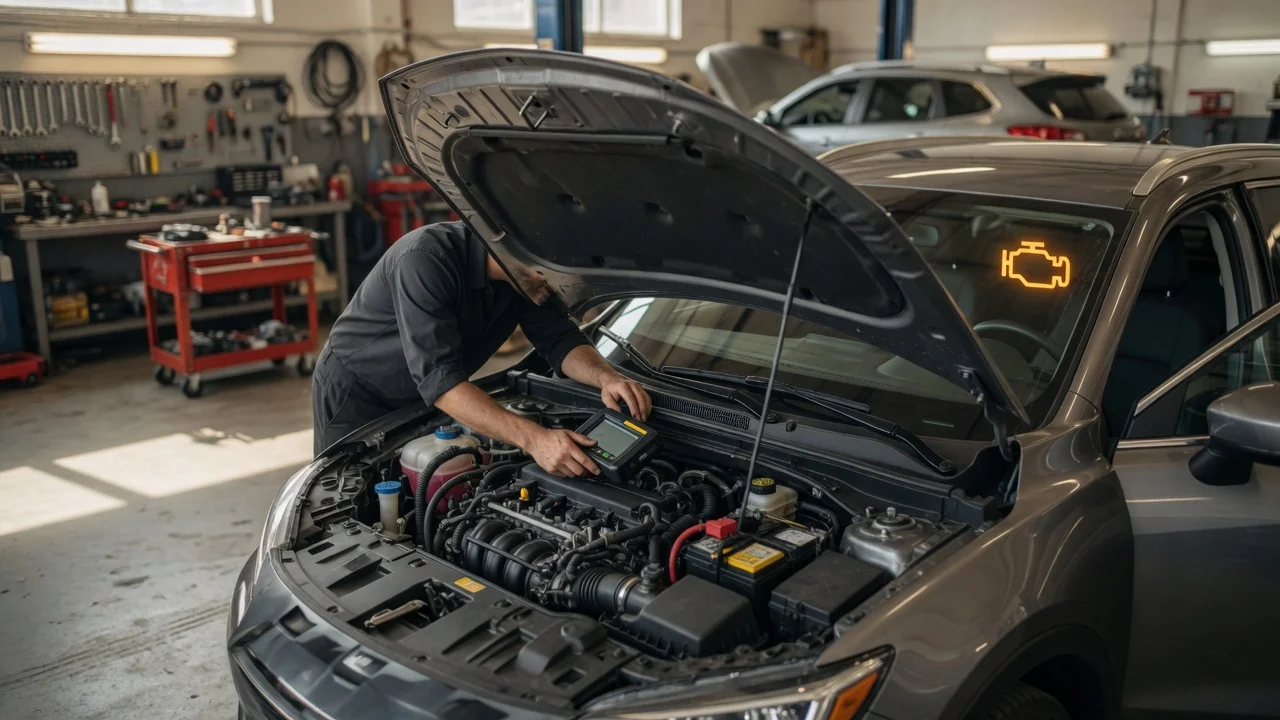
What the light means
A check engine light on a Chevrolet Equinox means the powertrain control module (PCM) has detected a fault that can affect emissions control, fuel delivery, ignition, or related engine management. The lamp is the OBD-II malfunction indicator. It reports that a monitor failed or a sensor reading left its expected range long enough for the PCM to store a diagnostic trouble code. It does not, by itself, name a failed part.
This guidance applies to gasoline and diesel Equinox models sold with OBD-II, which covers the retail Equinox line from the 2005 introduction onward. Exact causes, sensors, and code lists vary by model year, generation, and powertrain: first generation (2005–2009), second generation (2010–2017), third generation (2018–2024), and the redesigned 2025-and-later Equinox. A Chevrolet Equinox EV uses high-voltage and propulsion warnings rather than a conventional engine-management lamp; the material below is for Equinox models with an internal-combustion engine.
The pattern of the lamp changes the urgency. A steady light means a stored or confirmed fault. Many Equinox drivers can continue a short, moderate trip while arranging diagnosis, provided the engine runs smoothly, temperature stays normal, and no other red warnings appear. A flashing light means an active misfire severe enough to overheat and damage the catalytic converter. Reduce throttle, avoid heavy load, and stop as soon as it is safe if flashing continues, the engine shakes, or power drops sharply.
How to read the lamp and the first checks
Treat the light as a prompt to gather evidence, then interpret that evidence against how the vehicle is running. A trouble code is a starting point for inspection. Replacing a sensor or catalyst because a code names that component is a common misstep; the code often reflects a condition the sensor observed, such as a vacuum leak, wiring fault, or exhaust leak upstream of an oxygen sensor.
Note whether the lamp is steady or flashing, and whether it came on at start-up, after refueling, under load, or after a recent service. Write down any change in idle, hesitation, fuel smell, exhaust odor, or coolant temperature. Confirm the fuel cap is present, seated, and clicked to the stop. Equinox EVAP monitors are sensitive to a loose, damaged, or missing cap and to the seal on the filler neck. After tightening, the lamp may need several drive cycles to turn off even if the leak is gone. Look at the instrument cluster for related warnings: reduced power, traction, temperature, oil pressure, or charging. Those point to a broader powertrain or electrical problem that belongs in a shop if the engine is misfiring, overheating, or losing oil pressure. Check for an obviously disconnected intake hose, a loose electrical connector in the engine bay, or a recent repair that left a sensor unplugged. On turbo Equinox engines, inspect visible charge-air plumbing for a hose that has slipped off. Read the codes with an OBD-II scan tool at the diagnostic connector, typically under the driver’s side of the dash. Record every stored and pending code, freeze-frame data (engine speed, load, coolant temperature, fuel-system status), and whether the code is current. Clear codes only after recording them; clearing without a repair erases freeze-frame evidence and can delay a complete diagnosis.
Stop using the vehicle and arrange towing when the light flashes and the engine misfires, when temperature climbs into the hot zone, when oil pressure is low, when the engine will not stay running, or when a strong fuel smell is present. Those conditions can damage the catalyst, the engine, or create a fire risk. A steady light with normal temperature, stable idle, and no loss of power still warrants a code read within a short period; an Equinox that sits with an illuminated lamp will usually fail an emissions inspection, and an ignored misfire or lean condition can progress.
Plausible causes and what each check indicates
The systems below are the ones OBD-II most often flags on gasoline Equinox models. Rank order is not a documented failure-rate list for every year and engine. Confirm that a given test applies to the engine in that vehicle: naturally aspirated 2.4-liter and V6 engines in earlier generations, 1.5-liter and 2.0-liter turbo fours in 2018–2024 models, the 1.6-liter diesel offered in some markets, and the 1.5-liter turbo used in the 2025 redesign. Diesel and turbo gasoline engines add exhaust-aftertreatment and boost-control codes that earlier four-cylinders do not set.
Evaporative emissions (EVAP) and the fuel cap
A loose or leaking fuel-cap seal, a cracked EVAP hose, a stuck purge valve, or a failed vent solenoid can set EVAP leak or purge-flow codes and turn the lamp on, often after refueling. The engine may otherwise run normally. A cap that will not click, a damaged gasket, or a filler neck that is bent or corroded supports a cap or neck leak. A scan tool that shows a large or small EVAP leak (commonly P0442, P0455, or similar) is evidence of a leak somewhere in the tank-to-canister-to-engine path. Smoke testing the EVAP system, or following the GM diagnostic flowchart for that code, is the reliable next step. Replacing the purge valve because the code mentions purge flow is premature until commanded-purge tests and hose integrity are checked.
Misfire, ignition, and fuel delivery
A flashing light, rough idle, or stumble under acceleration points to misfire. Codes such as P0300 (random) or P0301–P0304 (cylinder-specific on four-cylinder Equinox engines; V6 models add cylinders 5 and 6) mean the PCM counted combustion events that did not complete. Causes include worn spark plugs, a failed coil, a leaking or clogged injector, low fuel pressure, an intake vacuum leak, or a mechanical problem such as low compression. A misfire isolated to one cylinder after swapping a coil to another cylinder, if the code follows the coil, supports a coil fault. A misfire that follows a plug supports the plug. Misfire on several cylinders with a fuel-pressure reading below specification supports a pump, filter, or pressure-control issue. Continue driving with a flashing misfire only as far as needed to get off the road; unburned fuel in a converter can melt the catalyst substrate.
Oxygen sensors, air-fuel control, and the catalytic converter
Upstream oxygen (or air-fuel ratio) sensors tell the PCM whether the mixture is rich or lean. Downstream sensors monitor catalyst efficiency. Codes for sensor circuit, sensor response, or fuel-trim limits can come from a failed sensor, wiring damage, an exhaust leak before the sensor, a vacuum leak, a dirty mass-airflow sensor, or a fueling problem. Catalyst-efficiency codes (often P0420, and P0430 on banks of V6 engines) mean the downstream sensor is seeing exhaust that still looks untreated. That result can be a damaged converter, an upstream exhaust leak, a rich or misfiring condition that poisoned the catalyst, or a slow downstream sensor. A catalyst code is not proof the converter must be replaced until exhaust leaks, misfire history, and fuel trims are ruled out.
Air metering, vacuum leaks, and boost (turbo models)
A disconnected intake duct, split vacuum line, dirty or failed mass-airflow sensor, or stuck throttle body can set airflow, throttle, or fuel-trim codes and cause surge, stall, or a high idle. On 1.5-liter and 2.0-liter turbo Equinox engines, a loose charge-air hose or leaking intercooler joint can produce the same lean or underboost codes. A visual find of a hose off the throttle or turbo outlet is a strong, immediate explanation. High positive fuel trims at idle that improve with the mass-airflow sensor disconnected (on engines where that test is valid) can support a metering or leak issue; follow the service procedure for that engine rather than treating the shortcut as a complete diagnosis.
Temperature, thermostat, and cooling
An engine-coolant-temperature sensor or a thermostat that sticks open can keep the engine in open-loop fueling, set a thermostat-range code, and illuminate the lamp, sometimes with a low temperature gauge reading. Overheating with a check engine light is a different problem: stop, allow the engine to cool, and treat it as a cooling-system failure. Continuing to drive an overheating Equinox can warp the head or damage the catalyst. Specific thermostat opening temperatures and cooling-system capacities are generation- and engine-specific; use the service information for that VIN rather than a generic figure.
Generation and powertrain notes
Second-generation Equinox models with the 2.4-liter Ecotec are widely associated in service literature and owner reports with timing-chain stretch, PCV-related oil consumption, and intake or ignition faults that can set misfire or cam-correlation codes. Those associations are a reason to inspect chain command and cam/crank correlation when those codes appear; they are not a substitute for a code-specific test. Third-generation 1.5-liter turbo engines have been the subject of technical service information covering carbon, PCV, oil consumption, and related drivability complaints on some model years; a check engine light on those engines still needs the stored code and freeze frame before any parts decision. Diesel Equinox models can illuminate the lamp for diesel-exhaust-fluid, NOx-sensor, or particulate-filter faults that do not exist on gasoline twins. Public, VIN-level bulletins and the factory diagnostic flow for the stored code are the supported source for those variant-specific paths. This article does not have a tabulated failure ranking by year.
What you observe What it often indicates Next action; Steady lamp, smooth idle, recent refuel EVAP leak or fuel-cap seal Tighten or replace the cap; read EVAP codes; smoke-test if the lamp remains; Steady lamp, poor fuel economy, no misfire O2/air-fuel sensor, fuel trim, or airflow metering Read fuel trims and sensor codes; inspect intake and exhaust leaks before replacing a sensor; Flashing lamp, shake, loss of power Active misfire; catalyst at risk Reduce load and stop; read cylinder misfire codes; do not keep driving to 'clear' the light; Catalyst efficiency code only Converter, upstream leak, or prior misfire/rich condition Fix misfire and exhaust leaks first; then retest catalyst monitors; Turbo Equinox, whistle or lag, underboost code Charge-air leak or boost control Inspect hoses and clamps; follow boost-control diagnostics for that engine; Temperature warning plus check engine light Cooling or overheat-related fault Stop if hot; diagnose cooling before further driving
What to do after you have a code
Match the code to the GM diagnostic procedure for that Equinox engine and year. Check wiring and grounds at the named sensor, command the related actuator with a scan tool where the procedure calls for it, and compare live data with the freeze-frame snapshot. Pending codes that have not matured still matter; they show a monitor that failed once and may return. If monitors are incomplete after a repair, the lamp can stay off while the vehicle remains unready for an emissions test until a complete drive cycle finishes.
Professional diagnosis is the appropriate boundary when the light is flashing, when multiple modules store codes, when a misfire continues after plugs and coils are verified, when fuel pressure or compression is out of specification, or when catalyst, timing-chain, turbo, or diesel-aftertreatment work is indicated. Independent shops and dealers with GM-capable scan tools can run bidirectional tests and inspect mode $06 monitor results that a basic code reader does not show. Parts replacement without that confirmation remains a guess, even when the code text names a sensor or catalyst.
After a confirmed repair, the lamp should go out once the PCM verifies the monitor, or it can be turned off with the scan tool and then watched through a drive cycle. If the same code returns immediately, the repair missed the cause. If a different code appears, diagnose the new code as a separate condition. Keep the recorded codes and freeze-frame data until the repair is verified; they are the only Equinox-specific evidence this process produces.