Cars with the most reliable CVT
Choosing a continuously variable transmission often raises one immediate question: what car has the most reliable CVT transmission? The answer is less about a single model than about matching a well-engineered CVT to disciplined service and realistic driving conditions. Some automakers have refined steel-belt and chain-type designs over many years, while others sourced early units that developed a poor reputation. This guide explains how a CVT works, what makes one durable, and which checks matter most during a used-car purchase or a new-car shortlist.
The direct answer
The most dependable answer in the US market points toward newer CVTs from Toyota and Honda when paired with their conventional hybrid or mainstream gasoline models. These transmissions have demonstrated generally consistent shift behavior and fewer widespread complaints than many early Jatco units used by other brands. That does not make them invincible, but their fluid specification, calibration, and production consistency give them an advantage. The condition that changes the answer is maintenance: a neglected Toyota or Honda CVT can still fail sooner than a well-serviced competitor.
Subaru also belongs in a short answer because its Lineartronic chain-type CVT has improved across successive generations and suits all-wheel-drive vehicles. Nissan produced some durable applications, yet certain older high-torque units account for much of the negative reputation around this transmission type. When someone asks what car has the most reliable cvt transmission, the practical reply is a current Toyota, Honda, or Subaru model with verifiable service history rather than a single nameplate. Exact rankings remain judgment calls, not a manufacturer-published reliability score.
Function and background
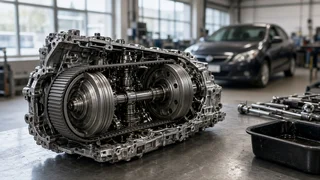
A CVT replaces fixed gear ratios with a stepless range controlled by pulleys and a belt or chain. Engine load determines how the pulleys change diameter, allowing the transmission to hold the engine near an efficient speed while road velocity rises. This explains the characteristic drone during acceleration and why shift feel differs from a conventional automatic. Smooth operation depends on precise hydraulic pressure and a belt that maintains friction without slipping. When either condition degrades, the transmission may shudder, flare, or enter a protective mode.
The transmission type also affects what a driver perceives as hesitation. A CVT may delay the expected surge because it is adjusting ratio before the engine builds speed. Observing normal behavior during a test drive helps separate a calibration trait from a fault. Diagnostic codes can identify pressure or speed-sensor errors, but a code alone does not prove internal wear. Since fitment varies by platform, one model year may use a different supplier or calibration than another, so vehicle-specific confirmation matters before judging reliability.
Choosing and buying
Service history is the strongest purchase filter for any used vehicle with a CVT. Confirm the fluid specification was followed and that the fluid has been changed at intervals appropriate for severe service. Clean, correct fluid preserves the belt-to-pulley interface and cooling performance. A vehicle without records is not automatically bad, but it increases uncertainty. Because CVTs are sensitive to contamination and overheating, a tow package or extended mountain use makes a documented service history more valuable.
During a test drive, note steady-speed smoothness, light-throttle response, and any shudder when pulling away from a stop. Shift behavior should be progressive rather than jerky. After warming the drivetrain, accelerate moderately up a grade and listen for whine or feel for surge. Also check that the selected model actually has the transmission type you expect; some trims use a conventional automatic or a hybrid eCVT, which uses a different mechanism. This fitment check changes parts expectations and repair options before you commit.
Understanding a problem
If a CVT shudders at low speed or flares between ratios, plausible causes include degraded fluid, a worn valve body, or a failing torque converter damper. The least expensive discriminating check is a fluid inspection followed by a fluid change using the specified product. If shudder disappears, the cause was often old fluid rather than mechanical failure. Continued judder after a correct service may point to pressure control or internal belt damage, which requires diagnosis rather than replacing parts on a guess.
A diagnostic code for a speed sensor or pressure solenoid does not automatically condemn the transmission. Connector corrosion, wiring faults, or a low fluid level can produce similar readings. Manufacturer-dependent codes require confirmation for the exact vehicle and transmission calibration. If the car enters limp mode or exhibits severe slipping, stop driving to prevent further damage. The next step is to retrieve the code, inspect fluid condition, and rule out external faults before considering repair options.