Car subwoofer placement: where to put it and which way to face it
A subwoofer does not radiate bass the way a tweeter projects highs, so its location and orientation in a vehicle are less about pointing at your ears and more about how the long low-frequency waves load the cabin. The practical question behind car subwoofer placement is which mounting spot couples the cone to the interior efficiently without creating cancellation, buzzes, or wasted output. Because every trunk, seat layout, and audio source behaves a little differently, the best answer depends on the enclosure style, available space, and how the head unit sends signal to the amplifier.
Essential answer
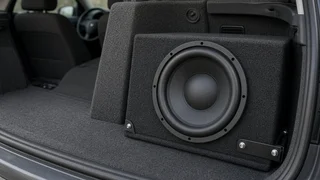
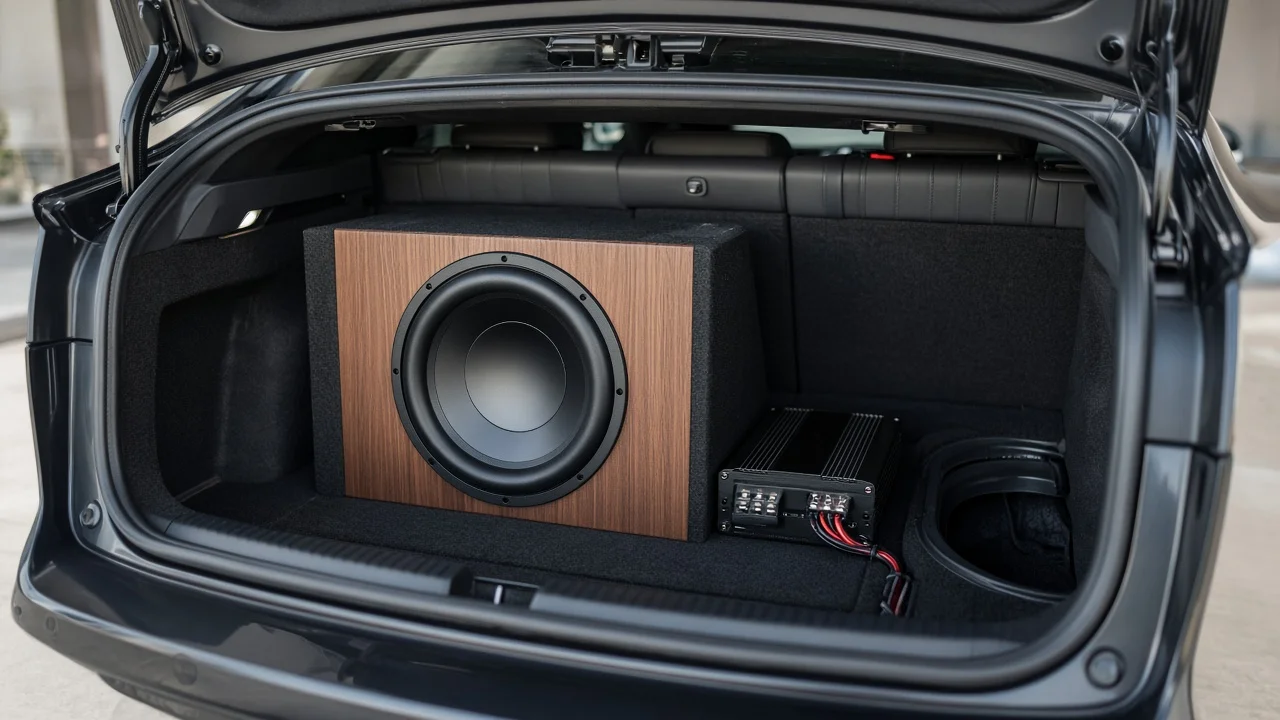
For most enclosed trunk installations, the most consistent result comes from placing the subwoofer near the rear of the trunk and facing the cone toward the rear bumper or tailgate rather than directly at the seatback. Bass wavelengths are much longer than the distances inside a car, so the sound reflects and pressurizes the cabin instead of beaming like a midrange. Facing the woofer backward often reinforces the boundary effect at low frequencies by using the rear panel as a coupling surface, which can increase perceived output without changing amplifier power.
The orientation is not a fixed rule for every vehicle. In a hatchback, SUV, or wagon, the cabin and cargo area share one open airspace, so a rear-facing driver may still work but a side or upward placement can change how evenly the bass reaches the front seats. If the enclosure fits behind a rear seat, firing through the ski pass-through or folding armrest can reduce the muffling caused by a sealed seatback. The goal is to test a few positions while playing familiar music and listen for the strongest, cleanest impact at the driver’s seat, since the head unit and amplifier settings interact with placement.
Identification and location
A subwoofer in a car door is generally a compromise because doors are shaped for midbass and midrange drivers, not for a large cone moving through a long excursion. Door cavities are thin and often leak air around clips, window seals, and drain openings, which reduces the controlled loading a subwoofer needs. Some factory systems include low-frequency drivers low in the front doors, but they usually operate as midbass rather than true subwoofers. Before building or modifying a door, check the depth behind the panel and whether the speaker wiring and vapor barrier can support a larger magnet.
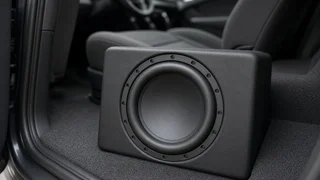
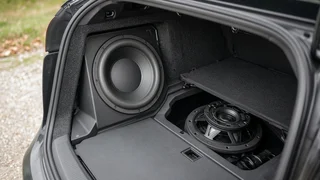
Popular installation choices include the trunk, under a seat, or in a corner of the cargo area. An under-seat enclosure saves cargo space and keeps the low-frequency source closer to the listener, though its smaller internal volume usually limits how deep it can play. A corner of the trunk can reinforce output through adjacent panels, but it may excite rattles in trim or the spare-tire well. Whatever location you choose, the subwoofer should be secured so it cannot slide during braking, and the speaker wiring should follow existing grommets rather than pinched door or hatch openings to avoid shorts and signal reception interference.