Car Imports in Pakistan: Routes, Eligibility, Duties and Customs Clearance
Car imports in Pakistan are legal but tightly controlled. A private individual cannot simply buy a car abroad and ship it home the way a dealer might in an open market. Most personal imports happen through a small number of government-defined schemes, mainly aimed at overseas Pakistanis. The vehicle must meet eligibility conditions such as age, steering position and condition, and it attracts substantial duties and taxes at customs. Whether importing a car to Pakistan makes sense depends on who you are, which scheme you qualify for, what vehicle you want and how the rules stand on the date the car arrives.
The short answer
If you are an overseas Pakistani, you can usually import one vehicle at a time under a personal scheme, provided the car falls within the permitted age, is right-hand drive and is cleared with the required documents and duty payment. If you live in Pakistan and have no qualifying overseas status, your realistic options are buying a locally assembled car, buying an already imported car from a dealer, or receiving a car as a gift from a qualifying relative abroad. Import policy is set by the federal government and administered by Pakistan Customs under the Federal Board of Revenue, and it is revised periodically. Treat any specific age limit, duty figure or scheme condition you read as time-sensitive, and check the current version before you buy or ship.
The main import routes
Pakistan's import policy has long distinguished commercial imports by registered businesses from personal imports by individuals. For individuals, three schemes have traditionally covered most cases. Their names and conditions have stayed broadly recognizable over time, but the details are amended through government notifications.
Route | Who it is for | General idea; Personal Baggage | Overseas Pakistanis traveling to Pakistan | The vehicle is imported in the traveler's own name, linked to their passport and travel record; Transfer of Residence | Pakistanis returning home after living abroad | The vehicle is shipped as part of relocating household goods, subject to a minimum period of residence abroad; Gift Scheme | Family members in Pakistan of an overseas Pakistani | The overseas relative sends a vehicle as a gift to an eligible family member; Commercial import | Registered importers and dealers | New or used vehicles imported for sale, under commercial duty and regulatory terms
The personal schemes typically come with frequency limits, such as one vehicle within a set period, and proof of overseas status. They have also often required that duties be paid in foreign currency remitted from abroad. These conditions exist to stop the schemes being used as an informal commercial channel, and they are the details most likely to change.
Vehicle eligibility
Vehicle eligibility is where many import plans fail. Even a qualifying importer can be turned away if the car itself does not meet the policy.
Age limit: Used vehicles must fall within a maximum age, measured from the date of manufacture or first registration. The limit has historically differed between ordinary cars and larger vehicles such as SUVs and four-wheel-drive models, and it has been revised more than once. Steering position: Pakistan drives on the left, so right-hand-drive vehicles are the norm. Left-hand-drive cars are generally not permitted for ordinary personal import, apart from narrow exceptions. Condition: Salvage, flood-damaged or heavily rebuilt vehicles can run into problems at inspection, and some categories are restricted outright. Ownership and title: The vehicle must have clear, transferable ownership documents in the importer's or sender's name, consistent with the scheme being used. Engine capacity: Engine displacement does not usually decide eligibility, but it strongly affects the duty payable.
Market specification: why a US car is usually the wrong choice
Market specification means the version of a model built for a particular country's roads, fuel, regulations and driving side. For readers in the United States, this is the most important practical point. US-market cars are left-hand drive, which normally rules them out of personal import into Pakistan regardless of age or condition.
That is why the used-import market in Pakistan relies heavily on right-hand-drive vehicles from markets such as Japan. Overseas Pakistanis in the US who want to use a personal scheme often source a right-hand-drive car from one of those markets instead of shipping a car they already own. Beyond steering, US-spec vehicles can also differ in lighting, emissions hardware, fuel requirements and parts availability. Local service support for a model sold mainly in North America may be limited even where the model name is familiar.
How duties and taxes are calculated
Import charges on cars in Pakistan are high and stack on top of each other. Exact rates change with each budget and policy notification, so no fixed figure stays reliable for long. The structure, however, is fairly consistent.
Customs duty: The base import duty on the vehicle. Regulatory and additional customs duties: Extra layers the government uses to manage import volumes and foreign exchange. Sales tax: Applied at the import stage. Withholding or advance income tax: Collected at import and sometimes again at registration, often at different rates for tax filers and non-filers. Valuation basis: Used vehicles are often assessed using customs valuation tables or fixed amounts linked to engine capacity and age, rather than only the price you paid. Engine displacement bands: Larger engines generally attract much higher charges, and the jump between bands can be significant.
The result is that the landed cost of an imported car can be several times its purchase price abroad, especially for larger engines. Before buying, estimate the total using the current duty schedule for the exact model, engine size and year, rather than relying on figures from forums or older articles.
Import documentation
Exact requirements depend on the scheme, but import documentation for a personal vehicle import usually includes the following.
Passport and national identity documents of the importer, and of the recipient for a gift; Proof of overseas status or residence abroad, such as visas, residence permits or travel records; Original vehicle title or export certificate from the country of origin; Purchase invoice or bill of sale; Bill of lading issued by the shipping line; Evidence of foreign remittance used to pay duties, where the scheme requires it; Gift declaration or proof of relationship for the Gift Scheme; Any inspection, de-registration or export documents issued in the source country
Customs clearance step by step
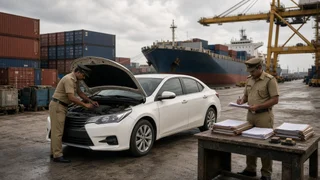
Customs clearance is the process of declaring the vehicle, having it assessed and paying the charges before it can leave the port. Most importers hire a licensed customs clearing agent, because the paperwork and electronic filing are detailed and errors cause costly delays.
1) Confirm eligibility for both the importer and the vehicle under the current policy before buying. 2) Purchase the vehicle and obtain clean ownership and export documents in the source country. 3) Arrange shipping, either roll-on/roll-off or in a container, to a Pakistani port. 4) File the goods declaration through the customs electronic system, usually via a clearing agent. 5) Customs examines and values the vehicle, checking age, chassis number, condition and documents. 6) Pay the assessed duties and taxes through the approved channel. 7) Collect the vehicle after release and settle port, terminal and agent charges. 8) Register the car with the provincial excise and taxation department, which involves its own fees and taxes.
Delays at the port carry real cost, because storage and demurrage charges accrue daily. Having every document ready before the ship arrives is one of the most effective ways to control the final bill.
The export side when shipping from the US
If the vehicle leaves from the United States, US export rules apply before Pakistani import rules come into play. US Customs and Border Protection requires vehicle exports to be documented. That generally means presenting the original title and supporting documents at the port of export ahead of shipment, and filing an electronic export record. Shipping companies and freight forwarders handle much of this, but a car with a lien, an unclear title or missing paperwork can be held before it ever leaves. As noted above, a US-market car is usually left-hand drive and may not qualify for import into Pakistan at all, so confirm eligibility before paying for export and shipping.
Emissions compliance and safety standards
Pakistan has adopted vehicle emissions standards modeled on the European framework and has moved toward stricter levels over time, with fuel quality as a related factor. Emissions compliance and safety standards are applied most directly to manufacturers, assemblers and commercial importers. For individual imports, the practical controls are usually the age limit, the steering requirement and the condition inspection, rather than a full certification test of each car. That can change, so do not assume an older or modified vehicle will pass simply because similar cars were cleared in the past. Cars with removed emissions equipment or major unapproved modifications are a risk at inspection and later at registration.
Costs beyond duty
Purchase price and any auction or dealer fees in the source country; Inland transport to the export port and export handling; Ocean freight and marine insurance; Port, terminal, storage and demurrage charges in Pakistan; Clearing agent fees; Provincial registration fees and annual token tax; Conversion costs between currencies and bank remittance charges; Immediate servicing, tires or parts that are harder to source locally
Common mistakes to avoid
Buying a car before confirming it meets the current age and steering rules; Shipping a left-hand-drive US-market car on the assumption it can be cleared; Relying on duty figures from older articles or social media posts; Using someone else's passport or overseas status in ways the scheme does not permit, which can lead to penalties or confiscation; Underestimating port storage costs caused by missing documents; Ignoring after-sales support and parts availability for an uncommon model
Is importing worth it?
Importing a car to Pakistan tends to make sense when you qualify cleanly for a personal scheme and want a model, trim or level of equipment not sold locally. It also helps when the total landed cost compares well with a locally assembled equivalent after duty. It makes less sense when the car is left-hand drive, near the age limit, fitted with a large engine that falls into a high duty band, or likely to be hard to service. The sound next step is to price your specific model under the current duty schedule, confirm your scheme eligibility, and get a quote from a licensed clearing agent before committing to a purchase.