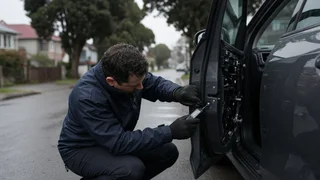
Car door lock repair in Singapore
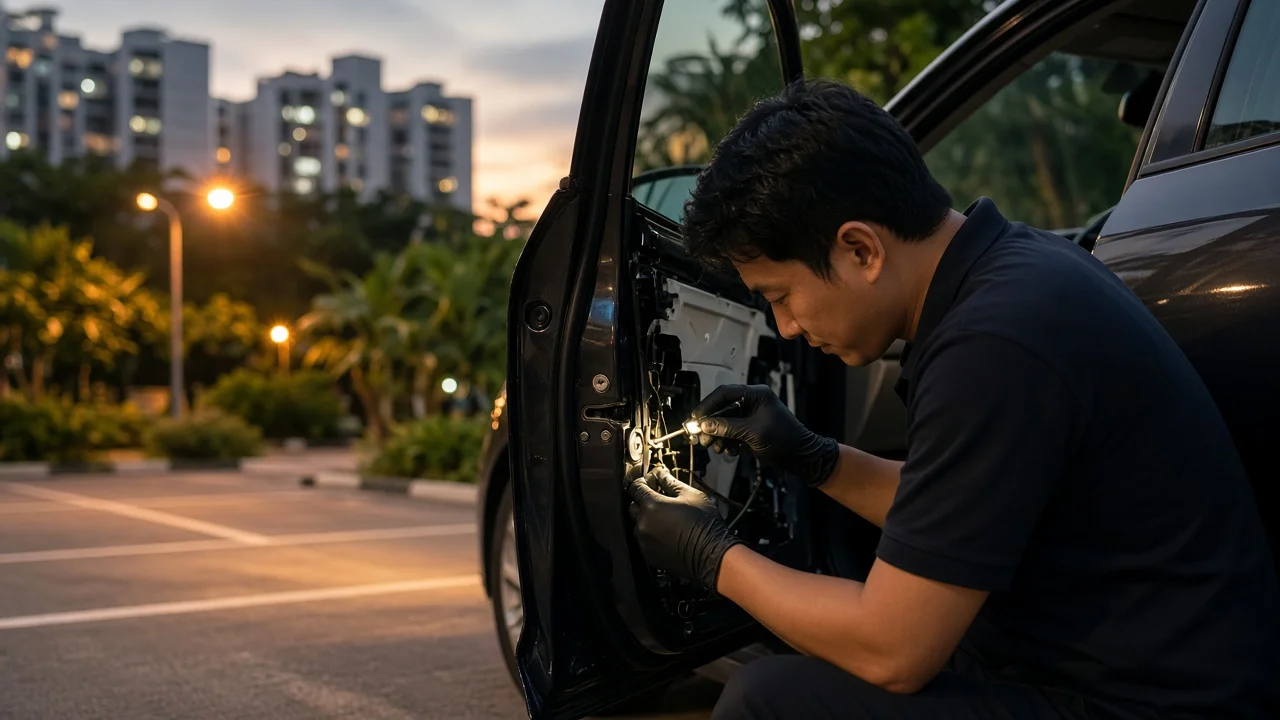
The short answer
Which repair shop to use depends mostly on which part of the lock has failed. A fault in the lock cylinder (where the key goes) or in a lost or damaged key usually suits an automotive locksmith. A fault in the latch, the internal linkage or the electric lock actuator suits a workshop that regularly removes door panels. A fault in central locking, the key fob or the body control electronics may need a brand dealer or a specialist with the right diagnostic equipment. Three things can change that choice: whether the car is still under manufacturer warranty, whether the damage came from a theft attempt that may be covered by insurance, and whether the car was a parallel import, because parts can differ from the locally distributed version of the same model.
This guide has no verified prices, turnaround times, shop names or reviews for Singapore workshops. Use it to narrow down the likely fault and to compare quotes, not as a price benchmark.
How a car door lock works
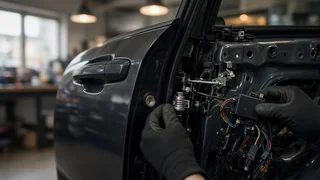
A modern car door lock has several parts, and a fault in any one of them can look like a broken lock.
Lock cylinder: the keyed barrel in the door handle or near it. Many newer cars have one only on the driver's door, sometimes hidden behind a cap. Latch: the mechanism inside the door that grips the striker on the body pillar and holds the door shut. Actuator: a small electric motor, often built into the latch assembly, that locks and unlocks the door when you press the fob or the central locking switch. Linkage: rods or cables that connect the outside handle, inside handle, lock knob and cylinder to the latch. Control electronics: the key fob, the receiver and the body control module that send the lock and unlock commands, protected by fuses.
Symptoms, possible causes and what to check first
The causes below are possibilities to check, not a diagnosis. The aim is to run the simple checks that tell the possibilities apart before you book a repair, so you can describe the fault accurately and choose the right kind of shop.
Symptom | Plausible causes | Check that helps tell them apart; No door responds to the fob, but the physical key works | Weak fob battery, fob fault, receiver or electronics fault | Try the spare fob. If the spare works, the first fob is the likely problem. No door responds to the fob or the interior switch | Blown fuse, control module fault, wiring fault | Check the relevant fuse using the owner's manual. If several electrical features failed together, mention it to the shop. One door does not lock or unlock electrically; the others do | Failed actuator in that door, wiring in the door hinge area, linkage detached | Listen at that door when locking. A buzz or click with no movement suggests a mechanical or actuator problem. Silence points to the actuator or its wiring. Key will not turn or turns with no effect | Worn or seized cylinder, worn key, disconnected linkage behind the cylinder | Try the spare key. If the spare turns smoothly, the original key may be worn. Door will not open from outside but opens from inside | Outside handle linkage or cable detached or broken | Note whether the outside handle feels loose or has no resistance. Rear door will not open from inside | Child safety lock engaged, interior linkage fault | Check the child lock lever on the door edge before assuming a fault. Door will not latch shut or bounces open | Latch fault, latch stuck in the closed position, striker misalignment | Look for damage around the striker and latch. Do not drive with the door in this state. Problem started after window tinting, speaker fitting or panel repair | Linkage clip or connector disturbed when the door trim was removed | Tell the original installer and the repair shop about the recent work.
Diagnostic codes
Some workshops will scan the car for stored fault codes. A code is useful only if it relates to the door lock or body control system, and even then it shows where the system detected a problem, not which part has failed. A code for a door circuit, for example, could come from the actuator, a broken wire in the door hinge area or a connector. Ask the shop to confirm the cause by testing before it replaces a part, and ask what the confirming test showed.
When to stop driving or stop testing
If a door will not latch securely or has opened while moving, do not drive with anyone using that seat, and get the car repaired before using it normally. If a door cannot be opened from inside, other than with the child lock engaged, treat it as a safety issue, because it affects how people get out in an emergency. If a key feels stiff, stop forcing it. Forcing it can snap the key in the cylinder or break the cylinder and make the repair bigger. If a cylinder, handle or door edge shows signs of forced entry, photograph the damage before anything is repaired. Consider making a police report and contacting your insurer, since they may need evidence or may have repair conditions. If you are unsure how to remove door trim, do not remove it. Trim clips, airbag wiring in some doors and window mechanisms are easy to damage.
Choosing a car door lock repair shop in Singapore
Match the shop to the fault
Automotive locksmith: a likely fit for a seized or damaged cylinder, a broken key, lost keys, or matching a replacement cylinder to existing keys. Confirm they work on your make, because key and immobiliser systems vary. Independent workshop: a likely fit for actuators, latches, linkages and door wiring. Ask whether they regularly do door lock work on your make. Brand dealer or authorised service centre: a likely fit if the car is under warranty, if fobs need programming with manufacturer software, or if electronic faults need brand-specific diagnostics. Body or accident repair shop: a likely fit if the lock was damaged in a collision or a break-in alongside panel damage, especially where insurance is involved.
Questions to ask before agreeing to a repair
Will you diagnose the fault before giving a firm quote, and is there a charge for diagnosis? Can the quote list parts and labour separately and name the specific part to be replaced? Is the part from the original manufacturer, an equivalent brand or used? What warranty comes with the part and with the labour? Is the part confirmed to fit my model year, variant and market specification? If the cylinder is replaced, will the new one work with my existing key, or will I need a separate key? If a fob or key needs programming, can you do it, or will the car need to go to a dealer? Will you return the replaced parts if I ask for them?
Parts compatibility
Door lock parts can differ between model years, variants, left and right doors, front and rear doors, and between cars with and without keyless entry. Parallel-imported cars may use parts built for another market rather than the locally distributed version of the same model. When you ask for quotes, give the chassis number, also called the VIN, so the shop can look up the correct part instead of matching by model name alone. If two quotes name different part numbers for the same job, ask each shop why.
Warranty and insurance
If the car is still under manufacturer or dealer warranty, check the warranty terms before using an independent shop, because some faults may be covered and some terms set conditions on where repairs are done. If the damage came from attempted theft, check your motor insurance policy before arranging a repair. Some insurers require approved workshops, an inspection or a police report.
What to have ready when you contact a shop
Make, model, model year and variant, and whether the car is a parallel import; Chassis number (VIN); Which door or doors are affected; What happens with the fob, the interior switch and the physical key, as separate observations; Any sound from the door when locking or unlocking; When the problem started and any recent work on the doors, such as tinting, audio installation or accident repair; Whether you have a working spare key or fob
Gaps in this guide
No confirmed information was available on repair prices, parts availability, turnaround times or individual workshops in Singapore, so none is given here. To compare costs and service, get written quotes from at least two suitable shops based on the same described fault, and check recent independent feedback on each shop yourself.