Can-Am Outlander Transmission Oil: What the Gearbox Takes and What to Verify
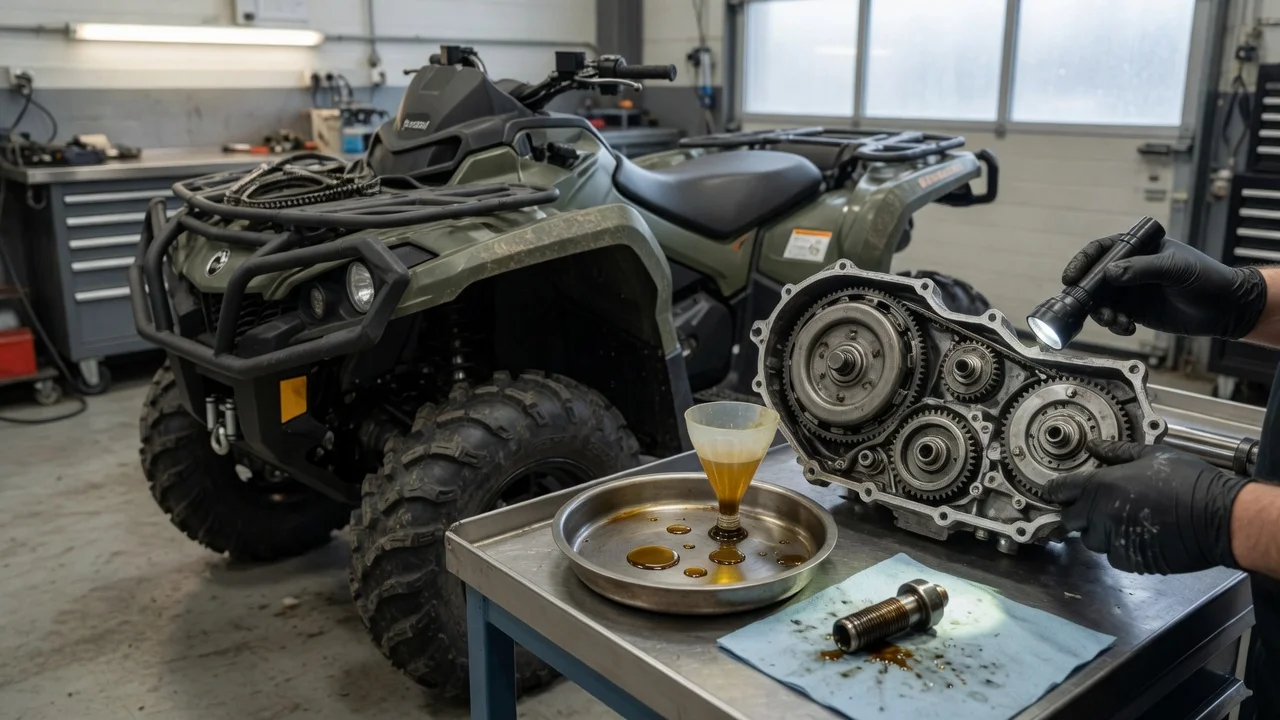
The short answer
On a Can-Am Outlander, "transmission oil" normally means the gear oil in the gearbox. The gearbox is the gear-driven unit behind the belt drive that provides high range, low range, neutral, reverse and park. BRP, the maker of Can-Am vehicles, specifies its own XPS-branded synthetic gear oil for this job. Owner and service references for many Outlander generations commonly cite a 75W-140 viscosity grade. However, no model-year-specific documentation was supplied for this article, so treat that grade as a starting point to confirm, not a verified specification for your machine.
The single most important qualification is that the correct oil type, viscosity and fill quantity depend on the generation, engine and model year. The owner's manual or service manual for your exact Outlander is the authoritative source.
The CVT and the gearbox are separate systems
The Outlander uses a CVT, or continuously variable transmission. A CVT is a pair of pulleys connected by a rubber drive belt that changes the effective gear ratio as engine speed and load change. The CVT runs dry inside its own housing. It does not take transmission fluid, and oil should never be added to it. Oil contamination on the belt or pulleys causes slipping and can damage the belt.
The gear oil goes into the gearbox, a sealed gear case downstream of the CVT. Product listings and owner discussions sometimes use "transmission oil" and "gearbox oil" interchangeably for this compartment.
Gearbox oil versus engine oil and differential oil
An Outlander can have several separate lubricant compartments: the engine, the gearbox, and the front and rear differentials. Whether the gearbox has its own oil supply or shares lubrication with the engine depends on the engine and generation. The material available for this article does not establish that arrangement for each model year, so check your manual before assuming the gearbox needs its own fill.
Differentials may call for a different fluid from the gearbox. On some models, for example, the front differential is specified separately from the gear case. Do not assume one bottle covers every drivetrain compartment unless the manual for your model says so.
What to confirm before buying oil
Model year and generation, because Outlander platforms have been redesigned over time and specifications changed with them. Engine displacement and configuration, since different Rotax engines can have different gearbox lubrication arrangements. The specified oil product and viscosity grade for the gearbox. The fill capacity, along with the check method, such as a dipstick, level plug or measured volume. The service interval, including any shorter interval for severe use such as mud, water crossings or heavy towing. The drain and fill plug torque values and whether the sealing washers or O-rings should be replaced.
Using a non-BRP gear oil
Some owners use other brands of synthetic gear oil that match the specified viscosity grade. No supplied evidence documents BRP's position on substitutes or how a substitute affects warranty coverage. If the machine is under warranty, the safer choice is the oil named in the manual. Otherwise, ask a dealer which specifications a substitute must meet. This is an editorial recommendation, not a documented BRP policy.
Gaps in this guide
This article does not give fill capacities, change intervals, torque values or a year-by-year specification table. No verified source material was supplied for those figures, and printing unverified numbers could lead to overfilling, underfilling or the wrong fluid. Your Outlander's owner's manual, a BRP service manual or a Can-Am dealer can provide the exact figures for your vehicle.