Brake Master Cylinder Repair: Service Options and What the Job Involves
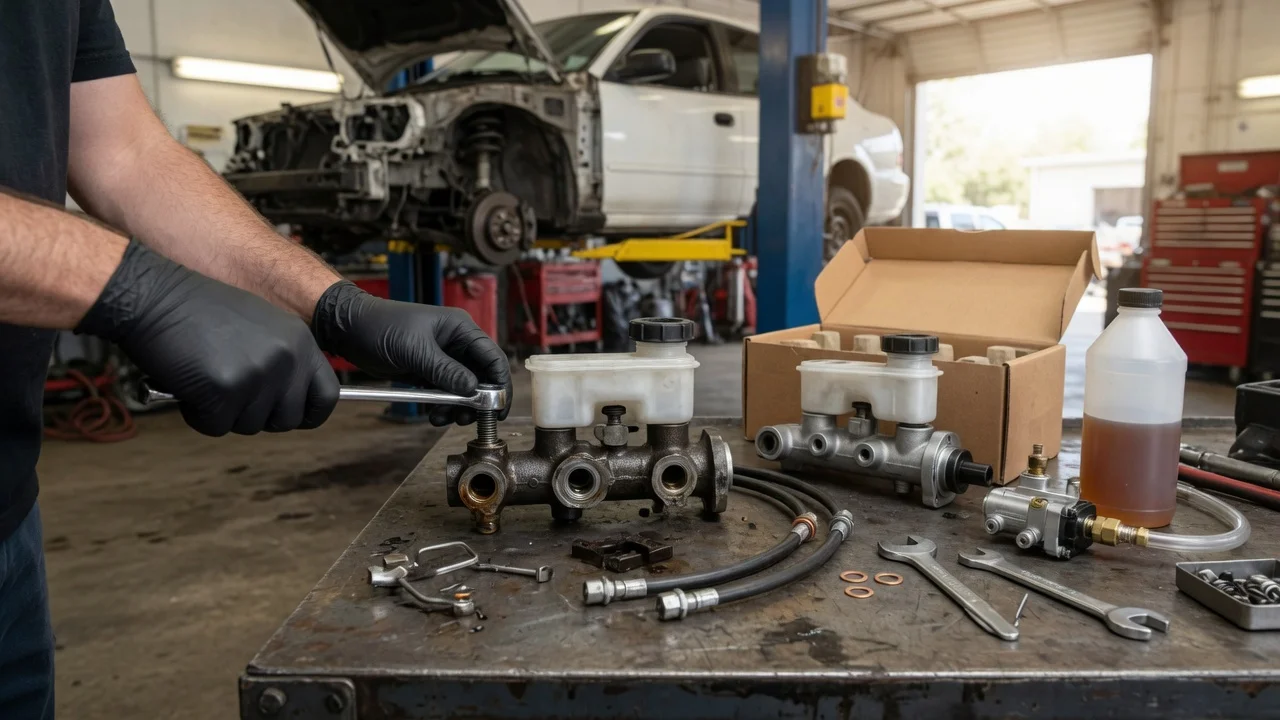
The essential answer
Brake master cylinder repair restores the hydraulic pump at the brake pedal so the system can build and hold pressure. On most late-model passenger cars and light trucks the practical repair is replacement of the complete unit, a refill with the vehicle’s specified brake fluid, and a full bleed of the hydraulic circuits. A seal-kit rebuild of the original housing remains a valid option when the bore is serviceable, a matching kit exists, and the housing was designed to be honed or sleeved.
The master cylinder is a safety-critical part. A unit that leaks externally, bypasses internally, or is full of contaminated fluid can leave a low, spongy, or sinking pedal and reduced stopping power. Fastener torque, fluid specification, pushrod setup, port thread, and bleed sequence are vehicle-specific. Those values come from the manufacturer’s service information for the model year, brake package, and market; they are not interchangeable, and this guide does not substitute for that data.
What the master cylinder does
The master cylinder converts pedal force into hydraulic pressure. Pressing the pedal moves a pushrod, often through a vacuum or electronic booster, which drives pistons along a precision bore. Rubber cups or rings on those pistons seal against the bore and force brake fluid out through outlet ports into the lines. That pressure at the calipers or wheel cylinders applies the pads or shoes.
Modern passenger vehicles use a tandem, dual-circuit master cylinder: two pistons, two outlet circuits, and a shared reservoir, so a failure in one circuit still leaves the other able to apply some brakes. Compensation and replenishing ports in the bore let fluid return to the reservoir when the pedal is released and let the cups recover volume as pads wear. When those ports are blocked by swollen seals or sludge, or when the cups leak past the pistons, the cylinder can fail to build or hold pressure even if the outside of the housing looks dry. A fluid-level switch in the reservoir often turns on a warning lamp when the level falls.
Rebuild, remanufacture, or replace
The choice is among rebuilding the original housing, fitting a remanufactured unit, or installing a new original-equipment or aftermarket cylinder. Compare those paths on the same application: identical bore size, outlet count and orientation, mounting pattern, reservoir, and electrical connector. Published prices, labor times, and warranties vary by vehicle, brand, and market, and no like-for-like price or durability test set is supplied here, so cost figures are omitted.
Option Fits best when Main limits; Seal-kit rebuild of the original housing The casting is designed to be serviced, the bore is within the kit maker’s wear and pitting limits, and a correct cup, seal, and boot kit is available. This path is most common on older cast-iron units, some commercial housings, and rare or high-cost applications. Scored, pitted, or out-of-round bores, corroded threads, and housings treated as non-serviceable on many late-model vehicles. Rebuild quality depends on hone or sleeve work, cup installation, and cleanliness. Remanufactured replacement A complete unit is wanted at a lower parts cost than a new original-equipment cylinder, and a matching reman is catalogued for the vehicle. A core return is often required. Quality and remaining bore life vary by remanufacturer. The unit must still match bore, ports, reservoir, sensor, and pushrod interface. New original-equipment or aftermarket replacement The usual shop repair on late-model vehicles, especially where the reservoir, fluid-level switch, or casting is sold only as an assembly, or where rebuild labor approaches the cost of a complete unit. The catalog entry must match the vehicle. A cheap mismatch in bore size, port thread, or pushrod length will leave a poor pedal or leaking fittings.
If brake fluid has reached the booster, the booster diaphragm is commonly damaged and the booster is replaced in the same visit. Contaminated fluid in the lines, hoses, calipers, or ABS modulator is also addressed at the same time, because new seals in a dirty system fail early. Crushed tube flares, rounded pipe nuts, and weeping line washers are corrected while the pipes are disconnected.
Prerequisites, tools, and professional limits
Confirm the master cylinder before buying parts. A pedal that sinks under steady foot pressure with the engine off is consistent with internal bypass in the cylinder, and fluid wet at the rear of the housing or inside the booster is consistent with an external rear seal leak. Dark, sludgy, or debris-filled reservoir fluid supports a full-system flush with any cylinder service. A soft pedal can also come from a leaking caliper or wheel cylinder, a swollen hose, air in the lines, or an ABS modulator problem. Treat those checks as reasons to inspect the rest of the hydraulic system; a warning lamp or a single symptom is a starting point for diagnosis, not proof that the master cylinder has failed.
Have the vehicle’s service information in hand for fluid type, bleed order, line-nut and mounting torque, and any pushrod length or booster setup. Work on a vehicle you can keep stationary until the pedal is firm. Stop and use a professional shop when line nuts are seized or rounding, hard lines are rusted through, the ABS or stability-control unit requires a scan tool to cycle the pump and valves, the booster is soaked, the vehicle is under warranty that would be affected, or you cannot complete a leak-free fill and a controlled brake check.
Service information for the specific model year, brake package, and market, including fluid specification and torque values.
tools
A flare-nut (line) wrench set sized to the brake-pipe nuts, plus the correct sockets for the master-cylinder mounting nuts.
tools2