Bad ABS Tone Ring Symptoms: How to Recognize and Confirm the Fault
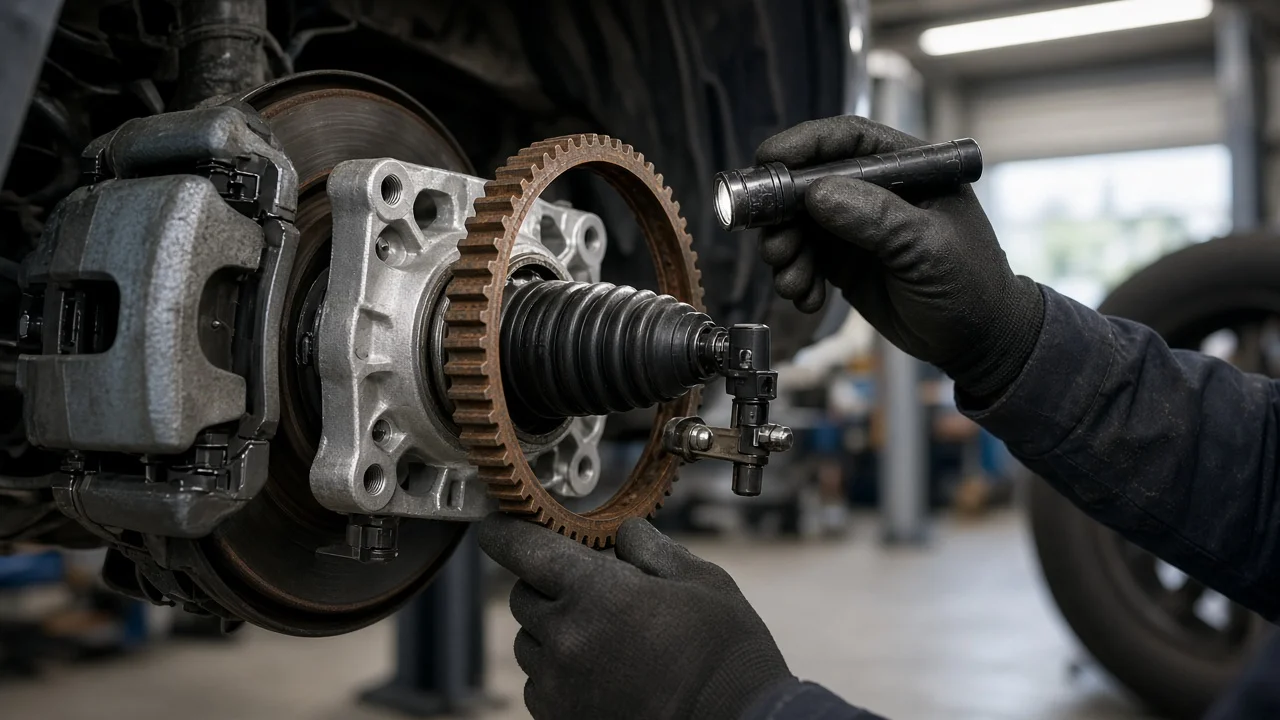
A damaged ABS tone ring, also called a reluctor ring, can make an otherwise healthy braking system behave strangely. The ring gives the wheel speed sensor a pattern to read. When its teeth crack, rust or collect debris, the signal becomes erratic, and the ABS module may react to a wheel that only appears to be slowing down. This guide covers how to recognize the problem, rule out look-alike causes and decide how urgently to act.
Establish the symptoms
The most common sign is an ABS warning light, often accompanied by the traction control or stability control light, because those systems rely on the same wheel speed data. A more noticeable symptom is unwanted ABS activation: the pedal pulses and the system buzzes or clicks during a gentle stop at low speed on dry pavement, when no wheel is actually locking. Some drivers notice the light comes on only above a certain speed, after a bump, or at a speed that repeats from trip to trip. On vehicles that use wheel speed data for other functions, the speedometer, cruise control or hill-start assist may also act up. A scan tool will usually show a stored code for an erratic, implausible or intermittent signal at one wheel.
Before anyone replaces parts, write down when the problem occurs. Note the road speed, whether it happens while braking or cruising, whether the road was wet or salted, whether it appears during turns, and whether it began after hitting a pothole. Recent work matters just as much: a replaced CV axle, hub or wheel bearing, new brake rotors or brake pads, or a tire change can all point toward the cause. Intermittent ABS faults often disappear once the vehicle reaches a shop, so a clear record saves diagnostic time.
Distinguish plausible causes
The tone ring itself fails in a few typical ways. Press-fit steel rings, often mounted on the outer CV joint, a rear axle shaft or the hub, can crack when rust builds up underneath and expands. Teeth can be chipped or bent during axle or hub work, and a ring can shift position on its mounting. Many newer vehicles use a magnetic encoder built into the wheel bearing seal instead of a toothed ring; it can be damaged or coated with metal debris. Evidence that supports a ring problem includes a fault isolated to one wheel, a disturbance that repeats once per wheel revolution, a visible crack, or symptoms that began right after related work.
The wheel speed sensor and its wiring produce very similar symptoms. A sensor tip covered in debris, rust forcing the sensor out of its bore and widening the air gap, a chafed wire that opens when the suspension or steering moves, and corroded connectors are all common. Faults that come and go with steering input or wet weather point toward wiring. A complete loss of signal, or a code describing an open or shorted circuit, points more toward the sensor or harness than toward the ring.
Other possibilities should not be skipped. Excessive wheel bearing play changes the distance between the sensor and the ring. Mismatched tire sizes or a compact spare can make one wheel read differently from the rest. On some vehicles the ring is integral to the hub or rotor, so a replacement part with the wrong vehicle fitment can leave the sensor with nothing to read. ABS module failures happen but are less common. Worn pads, caliper problems or low brake fluid do not usually create a wheel speed fault, but a grinding noise from worn friction material is sometimes mistaken for ABS noise.
Checks in a useful order
Start with observations that need no disassembly. Check whether the red brake warning light is on along with the amber ABS light, and look at the brake fluid level in the reservoir. Confirm that all four tires are the same size and properly inflated. With the vehicle parked securely, look along the sensor wiring for damage, loose clips or rubbing against suspension parts. On some front-wheel-drive vehicles, turning the steering to full lock exposes the ring behind the outer CV joint, where a flashlight may reveal cracks or rust. Never work under a vehicle supported only by a jack; use proper stands.
The next checks require tools and vehicle-specific service information. A scan tool that reads ABS codes and live wheel speed data is the most useful step: on a road test, with a passenger watching the data, a failing ring often shows one wheel dropping out or spiking at a regular interval. An oscilloscope can show missing or uneven pulses in the sensor signal. Passive sensors can be resistance tested against the manufacturer specification, and the air gap can be measured where a value is published. Removing the sensor, caliper, rotor, hub or axle to inspect the ring requires correct procedures and torque specifications, so this stage is best left to a qualified technician if you lack the tools.
Interpret the findings
A visible crack or missing teeth, combined with a once-per-revolution dropout at that same wheel, makes a strong case for the tone ring. A repeating dropout without visible damage calls for cleaning the ring or encoder, checking how the sensor sits in its bore, and confirming the air gap and bearing play before buying parts. A signal that disappears completely, or a circuit-type code, usually means testing the sensor and wiring first. If the readings depend on steering position or suspension movement, the harness deserves close attention.
Several questions remain open even after the ring is identified. Find out whether the ring can be replaced on its own or comes only as part of the CV axle, hub, bearing or rotor for your vehicle. Check whether the bearing is within specification, since a worn bearing can damage a new ring or sensor. After the repair, clear the codes and confirm on a road test that all four wheel speeds read evenly in live data. A warning light that stays off during a short drive does not prove the fault is fixed.
Urgency and next action
When only the ABS light is on, the base brakes usually still work, but anti-lock control and often stability control may be disabled, so the wheels can lock during a hard stop on slippery roads. False ABS activation is more serious, because the system releases brake pressure when it should not, which can lengthen stopping distance at low speed. Limit driving and arrange prompt repair. Stop using the vehicle and have it towed if the red brake warning light is on, the brake fluid is low or leaking, the pedal feels soft or sinks, the vehicle pulls hard while braking, you hear metal-on-metal grinding that suggests pads are past their wear limits, or a wheel has noticeable play or bearing noise. No one can promise a safe remaining distance with a braking fault.
To speed up the repair, bring the year, make, model, engine, drivetrain and VIN so parts match the correct fitment. Provide the stored ABS codes with any freeze-frame data, the wheel involved if known, the conditions under which the symptoms appear, and a list of recent brake, suspension, axle or tire work. This information helps the technician confirm the tone ring as the cause rather than replacing a sensor, axle or module on a guess.