ABS Tone Ring Location: Finding the Ring on Your Vehicle
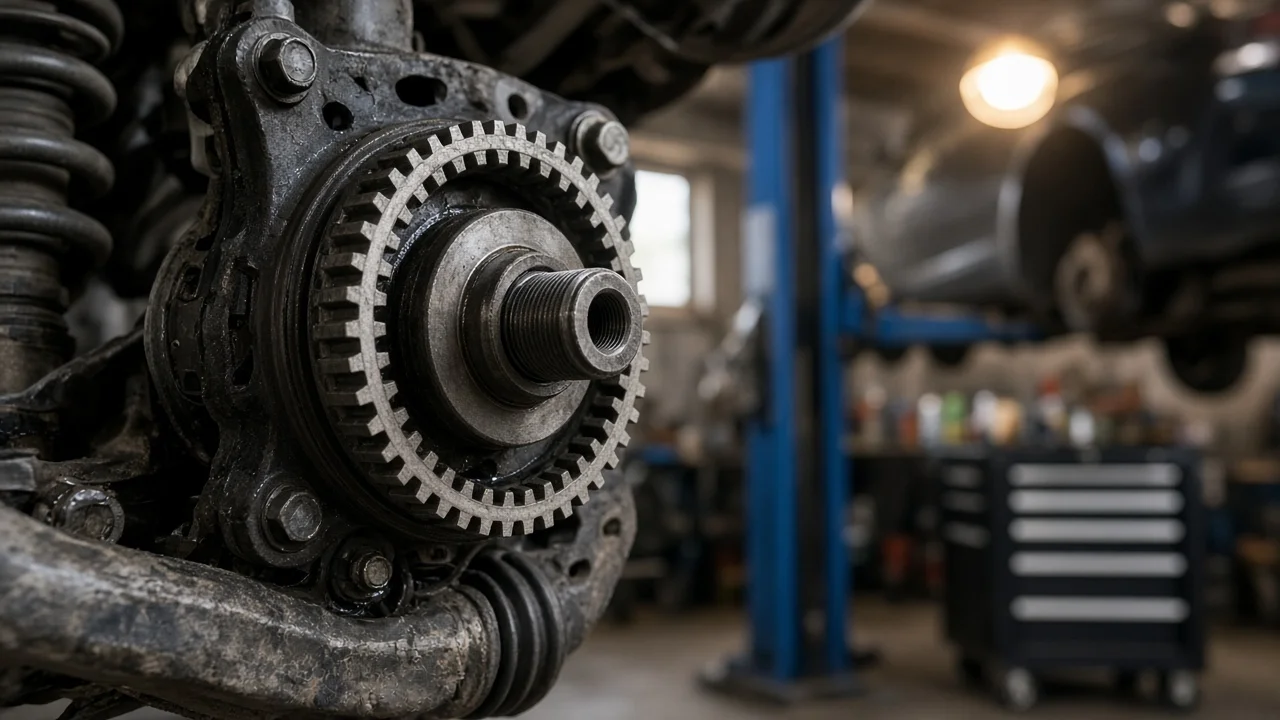
The ABS tone ring sits wherever the wheel speed sensor reads rotation. That is usually at the wheel end, on the hub, axle shaft or outer CV joint, but some vehicles read rear speed at the differential instead. To find the ring, start with the sensor. This guide explains where to look, how the ring and sensor work together, what differs between vehicles, and what an owner can safely check.
Where the ABS tone ring is located
On most vehicles the tone ring, also called a reluctor ring, is mounted on a part that turns with the wheel. It sits directly in front of the tip of the wheel speed sensor. On front-wheel-drive cars it is usually pressed onto the outer CV joint housing behind the hub, or built into the hub and bearing assembly. On rear axles with solid axle shafts, it is often pressed onto the axle shaft near the wheel bearing. On non-driven wheels it is typically part of the hub or hub bearing unit. Some older designs put the teeth on the back of the brake rotor or on the hub casting itself.
Many current vehicles use sealed hub bearings with a magnetic encoder ring built into the bearing seal instead of a visible toothed ring. On these, all you will see is a smooth, dark band on the bearing face, and the ring cannot be serviced separately. Some trucks and older rear-wheel-drive vehicles have no rear wheel-end rings at all. Instead, a single sensor reads a toothed ring on the differential carrier or the transmission output and reports one combined rear speed signal.
How the tone ring and wheel speed sensor work together
The ABS module needs to know how fast each wheel turns. The tone ring provides a repeating pattern, either teeth and gaps or alternating magnetic north and south poles. As the wheel rotates, the sensor converts that pattern into an electrical signal. Older passive sensors, also called variable reluctance sensors, contain a magnet and a coil. Each tooth passing the tip changes the magnetic field and produces an alternating voltage whose frequency rises with wheel speed. These systems need a toothed steel ring and a small, controlled gap between the ring and the sensor.
Newer active sensors use Hall-effect or magnetoresistive electronics powered by the module. They can read either a toothed ring or a multipole magnetic encoder, and they produce a clean square-wave signal even at very low speed. If one wheel's signal drops out, becomes erratic or disagrees with the others, the module sets a fault and lights the warning lamp. It then switches off ABS and usually traction and stability control as well. A damaged ring can also cause false ABS activation, where the pedal pulses and the system releases brake pressure during a slow, normal stop.
What changes the location on your vehicle
Drivetrain layout is the biggest factor. On a driven front wheel, the ring is usually on the CV joint or the hub. On a driven rear wheel with a solid axle, look at the axle shaft or the differential. Independent rear suspension often uses hub-mounted rings or encoders, as non-driven wheels do. Four-wheel-drive and all-wheel-drive vehicles vary with front axle design, so the same model can differ between its two-wheel-drive and four-wheel-drive versions.
Model year and repair history matter too. A vehicle may have left the factory with a separate pressed-on ring and later received an aftermarket hub assembly or CV axle with its own ring, or the reverse. Press-in bearings with magnetic encoders must be installed with the encoder side facing the sensor. If one goes in backward, the sensor cannot read it even though everything looks correct. Because of these differences, confirm vehicle fitment by year, drivetrain and axle option before buying a ring, hub or axle.
How to find and inspect the ring yourself
Start at the sensor. With the vehicle parked on level ground, follow the thin wire from the ABS connector along the suspension to where it enters the steering knuckle, axle housing or backing plate. The sensor is usually held by a single bolt, and its tip points at the ring. Raise the vehicle, support it on jack stands rated for its weight, and remove the wheel. You can often see the ring through gaps in the knuckle or behind the brake rotor while you turn the hub by hand. Some designs require removing the caliper and rotor for a clear view. If you do, hang the caliper with wire instead of letting it dangle from the brake hose, and keep brake fluid and grease off the brake pads and friction material.
Turn the wheel slowly and look for cracked, missing or bent teeth. Also check for a ring that wobbles or has slipped on its mount, rust swelling that splits the ring, and debris or metal particles packed between the teeth. A common failure on CV joint rings is rust jacking, where corrosion under a pressed ring expands until the ring cracks. Remove the sensor and check its tip for damage or rubbing marks, which suggest it has been contacting the ring.
Light cleaning with a brush and brake cleaner is reasonable. Keep magnets and magnetic tools away from an encoder-type bearing, and do not scrape its face, because that can damage the magnetic pattern. A cracked ring usually means pressing on a new one, or replacing the CV axle or hub assembly if the ring is not sold separately. Follow the service procedure for your vehicle, including torque values and any required press tools.
When to stop driving and get professional help
A visual check cannot prove that a ring is good. Hairline cracks, slight runout and an incorrect sensor gap are easy to miss, and a wiring fault or failing sensor triggers the same warning light. The reliable way to find the problem wheel is to read the stored fault codes and watch live wheel speed data with a capable scan tool. Sensor gap, where it is adjustable, and related specifications come only from the vehicle's service information, so do not guess.
With only the ABS light on, the base brakes normally still work. However, the wheels can lock in a hard stop and stability control may be disabled, so have the system diagnosed soon and allow extra stopping distance. Stop driving and have the vehicle towed or inspected by a professional if the red brake warning light is also on, the pedal feels low or soft, the brakes pull or grind, or the vehicle does not stop normally. While the wheel is off, it also makes sense to check the brake pads and brake rotors against their wear limits, since worn braking components need attention regardless of the ABS fault.