Air-to-water (water-cooled) turbo intercooler
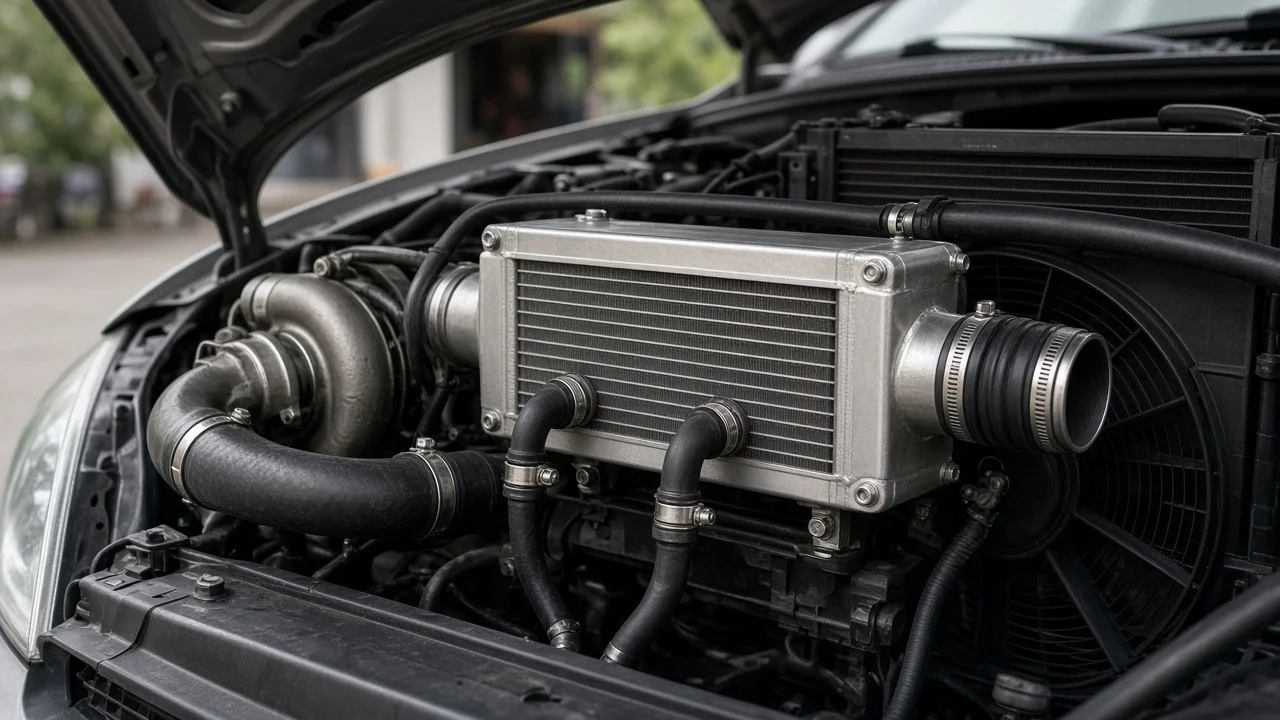
A turbo air to water intercooler uses liquid coolant rather than ambient airflow to pull heat out of compressed intake air before it reaches the engine. That distinction matters when packaging is tight, airflow at low speed is limited, or a driver wants short charge piping and consistent charge-air temperature. This overview explains how the water-cooled turbo intercooler works, where it fits relative to the compressor outlet, why boost pressure and pressure loss are affected by core and hose connection choices, and how the design differs from a common air-to-air charge cooler.
Essential answer
An air-to-water turbo intercooler is a heat exchanger placed between the compressor outlet and the intake manifold. Compressed air from the turbocharger flows through one side of the core while a separate liquid circuit circulates coolant through the other side. Because water absorbs heat more readily than air moving over external fins, the assembly can be compact and mounted close to the engine, which shortens charge piping and helps reduce the delay between throttle input and boost response.
The water-cooled turbo intercooler is not simply a radiator substitute. It still depends on a secondary heat exchanger, often a small front-mounted radiator, to reject heat from the liquid circuit into outside air. This means the system manages charge-air temperature in two stages: first from hot intake air to coolant inside the intercooler, then from coolant to ambient air at the secondary radiator. A water to air intercooler twin turbo setup can use one shared circuit or separate cores, but the same thermal principle applies: liquid transfers the heat, while airflow eventually removes it from the vehicle.