6L80E Transmission Relearn Procedure: How It Works and When It Is Needed
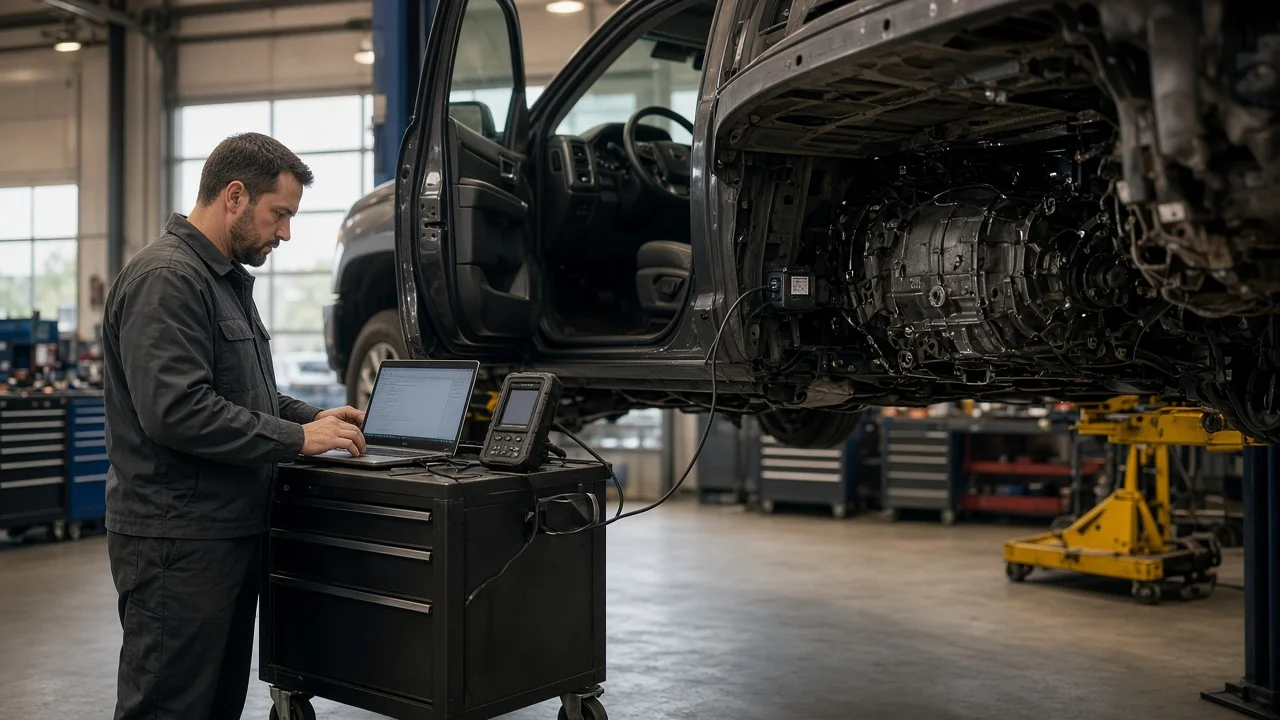
The 6L80E is a General Motors six-speed automatic used in many rear-wheel-drive and four-wheel-drive trucks, SUVs and performance cars. After certain repairs, its control module has to relearn clutch apply pressures so shifts feel firm and consistent. This guide explains what the relearn involves, why it needs a capable scan tool, what changes the procedure on a given vehicle, and when the job is no longer a do-it-yourself task.
Short answer: how the 6L80E relearn is done
Relearning a 6L80E is normally a two-part process done with a scan tool that supports GM transmission functions. First, the stored transmission adaptive values are reset. Then a Service Fast Learn routine runs with the vehicle stationary, the engine idling, the fluid at operating temperature and the brake firmly applied. During that routine, the tool commands repeated garage shifts so the module can learn apply pressures for engagement into drive and reverse. The second part is a road test. You drive through every upshift and downshift under light, steady throttle and repeat the pattern until shift quality settles.
No pedal-and-key sequence reliably replaces the scan tool step on this transmission. The exact conditions, menu names and drive pattern come from the service information for the specific vehicle. Treat the outline above as the general shape of the job, not a complete procedure.
Why the transmission needs to relearn
The 6L80E uses clutch-to-clutch shifting: one clutch releases while another applies, and pressure control solenoids manage the timing. On this unit, the transmission control module sits inside the transmission as part of the control solenoid valve body assembly. The module adjusts commanded pressure based on how long each shift actually takes. It stores those corrections as adaptive values, grouped by shift type and by throttle or torque range.
Adaptive values compensate for normal wear and small manufacturing differences. When clutches, the valve body, solenoids or the module itself are replaced, the old values no longer match the hardware. A rebuilt unit running on stale values can shift harshly, flare between gears or bump on engagement. Resetting and relearning gives the module a clean starting point, and normal driving keeps refining the values afterward.
What changes the procedure
Configuration matters. The 6L80E has been used across many model years in trucks, SUVs and cars, with differences in calibration, torque converter, and two-wheel-drive versus four-wheel-drive layouts. Closely related GM six-speeds follow the same general approach but are not interchangeable for service. Scan tool menus and the order of steps can differ between model years. Some vehicles need the module programmed with the correct calibration before any relearn will work. A replacement module or valve body assembly must match the vehicle's fitment and is typically programmed to that vehicle. Installing an unprogrammed unit and running a relearn is not the same thing.
Operating conditions also affect the result. The fast learn routine will usually refuse to run, or will produce poor values, if fluid temperature is outside its window, idle is unstable or trouble codes are present. Many 6L80E applications have no conventional dipstick. Their fluid level is checked through a check plug with the engine running and the fluid at a specified temperature, and a wrong level will undermine any relearn. The fluid specification is Dexron VI or the approved equivalent named in the vehicle's owner information. Incorrect or mixed fluid can change shift feel.
What an owner can do
Start by identifying the transmission and the reason for the relearn. Confirm the transmission type from the vehicle's build information or option codes and note the model year. Then gather the service history: fluid changes, prior module programming, and any valve body or clutch work. Read stored diagnostic codes and freeze-frame data before resetting anything, because a reset can erase evidence needed for diagnosis.
If your scan tool supports GM transmission special functions, check fluid level and condition first. Warm the transmission to operating temperature, then follow the tool's prompts for the adaptive reset and fast learn. For the road test, choose a safe road with room for repeated light-throttle acceleration from a stop through sixth gear, followed by gentle coast-downs. Watch the shift behavior: firmness, timing, flare between gears, delayed engagement and any shudder at steady cruise. Gradual improvement over several drive cycles is normal. A harsh or slipping shift that does not improve points to a fault that needs diagnosis, not to incomplete learning.
Without a capable tool, the practical choices are a shop with dealer-level GM software or an independent transmission specialist. Disconnecting the battery is not a dependable substitute. Adaptive values are generally kept in module memory and cleared through the scan tool function.
Limitations and next step
A relearn only adjusts how the module controls healthy hardware. It cannot repair worn clutches, a failing torque converter, internal leaks, a damaged valve body or wiring faults. It also cannot tell you which part has failed. A symptom such as a harsh 1-2 shift or torque converter shudder can come from fluid condition, calibration, mechanical wear or an electrical fault, and each cause needs its own diagnostic path.
Use the vehicle-specific service information whenever the transmission has been opened, the module replaced, or codes keep returning. Get professional help if the scan tool cannot complete the fast learn, if codes set during the relearn, or if shift quality stays poor after several drive cycles. A technician can then compare live data, check for calibration updates and choose among repair options such as reprogramming, valve body service or an overhaul.