THE SPARROW STORY
The Sparrow's Three-Wheel Reverse Trike Layout
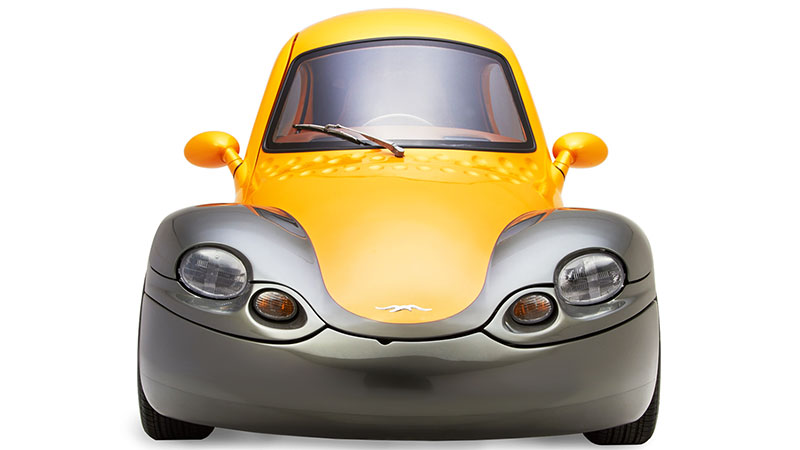
The Sparrow rides on three wheels: two at the front that steer and one at the rear that drives. Enthusiasts often call this arrangement a reverse trike, in contrast to trikes with a single front wheel. Corbin chose it for the original Sparrow in the 1990s and kept it for the modern prototype.
From the Sparrow archive. Product plans, events and availability described here belong to the original historical period.
What three wheels change
Dropping the fourth wheel removes a rear axle, a wheel, a tire and a brake, which cuts weight and rolling resistance. It also shrinks the overall footprint. The driver sits in the center of the triangle formed by the three contact patches, which the team considered the best location both for center of gravity and for occupant protection.
With its monocoque chassis, lithium-ion battery pack and patented swingarm drive, the modern Sparrow prototype weighed 1,440 pounds according to the team. For perspective, they noted this was roughly 500 pounds more than a Honda Gold Wing motorcycle and about 600 pounds less than a Smart coupe.
Registration and parking
Mike Corbin's original reasoning, recorded in his account of the idea, was that a three-wheel vehicle under a certain weight could be registered as a motorcycle in many jurisdictions, simplifying the path to the road for a small company. The compact size also meant that, in some areas, a Sparrow could park in spaces set aside for motorcycles. Rules on registration and parking vary by state and city, and the team presented these as observations from their own experience rather than guarantees.