Yamaha F150 Oil Change Kit: What to Check Before You Buy
A Yamaha F150 oil change kit is a good choice for most owners of this four-stroke outboard, as long as the kit is listed for your specific engine. Identify your outboard by its model code and serial number, then confirm that the kit's oil filter and drain plug gasket match it and that its oil meets the specification in your owner's manual. If the kit is listed only as "F150" without model years or serial ranges, check it more closely before buying. Yamaha has built more than one F150 configuration, including standard and counter-rotating versions, and parts can differ between them.
What an Oil Change Kit Usually Contains
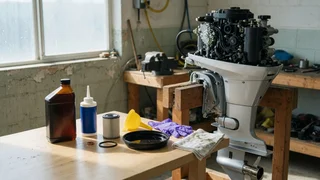
Kits are sold to save you from buying each item separately and risking a mismatch. Contents vary by seller and kit type, but a basic engine oil kit is typically built around these items:
Four-stroke marine engine oil, intended to cover a full oil change; An oil filter matched to the engine; A replacement drain plug gasket or O-ring; Sometimes, a filter wrench, drain hose or instructions
Some products sold under similar names are broader maintenance kits. These may add lower unit gear oil, spark plugs, a fuel filter element, anodes or other service parts. Read the parts list rather than assuming that "oil change kit" and "maintenance kit" mean the same thing. The right one depends on whether you are doing only an oil change or a full scheduled service.
Step One: Identify Your Exact Outboard
The F150 badge alone is not enough to guarantee fitment. Before you buy, gather these details:
Model code: printed on the identification label, usually found on the transom clamp bracket or swivel bracket. It encodes details such as rotation and shaft length. Serial number: on the same label. Sellers often use serial ranges to separate parts changes within a model. Model year: useful for cross-checking, though the serial number is usually more precise. Rotation: standard rotation (F150) or counter-rotating (often labeled LF150) on twin-engine setups. Check each engine on a twin rig.
Once you have these details, compare them with the seller's compatibility listing. Many marine parts retailers and Yamaha dealers let you search by model and serial number. That is a more reliable check than a product title.
Step Two: Match the Lubricant Specification
The oil in the kit should meet what Yamaha calls for in your owner's manual. That means the correct viscosity grade and the appropriate certification for four-stroke outboard use. In the US, look for oils certified to the NMMA FC-W standard, which covers four-stroke engines used in marine conditions. Yamaha markets its own Yamalube line for its outboards, and many official kits use it.
Automotive oil is not a substitute just because its viscosity number matches. Outboards often run at sustained high load in humid, sometimes saltwater conditions, and marine-certified oils are formulated with that duty in mind. If you plan to use a non-Yamaha oil, check its certification and viscosity against your manual. Also consider how the choice might matter if a warranty question ever comes up.
Step Three: Confirm the Fill Quantity Is Covered
Kits typically include enough oil for one change on the listed engine, but check this yourself. Your owner's manual gives the fill quantity, often listed separately with and without a filter change. Compare it with the total oil volume in the kit. If the kit falls short, or you prefer to have extra for top-ups, buy an additional bottle of the same oil so you do not mix products.
Do not rely on the kit volume alone when filling. Add oil gradually and do a level check with the dipstick, with the engine trimmed to the position the manual specifies. Overfilling can be as problematic as running low.
Official Yamaha Kit vs. Aftermarket Kit
Factor | Yamaha-branded kit | Aftermarket or retailer-assembled kit; Fitment confidence | Usually listed by model and serial range through dealer catalogs | Varies; depends on how carefully the seller lists compatibility; Oil | Typically Yamalube marine oil | May use another brand; check FC-W certification and viscosity; Filter | Genuine Yamaha part | May be genuine or an equivalent; confirm the cross-reference; Manufacturer approval | Aligned with Yamaha's own recommendations | Depends on the components; confirm against the owner's manual; Cost and availability | Often sold through dealers; pricing varies | Often widely available online; pricing varies
Either route can work. A Yamaha-branded kit gives you the simplest path to matching the manufacturer's recommendations. An aftermarket kit can be a sensible alternative if every component is clearly cross-referenced to your engine and the oil carries the right certification.
Service Interval: When You Will Need the Next Kit
Yamaha states the oil change service interval for its outboards in terms of both engine hours and elapsed time, whichever comes first. The exact figures, and any additional first-service requirement for a new engine, are in your owner's manual and maintenance schedule. Boats used lightly can still reach the time limit before the hour limit, so seasonal owners often change oil at the end or start of each season. If you run the engine hard, in saltwater, or at extended trolling speeds, ask a dealer whether a shorter interval makes sense for your use.
Common Buying Mistakes
Searching for the truck instead of the outboard: "F150" also refers to a Ford pickup, and search results sometimes mix the two. Make sure the kit is for the Yamaha outboard. Buying by horsepower only: Other Yamaha outboards near 150 hp, and older F150 configurations, may use different filters or service parts. Ignoring rotation on twin setups: Confirm which engine is the counter-rotating unit before ordering for both. Reusing the drain plug gasket: A fresh gasket helps prevent leaks, which is one reason kits include it. Assuming a maintenance kit includes oil: Some broader kits leave out engine oil or include only gear lube. Read the contents list.
Choosing Your Next Step
Start by recording your outboard's model code and serial number from the identification label. Use them to find a kit listed for your engine, then check three things: the oil's viscosity and FC-W certification match your manual, the total oil volume covers the stated fill quantity, and the filter and gasket are confirmed for your serial range. If any of those points is unclear from the listing, a Yamaha marine dealer can look up the correct parts by serial number. When you will soon be due for broader scheduled service, compare a full maintenance kit against buying the oil change kit and other parts separately.