Why Do Some Car Fasteners Require New Clips?
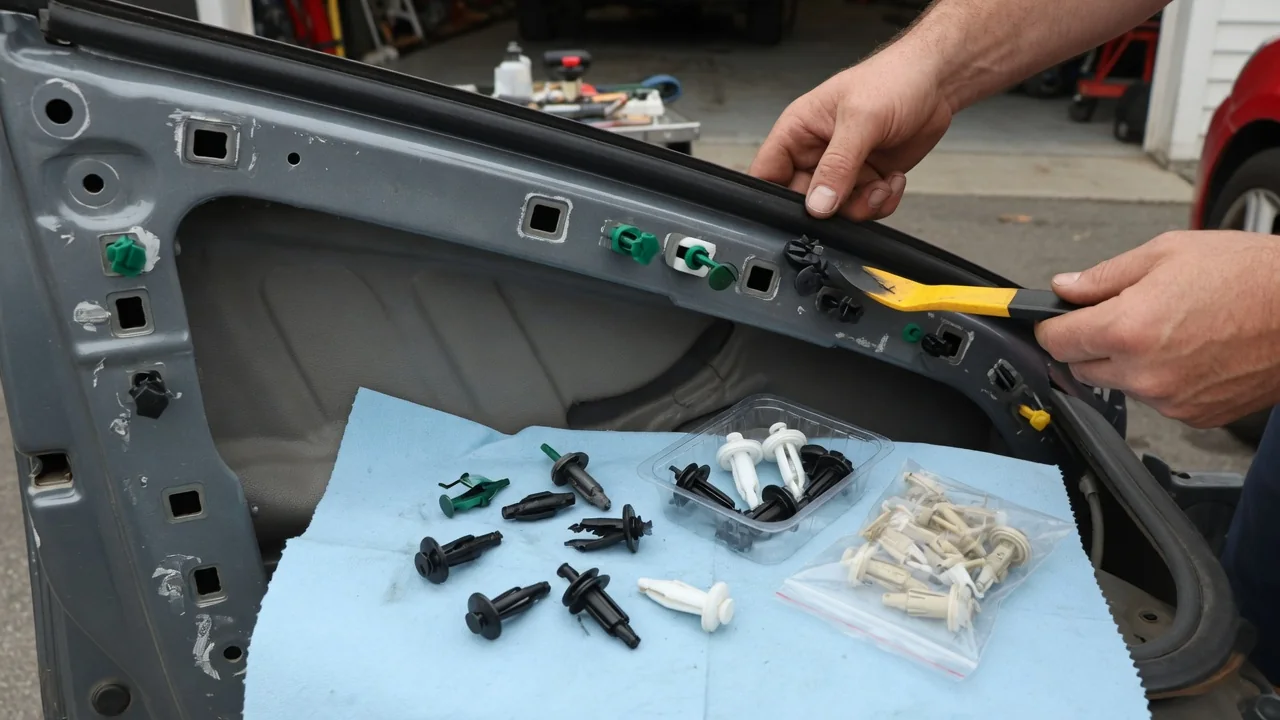
Anyone who has removed a door panel or bumper cover has probably wondered why do some car fasteners require new clips instead of going back together with the old ones. The answer lies in how these small parts are engineered: many are built to grip once, and the plastic they are made from changes with age, heat and the stress of removal.
Clip design
Many trim clips rely on barbed legs or fir-tree ribs that compress as they are pushed through a hole in sheet metal and then spring outward behind it. That expansion is what holds a door panel, wheel arch liner or bumper cover tight. The ribs are angled so insertion is easy while withdrawal is hard, which means pulling the clip back out drags those ribs against a metal edge and can shave, bend or flatten them.
Other designs use a center pin that spreads the legs, a locking tab that snaps over a ledge, or a foam or rubber seal molded onto the head to keep out water and noise. Some metal spring clips and push-on retainers bite into a stud and deform as they seat. Designers choose these one-time retention styles because they assemble quickly and resist vibration; ease of repeated servicing is often a secondary goal, and the approach differs between manufacturers and even between panels on one vehicle.
Removal effects
Removing a panel loads each clip in a direction it was shaped to resist. Legs may whiten at the bend, a sign the plastic has been stretched past its elastic limit, or one barb may snap off and stay in the hole. A clip that looks intact can still have lost its spring tension, so it slides back in with little resistance and no reassuring click. That reduced grip is the damaged plastic at work, even when nothing is visibly broken.
Age makes it worse. Years of heat cycles under the hood or behind a sun-baked door panel dry out plastic and make it brittle, while cold weather stiffens it further during removal. Clips near the engine, exhaust or road spray tend to suffer more than those in the cabin. Seals on the clip head can also take a permanent set or tear, so a reused clip may hold the panel yet let moisture or wind noise through.
Correct replacements
A replacement works only if it matches the original in the details that matter: stem diameter for the hole, grip length for the combined thickness of the panels, head size and shape for the slot in the trim, and any seal. Clips that look alike at a glance can differ by a small amount that leaves one loose or prevents another from seating. Color is sometimes used to distinguish types, but that convention is not universal, so comparing against the removed part is more reliable.
Service information for the specific vehicle usually indicates which fasteners are intended to be renewed, and a parts catalog identifies the right item for each location. Generic assortment kits can be useful for common push-type retainers, though material quality and dimensions vary. Some fasteners deserve extra care: retainers around airbag-equipped trim, such as pillar covers, may be designed to control how the panel behaves during deployment, and the manufacturer's specified part should be used there rather than a look-alike.
Everyday Use and Observations
Signs of tired clips show up in normal driving. A door panel that buzzes over rough pavement, a rocker molding with a gap at one end, an undertray that hangs low or scrapes, or a fender liner flapping at highway speed often point to retainers that were reused or never refitted after earlier work. Pressing gently on the trim can reveal a spot that moves freely where neighboring sections feel firmly anchored.
During installation, a healthy clip gives clear feedback: firm resistance followed by a distinct snap, and the panel sits flush with even gaps. A clip that pushes in silently, spins in its hole or lets the trim lift with light finger pressure is not retaining properly. Looking at the removed pieces is also informative; bent legs, stress whitening, missing barbs or a flattened seal explain why a fresh fastener is called for, and why some locations on the same car tolerate reuse better than others.
Limits and Next Steps
Not every clip is single-use. Many screw-type retainers, removable pin rivets and certain metal clips are meant to be released and refitted, provided they are undamaged and still hold firmly. There is no universal rule that applies across brands, model years or panel locations, which is why vehicle-specific service information is the authority on what must be renewed. A mounting hole that has been enlarged or a broken clip tower on the panel itself is a different problem that a new clip alone will not solve.
Before starting trim work, it is sensible to identify the clip types involved and have spares on hand, since a few usually break regardless of care. Proper trim tools spread the load and reduce damage to both clips and paint. For panels near airbags, structural covers or underbody shields that affect cooling and aerodynamics, a qualified technician can confirm the correct parts and fitment. Spending a little on fresh retainers generally avoids rattles, leaks and loose panels later.