Why Do Car Sensors Need Calibration?
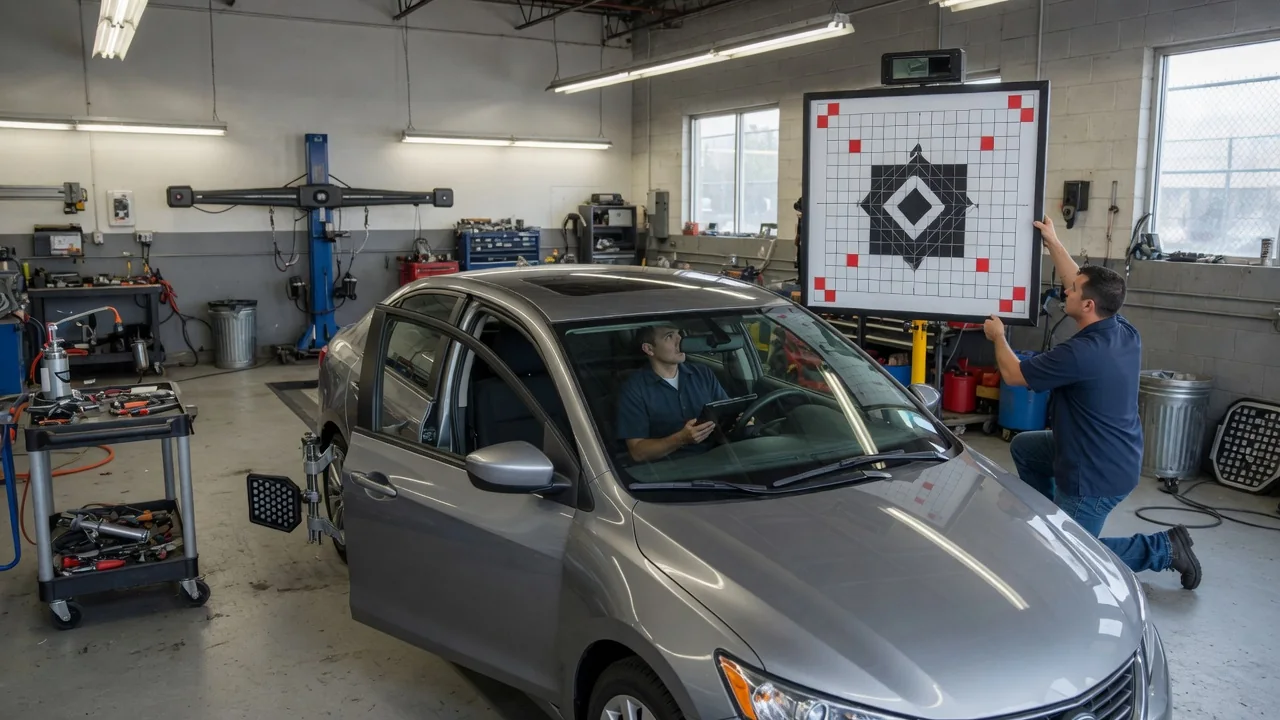
A sensor never measures the road directly. It produces a voltage, a frequency or a stream of data, and a control module converts that signal into an angle, a distance or a pressure. People who wonder why do car sensors need calibration are really asking how that conversion stays truthful. Calibration ties the signal to the physical position of the car and its parts.
Reference point
Every measurement needs a known starting value, and calibration is the act of setting it. A steering angle sensor can report rotation very precisely, yet it cannot know on its own which signal value means the front wheels point straight ahead. The module has to be told, or has to learn, that a particular reading equals zero degrees. Once that reference is stored, every later reading is calculated as a difference from it, so a wrong zero quietly shifts every value that follows.
The same logic applies elsewhere on the car. A forward camera needs to know where it is aimed relative to the direction the vehicle actually travels, and a radar unit needs its beam referenced to the centerline. Ride height sensors need a stored value for normal stance, and a throttle body often learns its closed position. How the reference is established varies widely: some systems learn it during ordinary driving, while others need a scan tool, printed targets or a specific driving routine.
After-service cases
Calibration is most often needed after work that changes the physical relationship between a sensor and the car. A wheel alignment moves the steering geometry, so the steering wheel position that once meant straight ahead may no longer match the stored zero. A replacement windshield can place a camera a fraction of a degree away from its previous aim. Removing a bumper cover or grille can disturb a radar bracket, and at highway distances a tiny angular error becomes a wide sideways miss.
Electrical events can matter as well. Disconnecting the battery, replacing a control module or fitting a new sensor may erase learned values, leaving the system with factory defaults that do not describe this particular car. Changes in ride height or tire size can alter what a camera or height sensor sees too. Whether any of these triggers a required procedure depends on the make, model and equipment, so the vehicle's own service information decides the question, not a general rule.
System warnings
Modern vehicles constantly compare sensors against one another, and a warning often appears when the readings stop agreeing. If the steering angle sensor says the wheels are turned but the yaw rate and wheel speed signals show the car traveling straight, the stability control module may judge the data implausible and switch the function off. The driver then sees a warning lamp or a message stating that a driver-assistance feature is unavailable, even though nothing feels mechanically wrong.
A stored fault code in this situation is evidence to interpret, not a verdict. A code pointing to a missing calibration or an implausible signal does not prove the sensor itself has failed; the cause may be a lost reference value, a shifted mounting, a wiring concern or a disagreement created by another component. Many of these codes are defined by the manufacturer, so their exact meaning has to be confirmed against information for that specific vehicle before any part is replaced.
Everyday Use and Observations
Calibration errors usually show up as behavior that seems slightly out of step with the road. Lane-keeping assistance may nudge the car toward one side of the lane or warn when the vehicle is centered. Adaptive cruise control may respond to traffic in a neighboring lane or pick up the car ahead later than expected. A steering wheel that sits off-center on a straight road, combined with a stability control lamp, is another clue that the stored zero and the true position disagree.
Not every odd reading traces back to calibration, which is why observation matters. A dirty camera lens, snow packed over a radar cover, heavy cargo that tilts the body or low sun can produce similar symptoms, and they usually clear when conditions change. Noting when the behavior occurs, whether it began after a repair and whether it persists in clean, dry conditions helps separate a temporary obstruction from a reference that has drifted. Some systems also refine their values gradually over many miles.
Limits and Next Steps
Calibration has clear limits. It can correct a reference value, but it cannot compensate for a bent bracket, a cracked housing, a damaged connector or a sensor that produces an unstable signal. Many procedures also depend on preconditions such as correct tire pressures, a level floor, proper wheel alignment and a normal load in the vehicle. If those conditions are not met, the process may fail or, worse, complete successfully while storing a reference that does not match reality.
When a warning stays on or a feature behaves strangely after service, a sensible next step is to read the owner's manual for what the message means and to tell the shop exactly what was done and when the symptom started. Camera and radar work in particular calls for equipment and space that suit the specific vehicle, so asking for a record of the completed calibration is reasonable. Until the system is confirmed accurate, treat the affected assistance feature as unreliable and drive accordingly.