Where to Place an Infant Car Seat in the Vehicle

The short answer
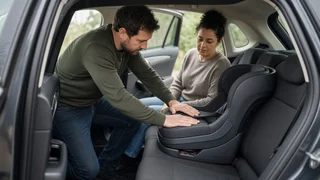
An infant car seat belongs in the back seat, facing the rear of the vehicle. It should never be placed in front of an active frontal airbag. Within the back seat, the center position is generally regarded as the most protected spot because it is farthest from a side impact. That preference has one important condition: the seat must be installable there tightly and correctly. A solid installation in a side (outboard) position is better than a loose or improper one in the center.
US federal safety guidance from NHTSA advises that children ride in the back seat through age 12. For infants, rear-facing is the expected orientation, and most dedicated infant seats are designed to be used only that way.
Why the front seat is off-limits
A rear-facing seat puts the back of the infant carrier close to the dashboard. If the passenger frontal airbag deploys, it can strike the carrier with enough force to cause severe or fatal injury. For that reason, car seat labels and vehicle manuals in the US warn against placing a rear-facing seat in front of an active airbag.
The narrow exception involves vehicles with no usable rear seat, such as some regular-cab pickups and two-seat cars. Some of these allow a child seat in the front only when the passenger airbag can be manually switched off. Whether that applies depends on the specific vehicle, so the owner's manual is the deciding document, not a general rule.
Choosing between the center and a side position
The center rear seat keeps the infant away from both doors. However, many vehicles do not have dedicated lower anchors in the center, and some center seats have a raised hump, a narrow cushion or a fold-down armrest that makes a secure fit difficult. Weigh these points when deciding:
Use the center if the vehicle manual permits a child seat there and you can achieve a tight installation with either the seat belt or dedicated anchors. Use an outboard position if the center seat shape, belt layout or lack of anchors prevents a secure fit. Do not borrow the inner lower anchors from the two side positions to install in the center unless both the vehicle manual and the car seat manual explicitly allow it. Consider practical factors once safety is satisfied, such as which side lets you load the carrier away from traffic and whether the seat leaves enough room for other passengers.
Some readers wonder whether the driver's side or the passenger's side is safer. There is no general rule that favors one side; installation quality and the vehicle's documented approved positions matter more.
Positions to avoid
Any front seat with an active frontal airbag. Side-facing seats, which some vans and older vehicles have; car seats are not designed for them. Any position the vehicle manual identifies as unsuitable for child restraints, which can include certain third-row or jump seats. A position where the carrier cannot achieve the correct recline angle shown by its level indicator.
How to find the anchors in your vehicle
Most US-market passenger vehicles include LATCH, which stands for Lower Anchors and Tethers for Children. Infant seats typically attach through a base that connects either to the lower anchors or to the vehicle seat belt, so knowing where the anchors are helps you decide which positions are workable.
Lower anchors are small metal bars set in the crease between the seat back and the seat cushion. They are often hidden by upholstery and may be marked with a small circular symbol showing a child seat, or with fabric tags or plastic guides. Top tether anchors are usually on the back of the vehicle seat, the rear shelf, the cargo floor or the ceiling, and are marked with an anchor symbol. Rear-facing infant seats generally do not use the top tether, though a few designs or bases do; check the seat's manual. Not every seating position has lower anchors. Many vehicles provide them only in the two outboard rear seats.
Anchor locations, the number of equipped positions and any limits on LATCH use vary by make, model, model year and body style. The vehicle owner's manual lists which seats are approved for child restraints and where the anchors are. The car seat manual sets its own rules, including when to switch from lower anchors to the seat belt. Both documents should agree before you commit to a position.
Confirming the installation
Once the seat is placed, a common check is to grip the base where the belt or anchor strap passes through and push side to side and front to back. The base should move very little. Also confirm that the recline indicator shows the correct angle for an infant and that the carrier clicks securely into the base. Certified Child Passenger Safety Technicians offer installation checks across the US if you want a second opinion.
What this guide cannot confirm
No vehicle-specific data was available for this article, so it does not state which seating positions are approved, where anchors sit in any particular model, or weight limits for lower-anchor use. Those details come only from the documentation for your exact vehicle configuration and car seat model.