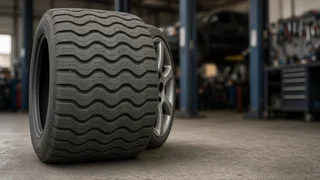
What Tire Cupping Looks and Sounds Like
Tire cupping produces a repeating, scooped-out wear pattern across the tread rather than a smooth, even contact surface. Drivers often notice it as a rhythmic thumping or growling that rises and falls with road speed before they spot the irregular tread. It is not a single tire condition but a wear signature tied to suspension motion, balance, or damping problems. Understanding what tire cupping looks and sounds like helps distinguish it from normal tread wear and points toward the underlying mechanical issue instead of treating the tire alone.
Essential answer
Tire cupping looks like alternating high and low spots around the tread circumference. Viewed from the side, the tread blocks appear scalloped or scooped rather than forming a continuous arc. The low areas may show a different sheen or texture than the adjoining high blocks, and the edge of each depression can feel abrupt when a gloved hand is drawn across the tread. This pattern usually repeats at regular intervals instead of appearing in one isolated spot.
Tire cupping sounds like a speed-dependent thump, drone, or growl that often resembles a worn wheel bearing or an aggressive off-road tire. Because the raised tread sections strike the pavement in sequence, the result is a rhythmic beat that may become most obvious between 30 and 60 mph. The noise generally deepens on smooth asphalt and can be mistaken for exhaust resonance, but it persists while coasting in neutral, which helps separate it from engine or driveline sounds.
How it works
A tire cupping wear pattern develops when the tread is loaded unevenly as the wheel travels through suspension movement. If a shock absorber cannot control spring oscillation, the tire bounces with varying force against the road. Each bounce allows a portion of the tread to scrub more heavily, gradually eroding a depression. The tire continues to rotate normally, but the contact patch pressure changes with every wheel revolution, deepening the alternating wear.
Tread depth, inflation pressure, and suspension geometry all influence how the tire maintains contact. When inflation pressure is too low, the tread shoulders flex excessively and can amplify irregular wear. When a suspension component such as a ball joint or control arm bushing develops free play, the wheel may shimmy slightly under load, shifting the contact patch in a repeating cycle. The tire effectively records that oscillation in its tread blocks over hundreds of miles.
Strengths, limitations and suitability
The visual signature of cupping is easier to identify on blocky or aggressive tread designs because the individual lugs exaggerate the high and low transition. On tightly spaced passenger-car tread it may appear first as a faint heel-and-toe wear pattern on the edge of each tread block. The irregular surface also affects ride quality by transmitting vibration through the steering wheel and seat, so the symptom is rarely silent or invisible for long once a driver is attentive.
Cupped tires are generally not suitable for continued high-speed use because the uneven contact patch reduces predictable grip and increases road noise. The worn surface can also accelerate wear in suspension components by feeding vibration back through the steering and hub assemblies. The pattern itself is not a tire defect in every case; it more often signals that the tire is the visible record of a mechanical problem elsewhere in the chassis.
Procedure
Begin an inspection on a level surface with the parking brake set. Look across the tread from the side and then run a bare or gloved hand around the circumference while the tire is cool. A dip-and-rise contour that repeats every few inches indicates cupping. Compare the inner, center, and outer tread bands, because some forms of irregular wear are more apparent near one shoulder. Rotate the tire slowly and check whether the depressions align with specific tread blocks.
If cupping is found, the next practical step is to identify whether suspension wear or tire service conditions are involved. Measure tread depth in the high and low areas to document the difference. Confirm the tire size, load index, and speed rating match the vehicle placard, and inspect inflation pressure before road-testing for the rhythmic noise. A vibration that remains after balancing and rotates with the tire position points toward the tire, while movement or noise from suspension joints points toward the chassis.
Diagnosing a problem
Cupped tread often starts with a failing shock or strut that permits repeated tire bounce. Worn strut mounts, weak coil springs, or loose control arm bushings can produce a similar result by changing wheel alignment dynamically. If the scalloped wear is more pronounced on one axle or one corner, compare the opposite side and listen for a soft clunk or flutter over small bumps. A suspension that allows rapid wheel movement will usually transfer that motion into the tire surface.
Wheel imbalance can also initiate cupping on a well-damped suspension by concentrating force at one part of the rotating assembly. A bent wheel, a lost balancing weight, or an improperly mounted tire can create a repeating load cycle that turns into scalloped tread. This is why diagnosing tire cupping requires checking the tire, wheel, and suspension together. Replacing only the cupped tire may temporarily quiet the noise while leaving the mechanical cause ready to damage the new tread.