What Is Seam Sealer on a Car Body? Purpose, Protection and Repair
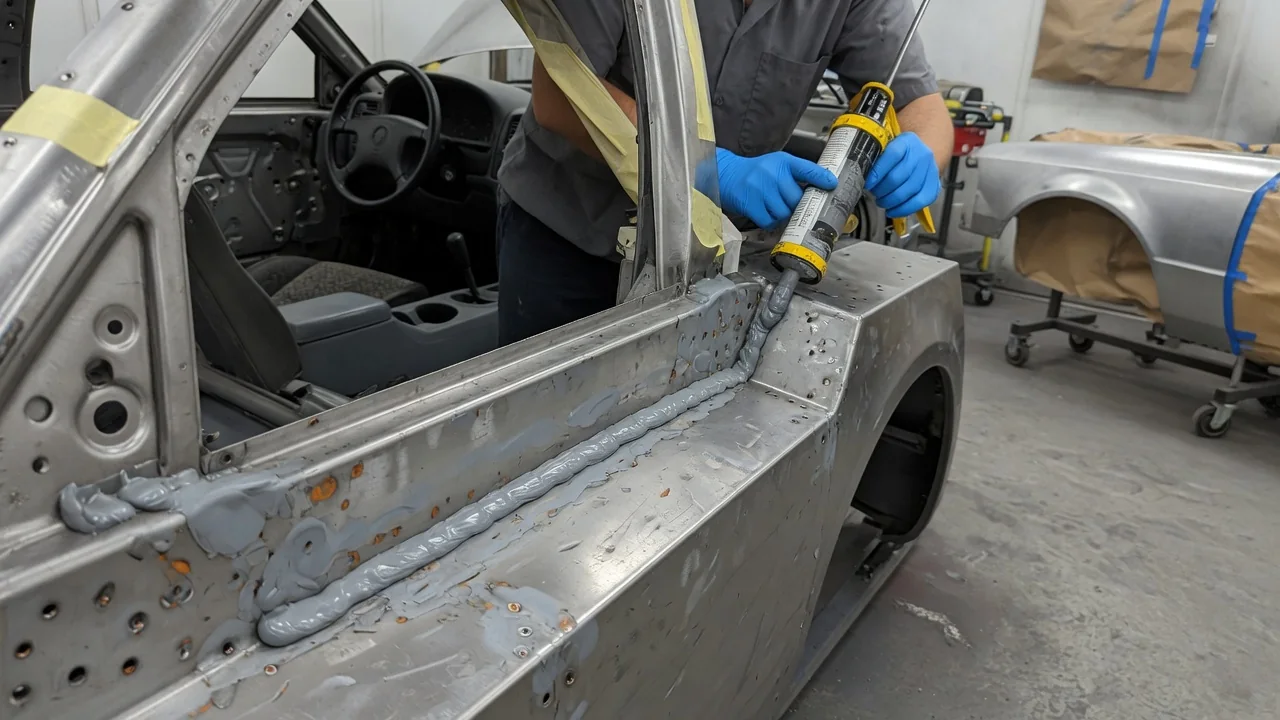
Seam sealer is a flexible compound applied along the joints where sheet-metal panels meet on a car body. If you have ever noticed a rubbery bead along a door hem, a trunk gutter or the edges of a floor pan, you have seen it. Its purpose is not to hold the body together but to close the gaps that welding and hemming leave behind, keeping out water, dust and fumes. This guide explains where seam sealer sits, what it protects against and how it is repaired.
Seam Sealer at the Panel Joint
A car body is assembled from many stamped steel or aluminum panels joined by spot welds, structural adhesives, rivets or hemmed edges, depending on the design. These joining methods give the body its strength, but they rarely produce a perfectly closed seam. Spot welds are separated by small gaps, overlapping flanges leave narrow crevices, and a hemmed door skin folds around the inner frame with an edge that stays exposed to the outside. Seam sealer is laid into or over these joints to fill the gaps and make the seam continuous. Typical locations include roof drip channels, door and hood hems, trunk and hatch gutters, wheelhouse seams, floor pan overlaps, firewall joints and the areas around the rear quarter panels. The exact pattern varies by manufacturer and model, so the factory repair information is the reliable map for any specific vehicle.
It helps to separate seam sealer from structural bonding. Welds and panel bonding adhesives carry loads and contribute to body stiffness and crash performance. Seam sealer generally does not. It is formulated to stay flexible, so it can move slightly as the body flexes over bumps, expands with heat and contracts in the cold without cracking away from the metal. In factories it is commonly applied after the body has received its corrosion-protective electrocoat and before the color coats, which is why it is usually painted over and blends into the body. Factory beads may be smooth, ribbed or textured, and some are sprayed rather than extruded. Those differences matter mainly when a repair needs to look original.
Seam Sealer as a Moisture Barrier
The core automotive seam sealer purpose is to keep moisture from entering and lingering inside a joint. An unsealed overlap behaves like a capillary trap: water wicks into the narrow space along with road salt and dirt, and it has little chance to dry out. Metal edges inside a seam can be harder to coat thoroughly than flat surfaces, so trapped moisture may start corrosion where nobody can see it. By filling the seam, the sealer keeps that water from getting in, and by covering the joint edge it shields an area that is otherwise difficult to protect.
The barrier also protects the cabin. Sealed floor, firewall and roof seams help stop rain and wash water from leaking onto carpets and help limit dust, exhaust fumes and some road noise reaching the interior. Seam sealer is one layer in a larger protection system that may also include electrocoat, primers, cavity wax, underbody coating and drain holes. Each layer covers a different weakness. Drain holes, for example, are meant to let water out of doors and rocker panels, so they are deliberately left open rather than sealed. A sealer that does its job keeps water out of the seam while the drains handle water that gets past window seals and other openings.
Seam Sealer Repair
Seam sealer can need attention for several reasons. Age, sunlight exposure, heat cycling and body flex can make it harden and crack. Previous collision repairs may have left gaps or used a product that did not bond well. Any panel replacement or welding near a seam also disturbs the original sealer, which then has to be restored. Common warning signs include cracks or lifting edges in a bead, bubbling paint along a seam, rust staining at a hem, and water leaks into the cabin or trunk.
A sound repair starts with removing loose, cracked or lifted sealer back to material that is still firmly attached. The joint is then cleaned, and any rust is removed or treated, because sealing over active corrosion only hides it. Repair procedures typically call for bare metal to be protected with a suitable primer before sealing, but the correct order of primer, sealer and topcoat depends on the specific product, so its technical data sheet and the vehicle maker's repair information should guide the process. Common repair sealers include polyurethane, MS polymer and two-part epoxy types, offered in thick-bodied, self-leveling, brushable and sprayable forms.
Application usually involves running a continuous bead into the joint, tooling it with a brush, gloved finger or spatula so it contacts both sides of the seam, and letting it cure for the time the product manufacturer specifies before painting. Where the repair should match a factory appearance, technicians choose the product form and tooling method that best reproduces the original bead profile or texture. The goal is full contact with clean, protected metal and a seam that stays closed as the body moves.
Practical Implications and Limits
For an owner, the most useful takeaway is that sealer condition is a visible clue to what is happening in places that are otherwise hard to inspect. Looking along door hems, trunk gutters, under the hood and in the wheel wells during routine cleaning can reveal cracks early, when a seam can still be resealed instead of repaired with new metal. When shopping for a used car, sealer in one area that looks uneven or different from the rest of the body can suggest past bodywork, although it does not by itself prove a collision or reveal the quality of the repair. A professional inspection is the way to confirm that.
Seam sealer also has clear limits. It cannot restore metal that has already rusted through, and it cannot add strength to a weakened joint; those problems require proper metal repair. Some hardening or fine surface checking in an old bead is not always a defect, and a cabin leak can come from door seals, glass seals or blocked drains rather than a failed seam. Because sealer locations, materials and procedures vary between vehicles, general guidance explains how the system works but does not replace the repair manual for a particular car. When a seam is part of a structural repair or sits near safety-related components, follow the manufacturer's procedures or have the work done by a qualified body shop.