What Is an Engine Oil Additive Package? Detergents, Anti-Wear and Service
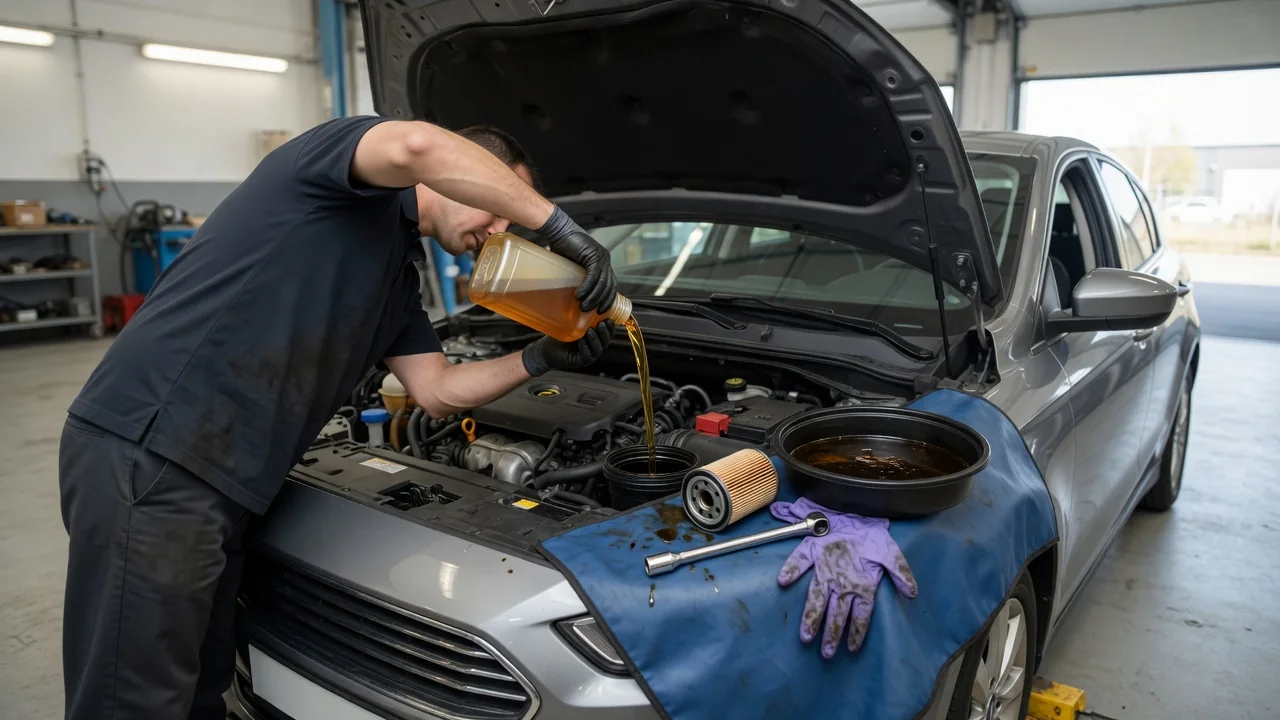
Every bottle of motor oil has two parts. The base oil provides the lubricating film. The additive package lets that film survive heat, combustion byproducts and metal-to-metal contact. So what is an engine oil additive package? It is the blend of chemical components a formulator adds to base stock so the finished oil meets a performance specification. In practical terms, motor oil additives answer three questions: what keeps the engine clean, what prevents wear, and how long those protections last.
Detergents
Combustion is never perfectly clean. Small amounts of fuel, water vapor and acidic gases slip past the piston rings into the crankcase, and heat oxidizes the oil itself. Left unchecked, these byproducts form varnish on pistons, carbon in ring grooves, and acids that attack metal surfaces. Detergents are the part of the additive package that fights this. Most engine oil detergents are metal-based compounds, commonly built on calcium or magnesium. They act on hot metal surfaces to keep deposits from forming and to help loosen those that begin to build.
Detergents also carry an alkaline reserve. Many detergent molecules are overbased, which means they hold extra basic material that neutralizes acids as they enter the oil. Oil analysis usually reports this reserve as total base number, or TBN. The oil spends that reserve as it works, which is one reason oil cannot simply stay in an engine indefinitely.
Detergents usually work alongside dispersants, a separate class of additive that contains no metal and therefore leaves no ash. Detergents protect surfaces. Dispersants surround soot and sludge-forming particles and keep them suspended in the oil. The filter catches some of these particles, and the rest leave with the drained oil instead of settling in the oil pan, valve cover or oil passages. This is why healthy oil, especially in a diesel, can turn dark quickly: it is holding contaminants in suspension rather than leaving them in the engine.
Anti-wear components
Under ideal conditions, a full film of oil separates moving parts. In practice, that film thins or breaks at certain moments. Examples include cold starts, high loads at low engine speed, and sliding contacts such as cam lobes and followers, where pressure is concentrated on a small area. Under these conditions, called boundary lubrication, metal would touch metal without chemical help. Anti-wear components are designed for exactly this situation.
The best-known anti-wear additive is zinc dialkyldithiophosphate, usually shortened to ZDDP. Under heat and pressure it reacts with metal surfaces to form a thin, sacrificial protective layer, often called a tribofilm. When microscopic high points on two surfaces rub together, this film wears away instead of the metal beneath it. The film keeps rebuilding as long as active additive remains in the oil. Friction modifiers, such as certain molybdenum or organic compounds, are related but different. Their main job is to reduce friction for efficiency, not to serve as the primary wear barrier.
Anti-wear chemistry involves trade-offs. Over time, phosphorus and sulfur from ZDDP can reduce the effectiveness of catalytic converters, so modern passenger car oil specifications limit these elements. Formulators balance those limits against wear protection. As a result, the amount and type of anti-wear additive differs between oils written for different specifications and engine designs.
Service
An additive package is used up as the engine runs. Detergents spend their alkaline reserve neutralizing acids. Dispersants fill up with soot and other contaminants. Antioxidants are consumed as they slow oxidation. Anti-wear compounds deplete gradually as they form protective films. High heat, towing, dusty conditions, long idling, and short trips that never fully warm the engine generally speed this process. The base oil can still look usable after much of its protective chemistry is gone.
That is the practical reason oil change intervals exist. The manufacturer's recommended interval, and its definition of severe service, reflect how quickly the additive package is expected to deplete in that engine. Some vehicles use an oil life monitor that estimates degradation from operating conditions. Others rely on fixed mileage or time intervals. For more precise condition data, laboratory oil analysis can track remaining base number, oxidation, contamination and wear metals. Keep in mind that it describes one sample and cannot predict every future operating condition.
Choosing the right oil matters as much as changing it on time. The additive package is the main thing that separates one oil specification from another. The most reliable guide is the owner's manual, which lists the required viscosity grade and performance standard, such as an API or ILSAC category, an ACEA sequence, or a manufacturer approval. Aftermarket bottle additives are generally unnecessary when the oil meets the correct specification. Adding them can also upset the balance of a package that was formulated and tested as a whole.
Practical implications and limits
For most owners, the additive package is invisible. Labels rarely list components or concentrations, and two oils with the same viscosity grade can carry quite different chemistry. The certification marks and approvals on the bottle are the practical summary. They show that the finished oil, as a complete formulation, passed a defined set of engine and laboratory tests. Comparing individual additive levels from data sheets tells you little unless you know how the whole formulation performs.
Some engine designs place particular demands on the package. Engines with exhaust particulate filters often call for low-ash oils, because metal-based detergents and anti-wear additives leave ash that can build up in the filter. Small turbocharged direct-injection gasoline engines can be prone to low-speed pre-ignition, an abnormal combustion event at low engine speed and high load. Newer specifications include testing for it, partly because detergent chemistry can influence it. Some older engines with flat-tappet camshafts are often discussed in connection with anti-wear additive levels. These cases are reasons to follow the manufacturer's stated requirement, not reasons to choose an oil by a single ingredient.
Additives also have clear limits. They can slow wear and deposit formation, but they cannot restore worn bearings, reseal leaking gaskets, or fix mechanical faults such as excessive blow-by or coolant leaking into the oil. Oil color and smell say little about additive condition. Symptoms such as a low oil pressure warning, unusual noise or rapid oil consumption call for diagnosing the engine itself. A different additive blend is unlikely to solve them.