What Is a Torque Converter Stator? How It Redirects Fluid and Boosts Torque
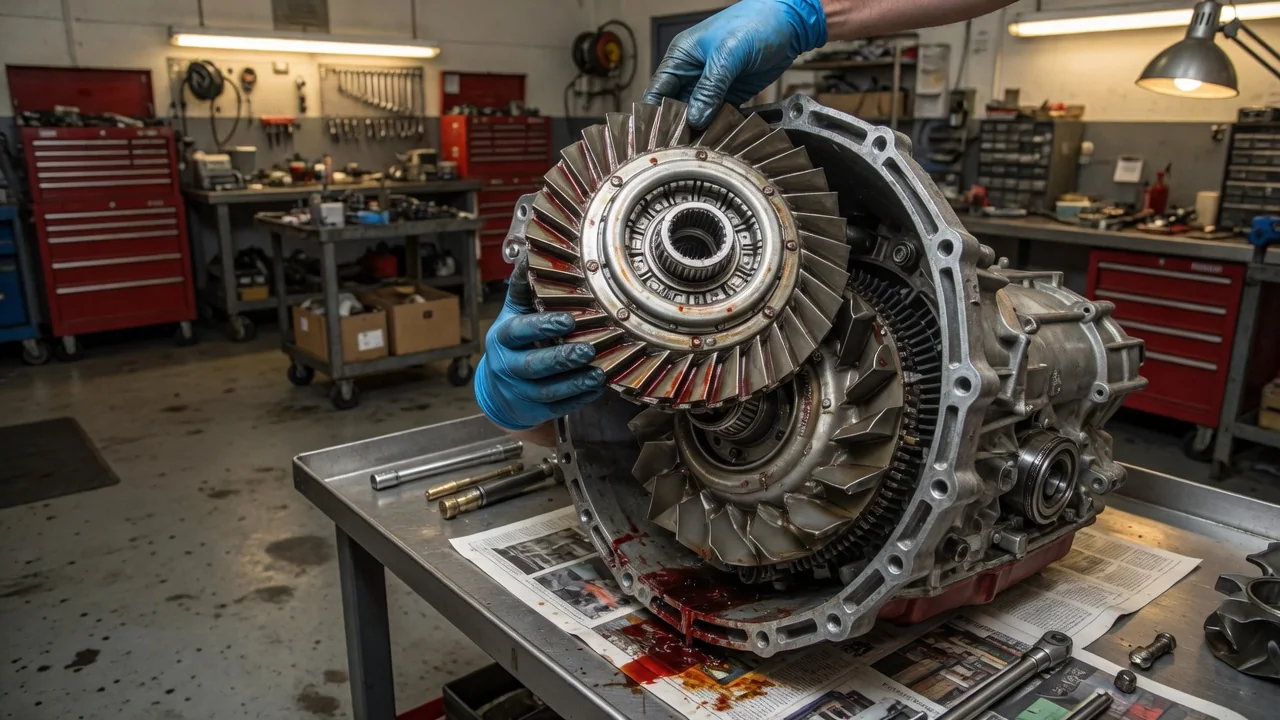
A torque converter stator is the small finned wheel between the impeller and the turbine inside an automatic transmission's torque converter. It does not connect to the engine or the wheels. Its job is to steer fluid. That redirection lets a converter multiply torque when a car pulls away from a stop. It is also why the stator's role changes once speeds rise and the lockup clutch engages. Here is how the stator works and what its function means for everyday driving.
Fluid redirection
A torque converter has three main bladed elements. The impeller, sometimes called the pump, is part of the converter housing and turns with the engine. It flings transmission fluid outward and into the turbine, which is splined to the transmission input shaft. The fluid strikes the turbine blades, gives up energy, and flows back toward the center of the converter on its way to the impeller. The stator sits in that return path. It is mounted on a one-way clutch, which rides on a stationary support shaft fixed to the transmission case.
Without a stator, fluid leaving a slow-turning turbine would head back into the impeller moving roughly against the impeller's rotation. The engine would have to spend effort just reversing that flow. The stator's curved blades catch the returning fluid and turn it, so it enters the impeller moving in the same general direction the impeller is spinning. Instead of fighting the pump, the returning fluid now helps push it. To deflect the flow this way, the stator must be held still. The one-way clutch does exactly that: it locks against rotation in one direction and freewheels in the other.
Low-speed torque
Torque multiplication comes from this redirected fluid. Because the returning stream adds to the force the impeller applies, the turbine receives more torque than the engine delivers to the converter. Turning the fluid creates a reaction force on the stator. The stator passes that force through its one-way clutch to the transmission case, which is why it is sometimes called the reaction member of the converter. The effect is greatest at stall, when the impeller is turning and the turbine is held still. That happens when the car is stopped in gear with the brakes applied, or just beginning to move.
As the vehicle accelerates, the turbine speeds up and the speed difference between impeller and turbine shrinks. The angle at which fluid leaves the turbine changes, and the multiplication effect tapers off. Eventually the fluid starts striking the back faces of the stator blades. This stage is often called the coupling point. Here the one-way clutch releases, and the stator spins freely with the fluid. From then on the converter acts essentially as a fluid coupling. It passes torque through at roughly a one-to-one ratio, while still allowing some slip between impeller and turbine. How much multiplication a converter provides, and at what speed coupling occurs, depends on blade geometry and overall design. Both vary from one transmission to another.
Lockup
Even in the coupling phase, a fluid connection never transmits power with perfect efficiency. The turbine always turns a little slower than the impeller, and that slip becomes heat and wasted fuel. To address this, many modern converters include a lockup clutch, also called a torque converter clutch. When applied, it mechanically connects the turbine to the converter cover, which is driven by the engine. The engine and the transmission input shaft then turn together without fluid slip.
The stator plays no active role during lockup. With the turbine and impeller turning as a unit, there is no speed difference for the stator to work with, so its one-way clutch simply lets it freewheel. Lockup generally comes after the converter has passed its coupling point, often at steady cruising speeds. Exactly when and in which gears it engages is set by the transmission's control strategy, and that differs between vehicles. The lockup clutch may release during a strong acceleration request or when slowing down. The fluid path then takes over again, and the stator can resume multiplying torque if the speed difference grows large enough.
Practical implications and limits
For drivers, the stator's work shows up mostly as smooth, strong pull from a standstill without a clutch pedal. Torque multiplication has a cost, though. Turning fluid at high slip generates heat, which is one reason automatic transmissions rely on fluid cooling. It is also why prolonged stall conditions, such as holding the car against the brakes with the throttle open, add thermal load. Using the fluid type and following any service recommendations in the owner's manual supports the converter as much as the gearsets.
When the stator's one-way clutch fails, the symptoms tend to depend on how it fails. If the clutch no longer holds, the stator can spin backward at low speeds. The converter then loses its multiplication, and the car may feel noticeably sluggish when pulling away even though it cruises normally. If the clutch seizes, the stator stays fixed even at higher speeds, where it obstructs fluid flow. That can mean weaker performance at speed, poorer efficiency, and extra heat whenever the converter is not locked up. These are general patterns, not a diagnosis.
Similar complaints can come from engine problems, slipping clutches or bands, lockup clutch faults, or control issues. Confirming a stator fault therefore requires the test procedures in the vehicle's service information, not guesswork. Some manufacturers specify a stall speed test while others discourage it, so procedures should not be assumed to carry over between transmissions. In many converters the stator is sealed inside a welded housing and is not serviced separately. A faulty stator usually means replacing or professionally rebuilding the converter. Finally, not every automatic uses a torque converter, so stator behavior applies only to converter-equipped transmissions.