What Is a PCV Valve and How Does It Work? Positive Crankcase Ventilation Explained
Every running engine leaks a little combustion pressure into its lower end, and something has to deal with those gases. Positive crankcase ventilation is the system that handles them, and the PCV valve is its small but essential regulator. Knowing how this part meters vapor, responds to vacuum and connects to engine sensors shows why such a modest component matters for oil life, seals and emissions.
What positive crankcase ventilation means and why an engine needs it
The crankcase is the sealed lower portion of the engine where the crankshaft spins and oil drains back to the pan. Piston rings seal well but never perfectly, so a small amount of combustion pressure slips past them on every power stroke. This leakage, called blow-by gas, carries unburned fuel vapor, water vapor and acidic combustion byproducts. If it stayed trapped, it would raise crankcase pressure, force oil past gaskets and seals, and mix with the oil in ways that promote engine oil sludge.
Early engines handled blow-by with a road-draft tube that simply vented fumes into the air beneath the car. A closed crankcase system replaced that approach by routing the vapors into the intake so they burn in the cylinders. The PCV valve meters that flow. It works with a breather hose from the valve cover, a fresh air inlet hose from the air cleaner and a connection to the intake. That makes PCV part of the emissions control system as much as an engine-protection feature.
What the PCV valve actually does inside the system
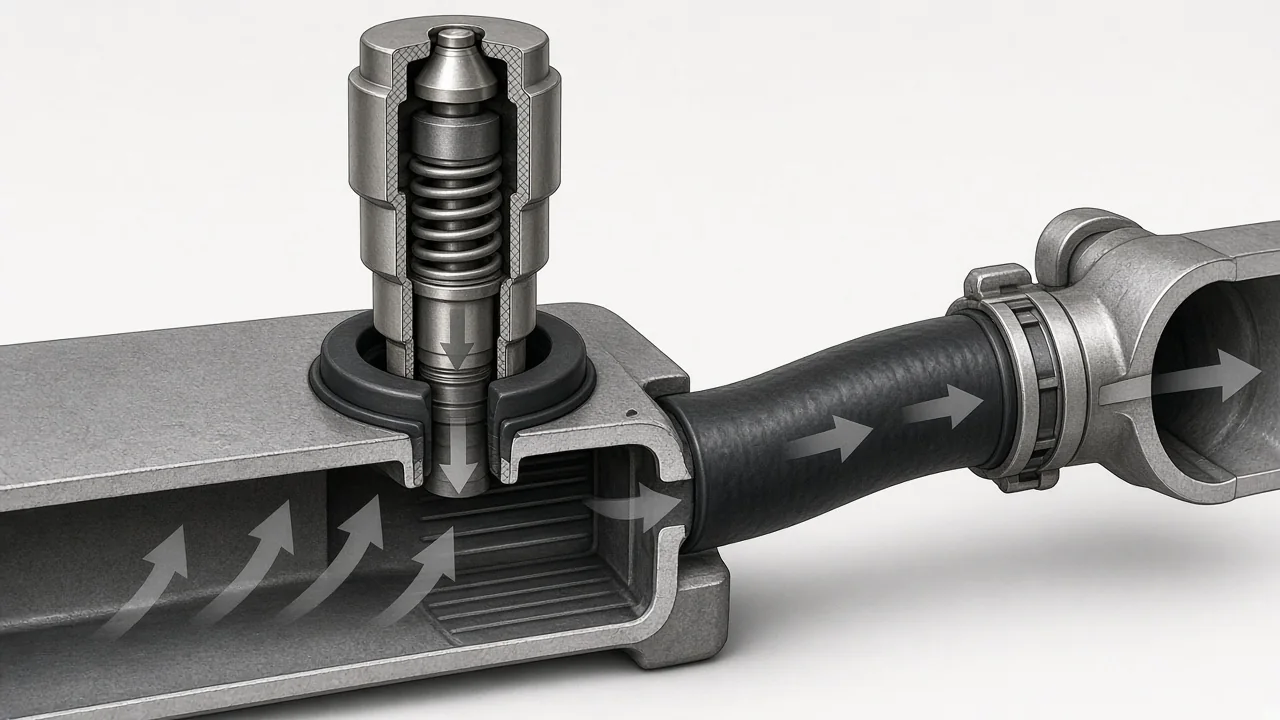
At its core, the valve lets crankcase vapors move toward the intake in a controlled amount while preventing flow in the opposite direction. Metering is the key idea. If too little vapor is drawn out, pressure and moisture build inside the engine and contaminants linger in the oil. If too much passes, the valve behaves like an unplanned vacuum leak, adding air the engine computer did not account for and pushing the air-fuel mixture away from its target.
The one-way function matters just as much. During an intake backfire, or when a turbocharger pressurizes the intake, reverse flow could push pressure and flame toward the crankcase, and the valve closes against that direction. The payoff for owners is practical even though it goes unseen: oil that stays cleaner longer, less stress on crankshaft and camshaft seals, and lower hydrocarbon emissions because the fumes get burned instead of released. The valve keeps adjusting as engine conditions change.
How the valve responds to vacuum at idle, cruise and full throttle
A traditional PCV valve contains a spring-loaded plunger, sometimes called a pintle, inside a small housing. Intake manifold vacuum pulls on one side of that plunger while the spring pushes back. At idle, vacuum is strong, so the plunger is drawn toward a position that leaves only a narrow passage. That limits vapor to a small stream, which suits the low blow-by an idling engine produces and keeps extra air from roughening a delicate idle.
Under moderate load, such as steady cruising or gentle acceleration, manifold vacuum drops and the spring moves the plunger to open a larger path, matching the greater blow-by at those speeds. At wide-open throttle or during a backfire, the plunger seats to block reverse flow. Turbocharged engines often add a second route or a separate check valve for boost conditions. Many newer engines use a diaphragm design instead, where a flexible membrane regulates the opening according to the pressure difference across it.
Where the PCV valve sits on a car and what it looks like
Locations vary, but a few arrangements are common. The valve may be pressed into a rubber grommet on the valve cover, threaded into the intake manifold, spliced in-line within a hose, or built into the valve cover or an oil separator housing. Older-style valves usually look like a small plastic or metal cylinder with a hose barb on one end. Others take the form of an elbow-shaped fitting or a plain-looking module molded into a cover.
Because shape and placement differ so much across engine families, the reliable approach is to check service information for your own vehicle rather than assume a universal spot. Following the hoses helps. One line carries vapors toward the intake, and another brings filtered fresh air from the air cleaner or intake tube into the crankcase, often through a valve cover breather. On many modern engines the valve is not a separate serviceable part at all, so an owner may find only an integrated cover assembly.
Fixed orifices, oil separators and electronic PCV designs
Not every system uses a moving valve. Some engines rely on a fixed orifice, a precisely sized hole that limits flow by its dimensions rather than with a spring and plunger. Many designs also include an oil separator, a set of baffles or chambers that knocks oil mist out of the vapor before it reaches the intake. This matters especially on direct-injection engines, where fuel is not sprayed over the intake valves, so oil carried into the intake can build up there as deposits.
Cold climates add another challenge. Blow-by contains water vapor, and in freezing weather that moisture can condense and turn to ice in the hoses or the valve, blocking flow entirely. Some designs use heated PCV valves or hoses to prevent this. On some newer vehicles, crankcase ventilation is electronically controlled or monitored, so the engine computer can command flow or watch for abnormal behavior. All of these variations share the goal of a simple plunger valve: steady, controlled removal of crankcase vapor.
Sensors and engine-computer logic tied to crankcase ventilation
PCV flow becomes part of the total air entering the engine, so the sensors that track air and combustion reflect it indirectly. Depending on the design, a mass airflow sensor or manifold pressure sensor tells the computer about intake air, and oxygen sensors report whether the resulting mixture runs rich or lean. When crankcase flow falls outside what the computer expects, fuel trim corrections may shift. Some engines add a dedicated crankcase pressure sensor or a disconnect detection feature that recognizes a missing or leaking hose.
Diagnostic trouble codes tied to crankcase ventilation have manufacturer-dependent meanings, so any code needs to be checked against the specific vehicle's service information before drawing conclusions. A code is evidence pointing toward a circuit, a flow condition or a hose connection, not proof that a particular part has failed. An owner can look at hose routing and see whether a pressure sensor is present, but confirming exactly what the computer monitors requires vehicle-specific documentation or professional scan-tool work.