What Is a Car Chassis?
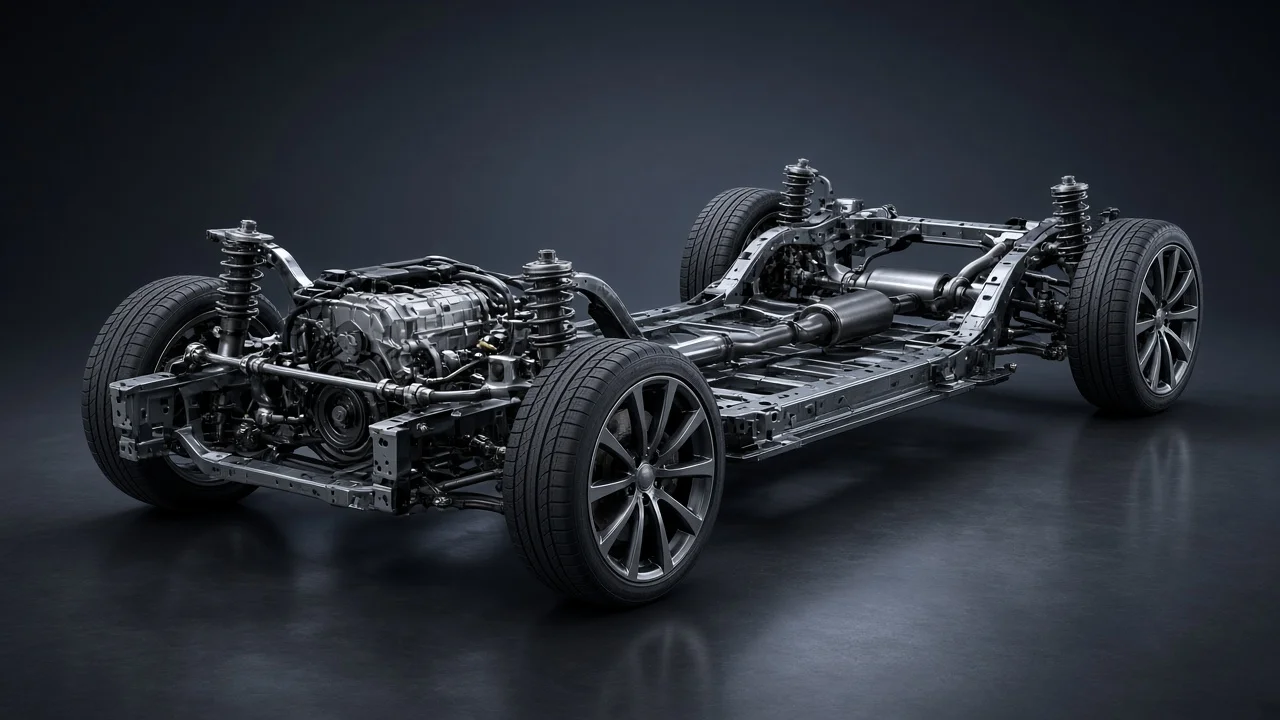
A car's chassis is the underlying structure that holds the vehicle together and carries its weight. In the broader sense, it is everything that lets the car roll and drive: the frame or load-bearing structure, plus the suspension, steering, brakes, wheels and the mounting points for the engine and drivetrain. The body, the outer shell that forms the cabin and panels, sits on or around it.
What the term means in an automotive context
The word chassis gets used in several related ways. Context usually tells you which one is meant.
Engineering sense: the complete rolling assembly without the body, meaning the structure plus suspension, steering, brakes, wheels and often the powertrain. A vehicle in this state is often called a rolling chassis. Everyday sense: the main structural skeleton of the car. Many people use chassis and frame interchangeably, although they are not strictly the same thing. Driving dynamics sense: in reviews and marketing, chassis tuning or a well-sorted chassis usually refers to how suspension, steering and brakes have been set up to make the car ride and handle. Identification sense: chassis number is a common term, especially outside the US, for the vehicle's unique serial number. In the US, the standardized term is Vehicle Identification Number (VIN). Chassis code is a separate idea, described below.
What the chassis does and what it affects
The chassis is the part of the car that takes the loads. The weight of the vehicle, passengers and cargo, the forces from bumps, cornering, braking and acceleration, and the pull of a trailer all pass through it. The suspension connects the wheels to the structure, the steering directs the front wheels, and the brakes slow the wheels. The structure ties these systems together so they stay in the correct positions relative to one another.
Ride and handling: a stiff, well-located structure lets the suspension do its job, which affects comfort, steering precision and stability. Safety: the load-bearing structure is designed to manage crash forces and protect the cabin. Capability: the type of structure influences how much weight a vehicle is designed to carry or tow. The actual ratings come from the manufacturer for each specific model and configuration. Durability and ownership: corrosion or damage to structural parts can affect safety and value, which is why structural condition matters in inspections, collision repair and used-car evaluations.
Chassis vs. frame vs. body
These terms overlap in everyday speech but describe different things.
Term | What it refers to | Includes; Chassis | The vehicle's structural base and running gear | Frame or load-bearing structure, suspension, steering, brakes, wheels, powertrain mounts; Frame | The rigid structural skeleton only | Rails and crossmembers, or the equivalent load-bearing structure; Body | The shell that forms the cabin and exterior | Roof, pillars, doors, panels, floor (in a unibody, the body is also the main structure)
How these parts relate depends on how the vehicle is built. There are two common approaches.
Body-on-frame: a separate, ladder-like frame carries the loads, and the body is bolted on top. This layout is common on many full-size pickups and some large SUVs, and it is often associated with heavy-duty use and towing. Unibody (also called unitized or monocoque construction): the body and frame are combined into a single structure, so the body shell itself carries the loads. Most modern passenger cars and crossovers are built this way. Many unibody vehicles also use bolt-on subframes to carry the engine and suspension.
With body-on-frame construction, saying chassis to mean the frame and its running gear is natural, because the frame is a separate part. On a unibody car there is no separate frame, so chassis usually means the integrated structure plus the suspension, steering and brakes.
Chassis, platform and chassis codes
Two related identification terms are often confused with the chassis itself.
Platform: a shared set of engineering foundations, such as core structure, suspension layouts and key dimensions, that a manufacturer uses across several models. Different vehicles can look very different but share a platform. Chassis code: an internal designation a manufacturer assigns to a specific generation or version of a model's underlying design. Enthusiasts, parts catalogs and repair resources often use these codes to tell generations apart, because a model name can stay the same while the underlying design changes. VIN or chassis number: a unique serial number for one individual vehicle, not for a whole model or generation.
Manufacturers use their own naming schemes for platforms and chassis codes, and the codes are not always printed on the vehicle in plain form. To confirm which platform or chassis code applies to a particular car, check the manufacturer's documentation or a parts source that looks up the vehicle by VIN, rather than relying on model name and year alone.
Limits of this explanation
This entry covers the general meaning of the term. It does not give construction details, load ratings or chassis codes for any specific vehicle, because those vary by make, model, year and configuration. For figures such as towing capacity or payload, or to learn whether a given vehicle uses body-on-frame or unibody construction, refer to the owner's manual, the manufacturer's specifications or the information label on the vehicle.