Wastegate Solenoid Symptoms, P0045–P0049 and P0243–P0250 Codes, and Replacement
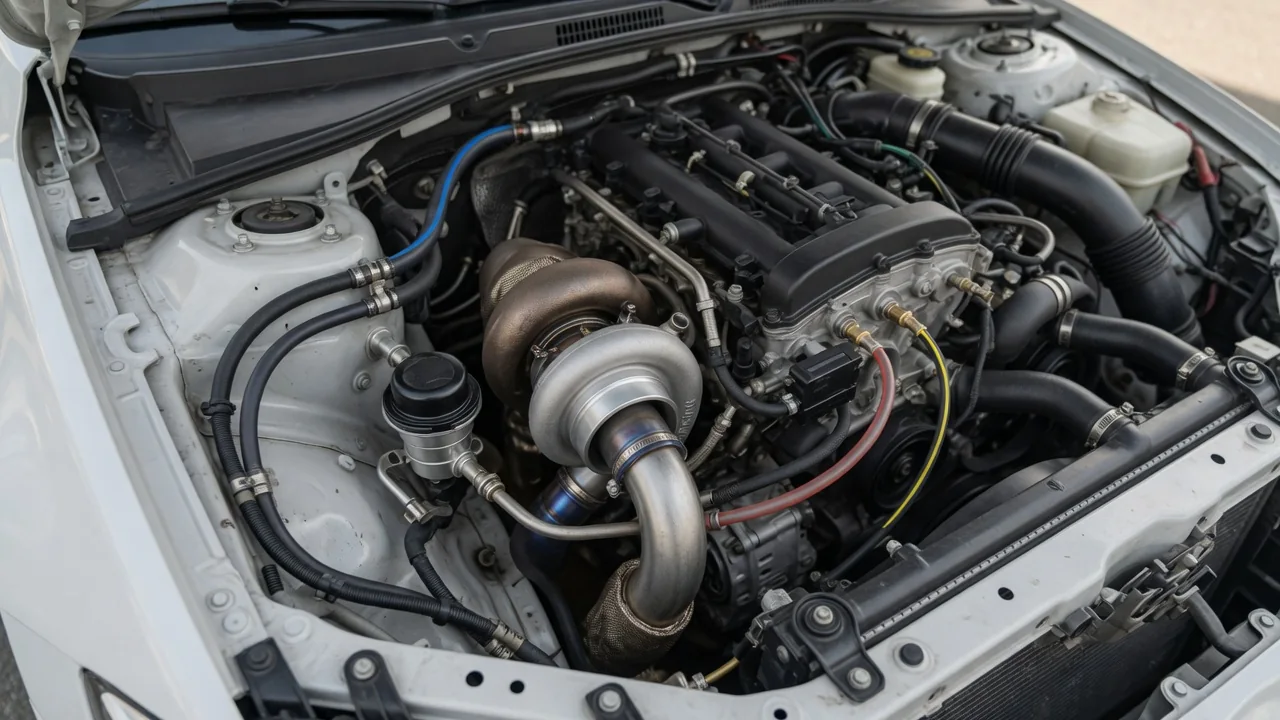
The engine controller uses a turbocharger wastegate solenoid, sometimes called a boost control solenoid or turbocharger solenoid valve, to meter the signal that reaches a wastegate actuator. Wastegate position then changes how much exhaust energy drives the turbocharger, so commanded boost and actual boost stay closer together. Vacuum supply, pressure feed, or electronic actuation may be used, and control hose routing is vehicle-specific.
How the Wastegate Solenoid and Control Hoses Regulate Boost
On many turbocharged engines, the powertrain control module pulses a turbocharger wastegate solenoid so the wastegate actuator sees a controlled vacuum or pressure signal rather than a raw, unregulated feed. That turbocharger solenoid valve sits between the vacuum supply or boost source and the actuator, opening and venting as the controller tries to match commanded boost with actual boost. As the actuator rod moves, the wastegate door opens or closes, diverting exhaust around the turbine or sending more flow through it, which raises or lowers compressor output.
A turbocharger wastegate vacuum hose is part of that control path, but plumbing is not universal. Some actuators are vacuum-operated, some are pressure-operated, and some use an electronic wastegate with no hose at all. Identify whether the vehicle uses turbocharger vacuum, a pressure line, or a motor-driven actuator before treating any hose or solenoid advice as applicable. Where hoses exist, routing, supply connections, and vent paths must remain intact so the solenoid can raise, hold, or dump the control signal. A misrouted or swapped line can make a healthy solenoid look defective.
Symptoms of a Faulty Solenoid or Damaged Control Hose
When the boost control solenoid or a related hose fails to deliver the intended actuator signal, the engine may make less power than expected, boost may surge or lag, and a warning lamp may illuminate. Many controllers also enter limp mode, a protective power limitation that reduces engine output when commanded boost and actual boost disagree or when a solenoid circuit is flagged. Drivers often notice delayed throttle response or a feeling that the turbocharger never comes on, especially under load. Those signs point to a boost-control problem, not automatically to one failed valve.
A cracked, disconnected, or obstructed turbocharger wastegate vacuum hose can leak the control signal, starve the actuator, or block venting so the wastegate cannot follow the solenoid command. The same complaints can come from wiring faults, a weak vacuum supply, a sticking wastegate actuator, or other turbocharger issues. Symptoms alone cannot prove the turbocharger wastegate solenoid has failed. If a boost fault is present, avoid heavy acceleration. Stop safely if severe power loss, smoke, unusual mechanical noise, or a critical warning develops, because those conditions can involve more than a solenoid or hose.
Interpreting P0045–P0049 in the Vehicle’s Boost Control System
A P0045, P0046, P0047, P0048, or P0049 code is a diagnostic clue, not proof that a turbocharger wastegate solenoid has failed. Confirm the exact definition and test path for the vehicle, engine, and boost control system before treating any of these as a solenoid replacement instruction. On many applications, the P0045 code is described as a turbocharger or supercharger boost control solenoid circuit or open condition, while the P0046 code is a range or performance concern. A P0047 code often indicates circuit-low monitoring, and a P0048 code often indicates circuit-high monitoring.
Circuit-low and circuit-high labels on P0047 and P0048 concern electrical monitoring of the solenoid circuit, not a direct reading of low or high boost pressure. Voltage, ground, driver, or circuit continuity problems can set those codes even when the wastegate actuator and turbocharger vacuum plumbing are intact. Treat P0049 separately. Where confirmed for the vehicle, a P0049 code relates to turbocharger or supercharger overspeed, not to a simple solenoid circuit failure. Overspeed monitoring does not by itself establish a failed wastegate solenoid or prove mechanical damage inside the turbocharger; further testing is required.
Understanding Wastegate Solenoid Codes P0243–P0250
P0243, P0244, P0245, P0246, P0247, P0248, P0249, and P0250 also belong to wastegate solenoid circuit families, but the letters A and B are controller labels, not proof of twin turbochargers. Confirm the vehicle-specific definition and which physical turbocharger solenoid valve each code names. Common listings describe P0243 as a turbocharger wastegate solenoid A circuit fault, P0244 as a range or performance concern, P0245 as circuit-low, and P0246 as circuit-high. Those descriptors still need the manufacturer's diagnostic chart for the engine in front of you.
P0247 is commonly listed as a solenoid B circuit fault, with P0248 covering range or performance, P0249 covering circuit-low, and P0250 covering circuit-high. A vehicle may use solenoid B for a second control channel, a different function, or another actuator path rather than a second turbocharger. These codes identify monitored electrical or performance faults. Diagnosis must still determine whether wiring, connectors, the solenoid, control supply, hose integrity, or mechanical wastegate response is responsible. Replacing a turbocharger wastegate solenoid because a P0243 or P0250 is stored, without that confirmation, can leave the original problem in place.
Safe Observations and Professional Tests Before Replacing Parts
Before any turbocharger wastegate solenoid replacement, record stored and pending codes, freeze-frame data, and the operating conditions when symptoms occur. Freeze-frame data can show load, speed, and whether commanded boost and actual boost had already diverged when the controller stored P0046 or a related code. Do not clear that information until it has been documented. With the engine off and cool, inspect accessible hoses and connectors for cracks, disconnection, abrasion, corrosion, or heat damage. A split turbocharger wastegate vacuum hose or a corroded connector can mimic a failed boost control solenoid.
Professional testing can check electrical supply and control, circuit continuity, hose integrity, wastegate actuator movement, and the relationship between commanded boost and actual boost using the vehicle's own specifications. That work belongs with service information for the engine and control system. Do not bypass boost controls, apply power directly to a solenoid or actuator, adjust the actuator, or road-test in a way meant to create excessive boost. Specialist diagnosis is needed when codes persist after a visible hose repair, when overspeed or limp mode is involved, or when actuator travel and turbocharger vacuum cannot be verified safely.
What Wastegate Solenoid Replacement Involves
Turbocharger wastegate solenoid replacement should follow confirmation that the identified valve is actually at fault and that the part matches the vehicle and engine. Access the component with the engine cool, note control hose routing and connector orientation, replace only the confirmed faulty solenoid, and restore every connection to its original path. Damaged hoses or connectors need proper repair rather than a clamp over a split. If the manufacturer requires a calibration or relearn after installing a turbocharger solenoid valve, complete that procedure with the specified scan tool process instead of assuming the new part will self-adapt.
Verification includes checking for leaks at the turbocharger wastegate vacuum hose and fittings, reviewing scan data for solenoid command and circuit status, and performing a controlled functional assessment of boost response. The goal is to see commanded boost and actual boost tracking without repeating the original limp mode or code. Access difficulty, integrated turbocharger assemblies, and the diagnostic time needed to separate a solenoid from wiring or actuator faults all affect repair scope. A successful replacement is defined by confirmed function, not by the presence of a previously stored P0045 or P0243 family code.