Walmart Battery Testing: What to Expect and How to Use the Results
The Short Answer
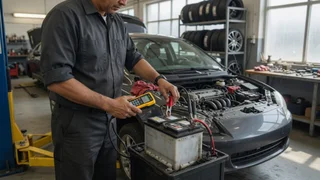
Walmart stores with an Auto Care Center generally offer car battery testing, and it is commonly provided at no charge. A technician uses a handheld electronic tester to estimate the battery's state of charge and its ability to deliver starting current, then tells you whether the battery looks good, needs charging, or should be replaced. Two conditions change that answer. First, not every Walmart has an Auto Care Center, and services, hours and staffing vary by location, so call the store before you drive over. Second, a battery test only judges the battery. If your car keeps going dead, a passing result can point toward the alternator, the wiring or a hidden electrical drain rather than settling the question.
What a Walmart Battery Test Usually Involves
Most retail auto centers, Walmart included, use a conductance-style battery tester. It clamps onto the battery terminals and sends a small signal through the battery to estimate its internal condition without a long load test. The technician typically enters the battery's rated cold cranking amps (CCA), the measure of how much current it should deliver for starting in cold weather, and the tester compares measured performance against that rating.
Depending on the equipment and the technician, the check may also include a quick look at the starting and charging system. That can mean watching voltage while the engine cranks and checking system voltage with the engine running to see whether the alternator is putting out a reasonable charge. Do not assume a full charging-system diagnosis is included; ask what the test covers at your store.
How to Read the Results
Testers usually report a verdict rather than just numbers. The common outcomes and what they mean for your next step:
Result | What it generally means | Sensible next step; Good | Battery holds charge and meets enough of its rated capacity | If problems continue, look at the charging system, connections or parasitic draw; Good, recharge | Battery is healthy but discharged | Fully charge it and retest; ask why it ran down; Charge and retest | Too discharged for an accurate reading | Charge first, then test again before buying anything; Replace | Battery cannot meet its rating or has an internal fault | Replace, and confirm the charging system is working so the new battery is not drained; Bad cell | Internal failure in one cell | Replace the battery
The "charge and retest" result matters most. A deeply discharged battery can fail a test even if it is not worn out. If you are told to replace a battery that simply sat for weeks or was drained by a light left on, ask whether charging and retesting is possible first.
As a general reference for a typical 12-volt lead-acid battery, a fully charged battery at rest reads roughly 12.6 volts, and readings noticeably lower suggest a partial charge. With the engine running, a healthy charging system usually holds system voltage somewhere in the high 13s to mid 14s. Exact targets vary by vehicle and battery type, so treat these as rough guides rather than pass-fail limits.
When the Battery Is Not the Real Problem
A dead car is often blamed on the battery when the cause sits elsewhere. If your battery tests good but the car still fails to start, or a new battery dies quickly, consider these possibilities:
Weak charging output: a failing alternator may not recharge the battery while you drive, leaving it slowly drained. A battery warning light on the dashboard while driving is a common sign. Corroded or loose battery terminals: white or green buildup, or a clamp that moves by hand, adds resistance and can cause slow cranking or no-start symptoms even with a healthy battery. Voltage drop in cables or grounds: a damaged positive cable or poor engine or body ground can lose voltage under load. Measuring voltage drop across a cable while cranking reveals this, but it is a more involved test than a quick battery check. Parasitic draw: something keeps drawing current after the car is shut off, such as an aftermarket accessory, a glovebox or trunk light that stays on, or a module that does not go to sleep. The battery runs down overnight or over a few days. Short trips: frequent short drives may not give the alternator enough time to replace the energy used for starting.
Finding a parasitic draw typically involves measuring current with an ammeter after the vehicle's modules go to sleep, then pulling fuses one at a time to see which circuit drops the reading. A wiring diagram for your exact model year helps identify what each circuit powers. When pulling and reinstalling fuses, always replace them with the same fuse rating; a higher-rated fuse can let a wiring fault overheat. This kind of diagnosis usually goes beyond a retail battery check and may be better handled by a repair shop or a careful DIY owner with a multimeter.
Before You Go to the Store
Call ahead to confirm the store has an Auto Care Center, that battery testing is available, and when the bay is open. Ask whether they test the battery in the vehicle, out of the vehicle, or both. Some customers bring in a removed battery. If the car will not start, ask whether they can test it once you get it there with a jump, or whether you should remove the battery and bring it in. Note your symptoms: slow cranking, clicking, dim lights, a warning light, or a battery that dies after sitting. This helps separate a battery fault from a charging or drain problem. Know your battery's details if possible, including group size and CCA rating, usually printed on its label.
If the Test Says Replace: What to Check When Buying
Walmart sells car batteries, including its EverStart house brand, and many Auto Care Centers can install a battery bought there. Whether you buy at Walmart or elsewhere, match the replacement to your vehicle rather than to the battery that happens to be on sale. Fitment can differ by model year, trim, engine and market, so confirm against your specific vehicle.
Group size: this sets the physical dimensions and terminal layout so the battery fits the tray and hold-down. Use the size listed for your exact vehicle. Terminal position and type: the positive and negative posts must sit on the correct sides so your cables reach without strain. Cold cranking amps: meet or exceed the CCA your vehicle calls for, especially in cold climates. Reserve capacity: indicates how long the battery can run essential loads if the charging system fails. Battery type: vehicles with start-stop systems or heavy electrical loads often require an AGM battery. Replacing AGM with a standard flooded battery can shorten battery life and may cause electrical issues. Manufacture date: batteries lose charge on the shelf. Check the date code and favor a recently made battery. Warranty terms: compare free-replacement and prorated periods, and keep the receipt. Core charge: retailers commonly add a refundable charge that is returned when you bring back the old battery.
Some newer vehicles need the battery registered with the car's computer after replacement so the charging system adjusts to the new battery. If your vehicle has this requirement, ask whether the installer can do it, or plan to have it done elsewhere.
Choosing Your Next Step
If your car starts slowly or the battery is several years old, a free battery test at a Walmart Auto Care Center is a reasonable first stop. If the result is "replace," buy a battery that matches your vehicle's group size, CCA and battery type, and have the charging system checked so the new battery is not drained. If the battery tests good but problems persist, shift your attention to charging output, terminal and cable condition, voltage drop or parasitic draw, and consider a repair shop for a fuller electrical diagnosis.