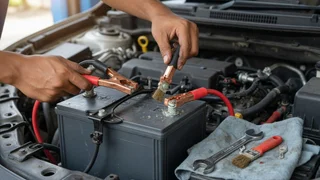
Walmart Battery Terminals: What to Check Before You Buy
Walmart battery terminals can fix a corroded, cracked or loose cable end, but only if the replacement matches your battery's post style, your cable's gauge and the way the cable attaches. Get those three things right and an inexpensive terminal from a general retailer can work as well as one from a parts counter. Get them wrong and you can end up with a connection that looks fine but drops voltage, overheats or works loose. The other condition that changes the answer is whether the terminal is actually the problem. If your no-start, dim lights or battery warning light comes from a weak battery, a failing alternator or a parasitic draw, new terminals will not solve it.
The Short Answer: Match Three Things
Post type: top post (the round tapered posts on most passenger vehicles), side post (threaded holes on the side of the case, common on many GM vehicles), or stud/marine-style posts. Polarity: positive and negative top posts are different sizes, so terminals are usually sold as a marked positive or negative part, or as a pair. Cable connection: the terminal has to fit your cable's gauge and attach in a way you can do properly, whether that is a bolt-on clamp, a compression fitting or a crimped lug.
Before shopping, look at your battery and cables, note the post style, and read the gauge printed on the cable insulation if it is still legible. Taking a photo of both ends of the cable helps when you compare packaging in the store or listings online.
Battery Terminal Types and Where They Fit
Terminal type | Fits | What to know; Top post clamp (SAE) | Most cars and light trucks with round tapered posts | Positive and negative sizes differ; confirm the marking before buying; Side post bolt or adapter | Batteries with threaded side terminals | Uses a bolt rather than a clamp; bolt length matters so it doesn't bottom out or stay loose; Top-to-side or side-to-top adapter | Fitting a different battery style to existing cables | A workaround that adds another connection point; Stud or wing-nut terminal | Marine, deep-cycle and some accessory batteries | Common on boats and RVs; less common as a primary car connection; Quick-disconnect terminal | Vehicles stored for long periods | Lets you break the circuit without tools; adds bulk and another contact surface
Dual-terminal batteries have both top and side posts. If yours does, use whichever set your cables were designed for and leave the other covered.
How the Terminal Attaches to the Cable
This choice matters as much as the post fit, because the cable-to-terminal joint is where many hidden problems start.
Bolt-on clamp terminals: the stripped cable sits under a plate and bolts. They are easy to install with hand tools and are the usual emergency repair, but the contact area can be limited and the joint is exposed to corrosion. Compression terminals: a threaded collar squeezes the cable strands. They usually make better contact than a simple clamp plate if sized correctly for the cable gauge. Crimp or solder-on lugs: often the most durable connection, but proper crimping on heavy battery cable needs a suitable crimping tool. A poorly crimped or hammered lug can be worse than a good bolt-on clamp.
If your cable is corroded deep under the insulation, shows green or white powder well past the end, or is stiff and swollen, replacing the whole cable is often a better fix than putting a new terminal on damaged copper.
Materials: Lead, Brass, Zinc and Plated Copper
Retail battery terminals are commonly made from lead or lead alloy, brass, zinc alloy, or tin-plated copper. Lead conforms well to the battery post and matches the post material, which helps reduce corrosion between dissimilar metals. Brass and plated copper conduct well and hold their shape, which helps clamp tension over time. Some low-cost zinc or die-cast terminals are softer or more brittle and can crack if overtightened. Check the packaging for the material rather than judging by color, since plating can make different metals look alike.
Cable Gauge and Fit
Battery cables are sized by gauge, where a smaller number means a thicker cable. Your starter cable needs to carry heavy current during cranking, so a terminal sized for a thinner cable can force you to trim strands, which reduces capacity. One sized for a much thicker cable may not grip securely. Match the terminal's stated gauge range to your cable. If your vehicle has extra wires connected at the positive terminal, such as a fused feed to the fuse box or an accessory lead, make sure the new terminal has a place for them. Many vehicles have small ring terminals stacked on the clamp bolt, and losing that connection can kill circuits that seem unrelated to the battery.
Some positive terminals include a built-in fuse or connection for fused leads. Do not change the fuse rating of any existing fused link to make a new terminal fit. Use the rating specified for your vehicle, which you can find in the owner's manual or a wiring diagram for your model year and trim.
Check Whether the Terminal Is Really the Problem
Corroded terminals are a common cause of slow cranking, clicking, flickering lights and intermittent no-starts. But the same symptoms also come from a weak battery, a failing alternator or a parasitic draw. A few basic checks help you avoid buying parts you don't need.
Resting voltage: with the engine off and the car sitting for a while, a fully charged 12-volt battery usually reads roughly 12.6 volts. A reading well below that points to a discharged or failing battery. Charging output: with the engine running, system voltage is typically somewhere around 13.5 to 14.5 volts on many vehicles. Much lower suggests a charging problem; much higher can indicate a regulator fault. Your vehicle's specification may differ. Voltage drop: with a multimeter, measure between the battery post and the terminal clamp while someone cranks the engine. A good connection shows very little voltage. A noticeable reading there means the joint itself is resisting current, even if it looks clean. Parasitic draw: if a healthy battery keeps going flat overnight or over a few days, something may be drawing current with the car off. Terminals won't fix that; the draw has to be traced.
If the battery warning light stays on while driving, treat it as a charging system issue first. Loose or corroded terminals can contribute, but the alternator, its belt, or its wiring are more common causes of that light.
Installing Replacement Terminals
Wear eye protection and gloves. Battery corrosion and acid residue can irritate skin and eyes. Disconnect the negative cable first and reconnect it last, so a wrench touching the body while you work on the positive side won't create a short. Clean the posts to bright metal with a post cleaning brush. A terminal on a corroded post will still make poor contact. Strip only as much cable insulation as the terminal needs and keep strands from fraying. Tighten firmly enough that the terminal can't be twisted by hand, without cracking the clamp or distorting the post. Apply a battery terminal protectant or anti-corrosion spray after the connection is tight, not underneath the contact surfaces. Some vehicles may lose radio presets, clock settings or learned idle values after disconnection; check your owner's manual for any relearn steps.
Buying at Walmart: Practical Tips
Walmart's automotive section, in store and online, typically stocks a mix of replacement clamps, side post bolts, adapters, cleaning brushes and anti-corrosion products. Selection varies by location, so if you need a specific style, check online availability for your store before making the trip. Read the package carefully for the post type, positive or negative marking, cable gauge range and material. If your local store has an auto care center, you can ask whether they inspect or replace terminals, but services differ by location. Keep the receipt and packaging until you've confirmed the fit, since a mismatched terminal is one of the most common return reasons for this kind of part.
When to Choose a Different Fix
A new terminal is a good fix when the cable is sound and only the clamp is cracked, stripped or badly corroded. Replace the full cable when corrosion has traveled up the wire, the insulation is damaged, or the cable has a factory-molded end with sensors or fused leads you can't reproduce with a generic terminal. Some newer vehicles use a battery sensor on the negative terminal for charging control; in that case, a generic clamp may not be a suitable substitute, and you should check what your model year and trim require before buying.