Volvo XC90 Steering Angle Sensor Fault

A steering angle sensor fault on a Volvo XC90 usually appears as a warning message, disabled stability assistance, or a stored chassis code rather than a hard mechanical failure. The condition means the network is receiving an implausible, missing, or out-of-range steering position value. Because the value feeds stability control, traction logic, and sometimes headlight aiming, the driving feel may change even when the steering wheel still turns normally. Understanding where the signal originates and how the module validates it helps separate a simple calibration issue from a wiring, power supply, or internal sensor problem.
Direct answer
The direct answer is that a Volvo XC90 steering angle sensor fault indicates the steering angle signal is unavailable or not matching the values the stability control module expects. It does not automatically mean the sensor itself has failed. The fault can be caused by a lost calibration after a wheel alignment, a weak battery or voltage interruption, damaged clock spring wiring, connector corrosion, or a genuine internal sensor defect. The most useful first step is to read the complete fault description and freeze-frame conditions, because the code alone only tells you which plausibility check was violated, not which component created the violation.
The scope also matters because the XC90 has used different steering systems and electronic architectures over its production run. On some versions the steering angle sensor is a separate module near the steering column, while on others the value is calculated inside the steering rack or derived from other chassis sensors. A stored fault after a low battery or steering work may clear with a drive cycle and steering-angle calibration, but a fault that returns during normal cornering often points to an intermittent signal dropout. Vehicle-specific scan tool data and the exact code designation are therefore more meaningful than the generic dashboard warning.
Interpreting symptoms and test results
Begin by checking under what operating conditions the fault appears. If the code sets only after a battery disconnect, jump start, or wheel alignment, the most likely explanation is a loss of learned steering center position. In that case the sensor may still be healthy, but the module no longer knows what voltage or angle represents straight ahead. Performing the appropriate steering angle reset or calibration procedure, then driving straight on a level surface while observing live data, can restore the reference. A calibration routine that will not complete, or a value that jumps erratically with the wheel held still, suggests a real signal problem rather than a lost setting.
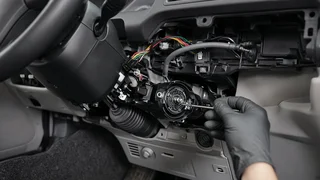
Next inspect the physical signal path. Because the steering wheel rotates continuously, the connection often passes through a clock spring and column harness, where rubbing, broken conductors, or terminal fretting can create an intermittent circuit. Watch the scan tool steering angle display while slowly turning the wheel lock to lock with the vehicle supported according to the manufacturer's guidance. If the reading freezes, drops out, or reverses at a specific wheel position, concentrate on the clock spring, connector, and mounting points before condemning the sensor. Voltage supply and ground checks at the sensor connector can also reveal a circuit fault that mimics an internal failure.