Volkswagen Engine Code Location: Where to Find It and How to Read It
Parts catalogs, repair procedures, fluid specifications and timing components for a Volkswagen are often organized by engine code rather than by model name or displacement. Two cars with the same badge and the same engine size can use different engine codes and need different parts. This guide explains where the VW engine code is usually located, how to recognize it, and how to avoid confusing it with other identifiers.
The short answer
On most Volkswagens, the easiest place to find the engine code is the vehicle data label. This is a printed sticker that is commonly placed in the spare tire well under the trunk floor covering, with a matching copy often included in the maintenance or service booklet. The code is also stamped directly on the engine, usually on a flat machined area of the block. Where exactly it is stamped depends on the engine family. If neither is accessible, a Volkswagen dealer or parts department can usually identify the factory engine code from the VIN.
Locations vary by model, generation, model year and market. The owner's documentation or a service resource for your specific vehicle is the best confirmation.
What a VW engine code is, and what it is not
A Volkswagen engine code is a short group of letters, sometimes mixed with numbers, that identifies a specific engine variant. Older engines typically use two- or three-character codes. Many newer engines use four characters. The code separates engines that share a displacement but differ in output, emissions equipment, fuel system, internal parts or calibration. Volkswagen Group brands share many engines, so the same coding approach also appears on related vehicles.
The engine code is easy to confuse with several other identifiers found on the same labels or nearby:
Identifier | What it identifies | Typical appearance; Engine code | The engine variant (family and specification) | Short letter group, often three or four characters; Engine number | The individual engine's serial number | The engine code followed by a longer number, usually stamped on the block; Transmission code | The gearbox variant | Short letter group listed next to the engine code on the data label; VIN | The individual vehicle | 17-character vehicle identification number; PR (option) codes | Factory equipment and options | Rows of three-character codes on the data label; Paint code | The factory paint color | Short code on the data label
When a parts supplier or repair procedure asks for the engine code, it means the short variant code, not the full serial number or the VIN.
Where to look on a Volkswagen
1) Vehicle data label in the trunk
Many Volkswagens carry a vehicle data label in the spare tire well. To check, lift the trunk floor covering and look on the floor of the well, near the spare wheel or tire repair kit. On some models it may be placed elsewhere in the cargo area, such as behind a side trim panel. Labels in the trunk can fade, peel or be removed during bodywork, so it may be missing on older or repaired cars.
2) Copy of the data label in the service booklet
Volkswagen has often included a duplicate of the vehicle data label in the maintenance or warranty booklet supplied with the car, usually near the front. If you have the original owner's literature, check there before lifting carpets or looking under the hood.
3) Stamped on the engine block
The engine number, which begins with the engine code, is stamped on the engine itself. The position depends on the engine family. Common areas include:
A machined pad on the block close to the joint between the cylinder block and cylinder head; The area of the block near the flange where the engine bolts to the transmission; The front face of the block, sometimes partly hidden by hoses, brackets or the oil filter housing
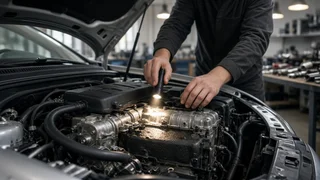
The stamping is often small and can be covered by dirt, oil residue or surface corrosion. You may need a flashlight, a mirror or an inspection camera to read it. Cleaning the area gently helps. Avoid abrasive tools that could damage the characters. On some vehicles the stamping is only easy to reach with the car raised or an undertray removed.
4) Labels on engine covers or components
Some Volkswagen engines have a printed label with the engine code and number on a component such as the timing belt cover or another plastic cover. These labels are easy to read when present, but they can be lost when parts are replaced. They also identify only the part they are attached to, which may have come from another engine.
5) VIN lookup through a dealer or parts system
The 17-character VIN is visible through the windshield at the base of the driver's side and on the door jamb label. On its own, it does not always state the exact engine code in a form owners can easily decode. A Volkswagen dealer's parts department, or a parts catalog that accepts VIN input, can usually return the factory engine code. This method reports what the car was built with, which matters if the engine has since been replaced.
6) Diagnostic scan tool
On many newer Volkswagens, scan tools that read the engine control module's identification data may display the engine code or related software and hardware identifiers. What is shown depends on the tool and the control module. Treat it as a useful cross-check rather than the sole source.
How to read the vehicle data label
The data label packs a lot of information into a small space, so it helps to know the typical layout. It generally shows the VIN, a model description and model code, and the production date. One line usually carries the engine code and transmission code side by side, often along with paint and interior codes. Below this are several rows of PR option codes. The engine and transmission codes tend to appear as two short letter groups next to each other. Do not mistake an option code or the model code for the engine code.
If the layout is unclear, compare the candidate code with the stamping on the engine or confirm it with a VIN lookup.
When the label and the engine do not match
The data label and VIN records describe the car as it left the factory. If the engine has been replaced with a different variant, the code stamped on the block is the one that matches the engine actually installed. For engine parts and procedures, the stamped code is the stronger reference. For items tied to the original vehicle build, such as emissions configuration or warranty records, the factory information may still be relevant. If the two codes differ, find out why before ordering engine-specific parts.
Which method to use
Quickest check: the vehicle data label in the spare tire well or service booklet; Confirming the engine actually installed: the stamping on the engine block; No label and a hard-to-reach stamping: a VIN lookup through a dealer or a VIN-based parts catalog; Cross-check on newer models: control module identification data read with a scan tool
Finding the engine code before buying parts or starting a repair avoids the most common mismatch: assuming two engines are interchangeable because they share a model name or displacement. When the label, the stamping and the VIN record all agree, you can rely on the code with confidence.