Types of CVT Transmissions: Belt, Chain, Toroidal and Hybrid eCVT
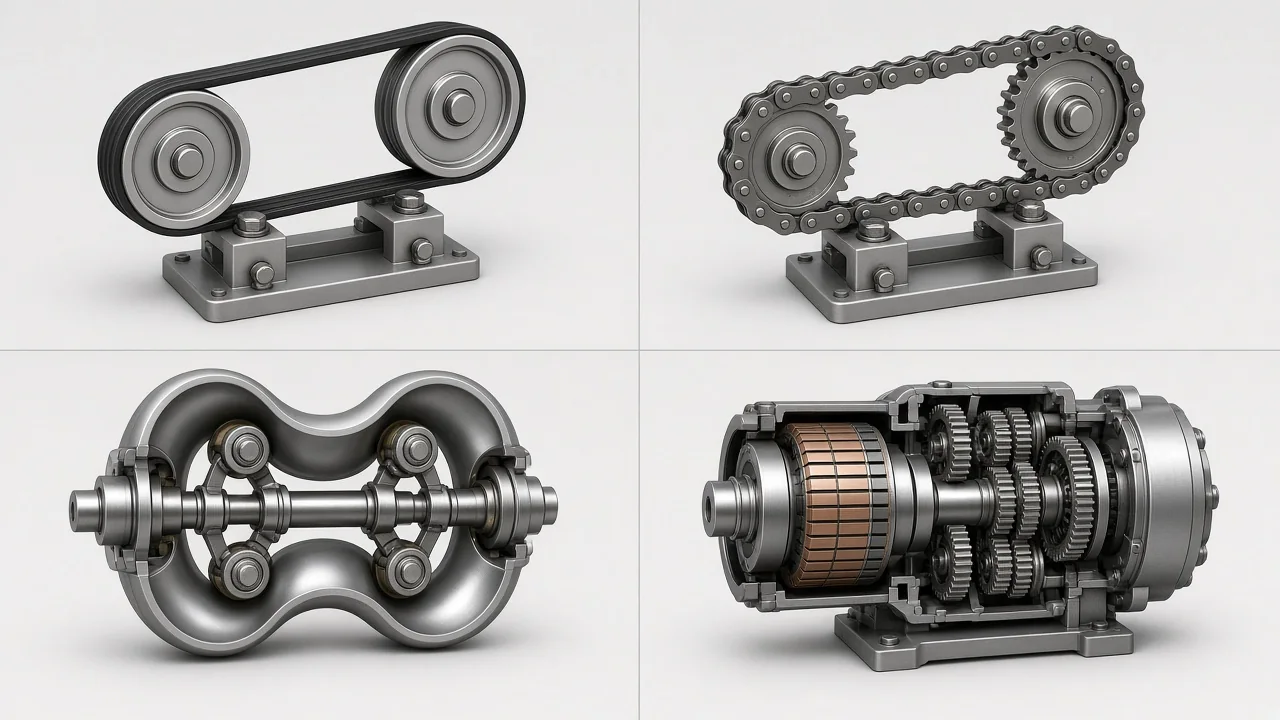
Continuously variable transmissions share a purpose rather than a single internal layout. Different CVT transmission types change the effective drive ratio smoothly, without a ladder of fixed gears, yet they do so with belt or chain pulleys, toroidal discs, or a hybrid planetary arrangement. The Toyota Prius CVT transmission belongs to that last family. Understanding those mechanisms helps interpret drivability, service documentation, and why one CVT badge does not describe every design.
What the CVT Label Describes
A continuously variable transmission does not step through a published sequence of fixed gear ratios. Instead, the control system can hold or change the effective drive ratio anywhere within a designed range, matching engine speed to road load more finely than a conventional stepped gearbox. That is the operating idea behind several types of CVT transmission, including pulley systems that use a steel belt or a transmission chain, toroidal layouts that rely on traction rollers, and planetary hybrid eCVTs.
The letters CVT on a window sticker, underhood label, or owner's manual heading only indicate that the driveline can vary ratio continuously. They do not tell you whether the hardware uses variable-diameter pulleys, toroidal discs, or a planetary gearset with motor-generators. Maintenance, fluid type, and inspection intervals follow the specific architecture and the vehicle's published specifications, not the marketing name. A hybrid CVT transmission and a pulley CVT can share a label while remaining mechanically unrelated, so the badge is a starting description rather than a service map.
How Belt and Chain CVTs Adjust Their Ratio
In a pulley-based design, each pulley assembly is a pair of conical faces that can move toward or away from each other. As the gap changes, the steel belt or transmission chain rides at a larger or smaller radius, so the two pulleys together set a continuously changing effective drive ratio. One assembly typically grows while the other shrinks, keeping belt or chain length accounted for. Torque travels through that belt or chain between the driving and driven pulleys rather than through meshed gear pairs.
Clamping force on the pulley faces keeps the belt or chain from slipping under load, and the specified lubricant cools, reduces wear, and supports that friction or traction at the contact surfaces. Hydraulic or electronic controls modulate that clamp as torque demand changes. Some calibrations also insert programmed ratio steps so the vehicle feels closer to a conventional automatic, yet those simulated shifts are a control feature. They do not convert the hardware into a stepped gearbox or identify whether a steel belt or a chain is installed.
How a Toroidal CVT Uses Discs and Rollers
A toroidal CVT transmission uses input and output discs with curved working surfaces, forming a doughnut-like cavity. Traction rollers sit in that cavity and transmit motion from one disc to the other. Tilting the rollers changes where they contact each disc, so one contact radius grows while the other shrinks. That geometry change is what varies the transmission ratio continuously. Unlike a pulley CVT, there is no steel belt wrapping variable-diameter pulleys; the ratio lives in the roller-to-disc contact path.
Torque in a toroidal CVT transmission passes through a thin film of traction fluid at the roller and disc interface rather than through gear teeth or a wrapped belt. The specified lubricant is part of that mechanism: it must support high contact pressure, prevent metal-to-metal welding, and still allow enough shear in the film to carry load. Fluid that is merely labeled as automatic transmission fluid may not meet that requirement. Applications, durability, and how often this layout appears in production vehicles vary by manufacturer and should not be assumed from the CVT name alone.
How a Planetary Hybrid eCVT Manages Power
A planetary hybrid eCVT does not rely on variable-diameter pulleys or toroidal discs. A planetary gearset, often called a power-split device, mechanically links the engine, one or more motor-generators, and the drive output. The sun, planet, and ring elements stay in mesh. Continuously variable behavior comes from controlling motor-generator speeds so the relationship among those three paths can change smoothly. The teeth do not step through discrete gears; the effective drive ratio still varies because electrical machines can hold or accelerate their connected members.
Mechanical power from the engine and electrical power through the motor-generators both participate in propulsion, and their mix changes with speed, load, battery state, and control strategy. At times the electrical path mainly supports ratio control; at others it adds torque or recaptures energy. A hybrid CVT transmission can be a power-split eCVT or a hybrid that still uses a belt or chain unit, so the same family of names covers more than one architecture. Identifying a particular system requires vehicle documentation rather than the hybrid or eCVT label by itself.
Understanding the Toyota Prius eCVT
The Toyota Prius CVT transmission is a planetary power-split hybrid transaxle with motor-generators, not a belt-and-pulley unit. Continuously variable behavior comes from coordinating engine speed with the motor-generators so the power-split device can deliver a wide range of effective drive ratios while the gear teeth remain engaged. That eCVT result is what drivers mean by a Prius CVT transmission, rather than a steel belt riding on variable-diameter pulleys. The transaxle still uses conventional gear teeth; the variability is in how those members are driven.
Because the power-split device and motor-generators can absorb or supply speed differences, engine speed is not locked to road speed the way a single mechanical gear would lock it. During acceleration the engine may hold a relatively steady speed while vehicle speed rises; during charging or light-load running it may spin at a speed chosen for efficiency or battery management rather than for a fixed ratio. Internal layout, fluid requirements, and service details still depend on model year and configuration. Confirm those from manufacturer information before treating any Prius as identical hardware.
Identifying the Installed Design and Assessing Symptoms
The reliable way to identify which CVT is in a vehicle is the owner's manual, manufacturer specifications, or VIN-based service information. Engine sound, a CVT badge, and even simulated shift steps cannot establish whether the hardware is a belt unit, a chain unit, a toroidal CVT transmission, or a planetary eCVT. A Toyota Prius CVT transmission and a pulley CVT can both sound busy under load for different reasons. Guessing from cabin cues mixes those designs together and can send service work down the wrong path.
When something feels wrong, record warning messages, unusual noises, vibration, visible leaks, and the speeds, temperatures, and loads when they occur. Those notes help a technician, but they do not identify a failed pulley, roller, planetary gearset, or motor-generator by themselves. A fault indication is evidence to interpret, not proof that a part has failed. Persistent concerns need professional diagnosis. Hybrid high-voltage components, including those in a Prius CVT transmission, require qualified service and should not be probed as if they were a conventional gearbox.