What Is a CVT Transmission and How Does It Work?
A CVT, or continuously variable transmission, is an automatic design that changes its ratio smoothly instead of stepping through a fixed set of gears. That one difference affects how the car accelerates, how it sounds and how it uses fuel. Once you know what the letters mean, how the pulleys and belt work together and where the design came from, it is easier to judge whether a CVT suits your driving.
CVT Meaning: What Continuously Variable Transmission Stands For
CVT stands for continuously variable transmission, and each word matters. Continuously means the ratio changes without interruption instead of in jumps. Variable means the ratio is not locked to a handful of preset values and can settle anywhere within its range. Transmission is the assembly that takes power from the engine and delivers it to the wheels at a usable speed and torque. Taken together, the name describes a gearbox that can use any ratio between its lowest and highest limits instead of choosing from a short menu.
From the driver's seat, a CVT behaves like any other automatic. You select park, reverse, neutral or drive, and there is no clutch pedal. Some automakers put their own badge, such as CVT-i or a similar trade name, on their version of the technology. These are marketing labels for a specific design, so check the owner's manual to confirm exactly what is fitted. Whatever the label, the principle is the same: engine speed and wheel speed are linked through a smoothly adjustable ratio rather than a set of fixed steps.
How the Belt-and-Pulley System Creates Infinite Ratios
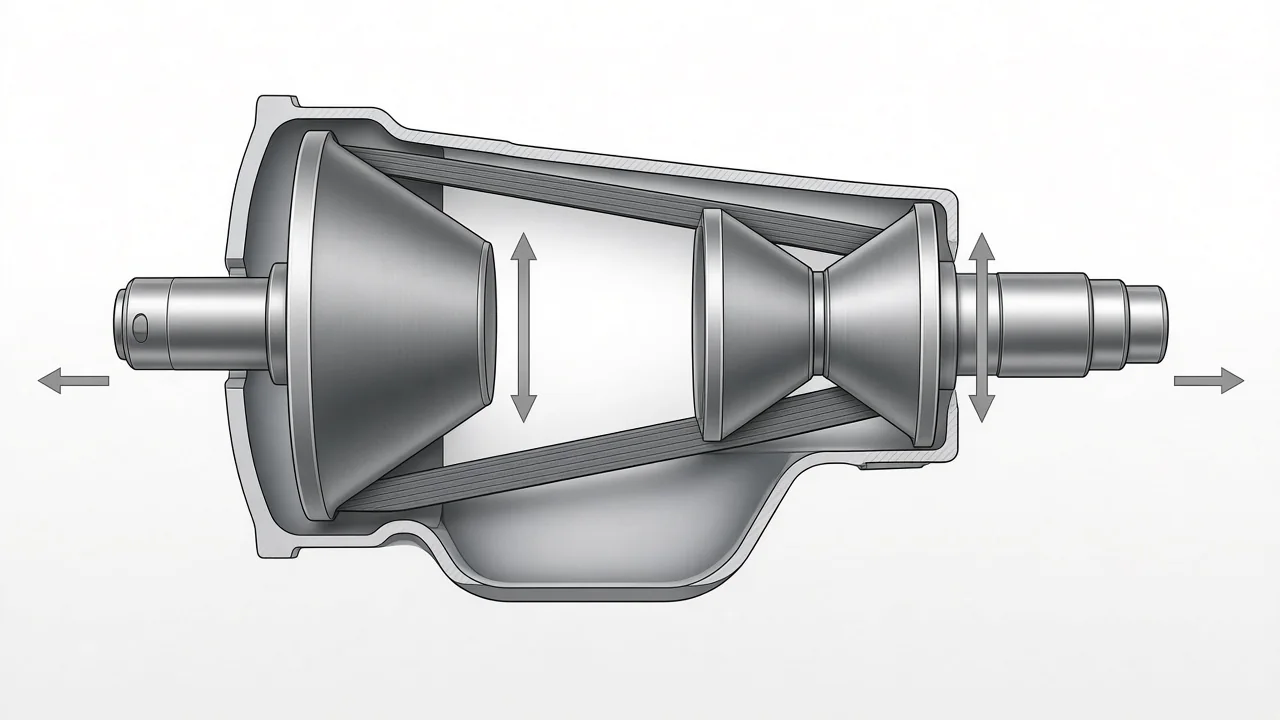
Most CVTs rely on two variable-diameter pulleys. The engine drives the input pulley, the output pulley sends power toward the wheels, and a steel push belt or chain connects the two. Each pulley is made of two cone-shaped halves facing each other, which form a V-shaped groove. Hydraulic pressure pushes the halves together or lets them spread apart. When the halves close, the belt is forced outward and rides on a larger effective diameter. When they open, it sinks lower into the groove and rides on a smaller one.
Picture pulling away from a stoplight. The input pulley starts small and the output pulley large, much like a low gear on a bicycle, which multiplies torque to get the car moving. As speed builds, the input pulley's effective diameter grows while the output pulley's shrinks, moving gradually toward a tall cruising ratio. A torque converter or start clutch handles the standing start, and a transmission control unit sets the pressures based on throttle, speed and load. A typical CVT diagram shows this layout: engine input, the two pulleys, the belt and the output to the final drive.
Does a CVT Have Gears? Why There Are No Shift Points
A belt-type CVT does not have fixed forward gear ratios the way a conventional automatic or manual does, so there are no shift steps to feel. That does not mean the case contains no gears at all. Most units still use a reduction gearset, a mechanism that provides reverse, and a final drive that feeds the differential. The accurate way to put it is that a CVT has no stepped forward ratios, not that it has no gearing anywhere.
Because the ratio can change continuously, the control unit can hold engine rpm nearly steady while road speed climbs. If you press the accelerator firmly, the engine may rise to a strong point in its power band and stay there as the car gathers speed. Drivers used to stepped shifts sometimes describe this as a droning or disconnected feeling. To address that, many CVTs offer simulated shift steps or a manual mode. These are software features that hold preset ratios, and no physical gear change takes place.
CVT vs. Conventional Automatic: The Key Differences
A conventional automatic uses planetary gearsets combined with clutch packs and bands. It engages different combinations of these parts to select one of several discrete ratios, so every upshift or downshift is a handoff from one fixed ratio to another. A CVT changes ratio by moving the pulley halves, so there is no handoff. That lets it keep the engine near its most efficient speed for a given load. A stepped automatic has to compromise, and between its available ratios the engine can end up turning a little too fast or too slow.
The driving experience follows from that design. A CVT tends to give smooth, shift-free acceleration, while a conventional automatic produces gear changes you can feel, which some drivers find more engaging. Neither is inherently better, and the choice comes down to preference. There are engineering trade-offs, though. A belt or chain can carry only so much torque before it slips, which is one reason CVTs have been more common behind smaller engines. How long one lasts depends on its design, how the vehicle is used, and whether maintenance, including CVT fluid service, follows the manufacturer's schedule.
Cars With CVT Transmissions: Where You Find Them Today
Today CVTs are widespread in compact cars, crossovers and many hybrids, segments where efficiency and smoothness are priorities. If you are not sure whether a particular car has one, the owner's manual, window sticker or spec sheet usually lists the transmission type. Driving feel offers a clue too, since steady engine rpm during acceleration points toward a CVT. Simulated shift steps can hide that sign, however, so the paperwork is the more reliable check.
Hybrids add a twist. Many use what is called an eCVT, which has no belt or pulleys at all. Instead, a planetary power-split device blends output from the engine and one or more electric motors, and changing the motor speeds produces a continuously variable ratio. From behind the wheel it feels like a CVT, but it works on a different principle. The same model may be sold with different transmissions depending on trim, market or year, so confirm with the manufacturer's documentation rather than assuming.
A Brief History of the CVT in Automobiles
The idea of changing a ratio smoothly is far older than the automobile. Early industrial machinery and some pioneering vehicles used belt drives running on adjustable pulleys or cones. The first production passenger-car CVTs appeared in the mid-20th century, mostly in small cars with rubber belts. Those early designs proved the concept, but the belts could handle only limited torque and wore out relatively quickly. As a result, the technology stayed in a niche for decades.
The turning point came in the late 20th century with the steel push belt. It is a band of thin steel elements held together by steel rings, and it pushes power between the pulleys rather than pulling it. This design made CVTs durable enough for mainstream cars. In the 2000s and 2010s, stricter fuel-economy pressure led more automakers to adopt CVTs as they looked for every possible efficiency gain, and hybrid eCVT designs spread at the same time. The CVT has since gone from a curiosity to one of the most common types of automatic transmission.