TVS Jupiter Engine Oil Capacity: What to Know Before an Oil Change
If you are searching for the TVS Jupiter engine oil capacity, you most likely want to know how much oil to buy or add at your next service. The short answer is that the correct quantity depends on which Jupiter you own, and the authoritative figure for your scooter is printed in its owner's manual and reflected by the marks on its dipstick. This guide explains what the capacity figure means, why it changes between variants and between a drain-and-refill and a fresh engine, how to check the level correctly, and how engine oil differs from the separate transmission oil the scooter also uses.
The direct answer and its main qualifications
The TVS Jupiter is a small-displacement automatic scooter, so its engine holds well under a single liter of oil, far less than a car engine. This article does not state a single precise number because the figure depends on details that change the answer: the variant you own, its model year or generation, and whether you are performing a routine oil change or filling a rebuilt, completely dry engine. Use the quantity listed in your scooter's owner's manual or service booklet, then confirm the result on the dipstick rather than relying on a number alone.
Factors that change how much oil your Jupiter needs: • Variant and engine: the Jupiter name covers more than one model, including the 110cc versions and the Jupiter 125, which uses a different engine. • Model year or generation: engine revisions over the years can alter internal volumes and recommended quantities. • Market: the Jupiter is built mainly for India and select export markets, and specifications or recommended oils can differ by region. • Type of fill: a routine drain-and-refill takes less oil than the total capacity of a dry engine, because some oil always remains inside after draining.
Equipment identification: confirm which Jupiter you have
Before buying oil, identify your scooter precisely. The model name on the bodywork may not be enough, since trims such as standard, ZX, Classic or special editions can share a name while differing in equipment, and the 125 is a separate engine platform. Your registration documents, the vehicle identification number, the engine number and the owner's manual together tell you which model and production period you have. A TVS service center can also look up the correct fill quantity and oil grade from those identifiers.
Total capacity versus oil change quantity
Manuals often distinguish between two figures. Total or dry capacity is the amount needed to fill an engine with no oil in it, such as after a rebuild. Oil change quantity is the smaller amount needed after draining the old oil through the drain plug, since a film of oil stays on internal parts and in passages. If your manual lists both, use the oil change figure for routine servicing. If only one figure is given, add slightly less than that amount first, run the engine briefly, let it settle, and then top up to the correct dipstick mark.
How to do a level check
The dipstick, not the bottle, is the final reference for the correct fill quantity. Overfilling can increase internal pressure and lead to leaks or oil being pushed where it should not go, while underfilling reduces lubrication and accelerates wear. Follow the procedure described in your manual; the steps below reflect common practice for small four-stroke scooters.
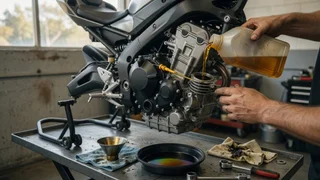
General steps for checking engine oil on a scooter like the Jupiter: 1) Park on level ground and put the scooter on its center stand so it sits upright. 2) If the engine has been running, wait a few minutes for the oil to drain back into the sump. 3) Remove the filler cap with its attached dipstick and wipe it clean. 4) Reinsert it as the manual instructs; on many scooters the dipstick is rested in the opening rather than screwed in for a reading, but follow your manual. 5) Remove it again and read where the oil reaches between the lower and upper marks. 6) If the level is near the lower mark, add a small amount of the correct oil, wait, and recheck. Stop before the upper mark is exceeded. 7) Refit the cap securely and check for leaks around the drain plug if you have just changed the oil.
Lubricant specification and manufacturer approval
Quantity is only half of the decision; the oil must also match the specification in the manual. Three things matter: the viscosity grade (the numbers such as 10W-30 describe how the oil flows when cold and at operating temperature), the API service category, and the JASO classification used for motorcycles and scooters. Many automatic scooters with a dry belt-drive clutch, like the Jupiter, are specified for JASO MB oil, because the engine oil does not lubricate a wet clutch. Your manual is the reference for the exact grade and category for your model and market. TVS also sells its own branded oils, but any oil meeting the listed viscosity and specifications is generally suitable unless the manual states otherwise. If you are concerned about warranty coverage, follow the manual's specification exactly and keep service receipts.
Engine oil versus transmission (gear) oil
A common source of confusion is that the Jupiter uses two separate lubricants. Engine oil lubricates the crankshaft, piston, valvetrain and other engine internals and is checked with the dipstick on the engine. The final drive gearbox at the rear wheel has its own small reservoir of gear oil, with its own filler and drain plugs, its own specification and a much smaller fill quantity. The two are not interchangeable, and gear oil is changed far less often than engine oil. When a workshop quotes an oil change, it is worth asking whether the price covers engine oil only or the gear oil as well.
Item | Engine oil | Transmission (final drive) gear oil; What it lubricates | Engine internals | Rear reduction gears; How it is checked | Dipstick on the filler cap | Filler or level plug on the gearbox, per manual; Typical specification type | Four-stroke motorcycle oil with viscosity, API and JASO ratings | Gear oil grade specified in the manual; Relative quantity | The larger of the two, still under one liter | Much smaller; Change frequency | At each scheduled oil service | Less frequent, per the maintenance schedule
Service interval
The recommended oil change interval for the Jupiter is set out in the maintenance schedule of the owner's manual and is usually expressed as both a distance and a time period, whichever comes first. The first service on a new scooter is often scheduled earlier than later ones. Riding in heavy stop-and-go traffic, very hot or dusty conditions, or with frequent short trips is generally considered severe use, and shortening the interval in those conditions is a reasonable precaution. Many owners also check the oil level between services, since small engines carry so little oil that even modest consumption makes a noticeable difference.
Practical next steps
• Identify your exact model, year and market from your documents. • Look up the oil change quantity and oil specification in the owner's manual or service booklet. • Buy an oil that matches the stated viscosity, API category and JASO class; a one-liter bottle typically covers a single change on a small scooter, with some left for topping up. • After filling, confirm the level on the dipstick rather than emptying the bottle. • Ask your service center for the figure if you do not have the manual, and check whether gear oil is due at the same visit.