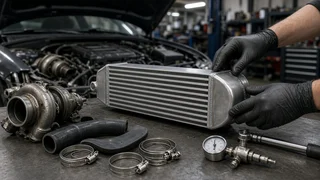
Turbo intercooler size calculator
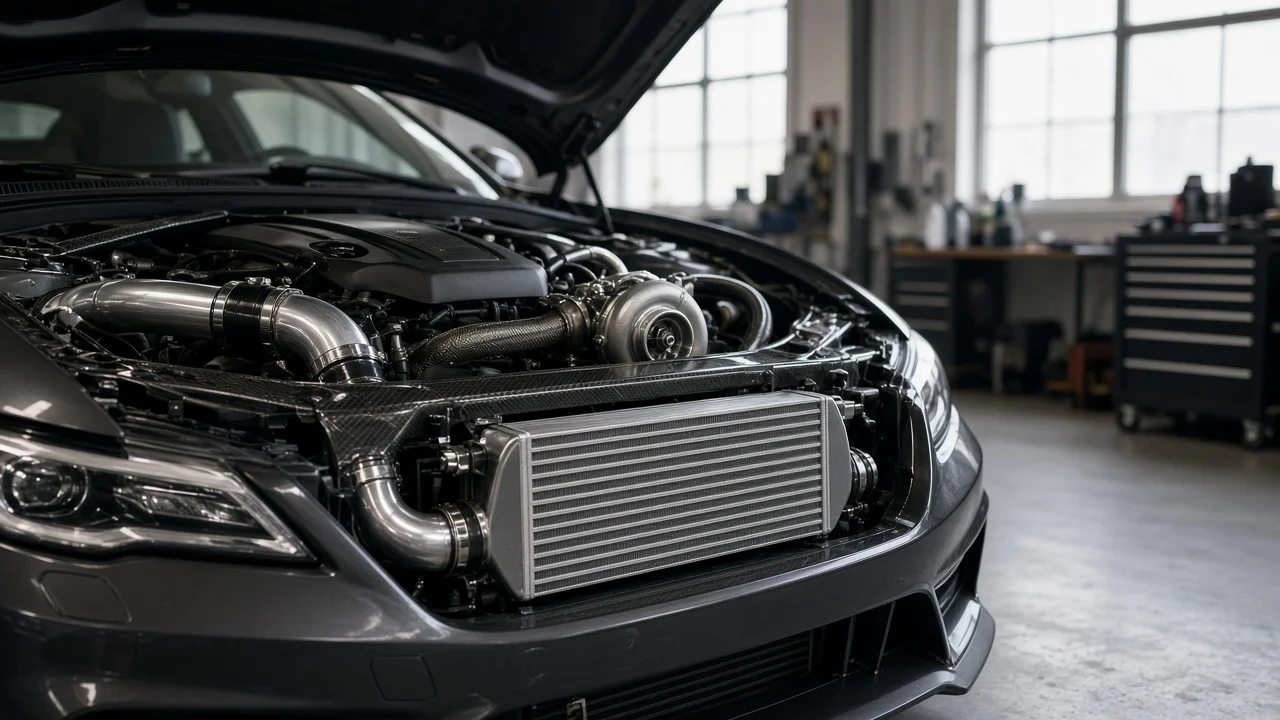
Choosing the right air-to-air or liquid-to-air heat exchanger for a turbocharged engine involves more than matching hose diameters. A turbo intercooler size calculator estimates the core volume and frontal area needed to support a target horsepower, boost pressure, and airflow range. Without enough surface area, charge-air temperature climbs, density falls, and the engine becomes prone to knock. The goal is to balance cooling capacity against packaging, weight, and pressure loss so the compressor outlet temperature is reduced without creating excessive restriction in the intake tract.
Essential answer
A turbo intercooler size calculator converts expected engine airflow, desired boost pressure, and estimated compressor efficiency into a minimum core dimension. The tool applies heat-transfer principles to predict how much internal fin area and ambient airflow are required to remove heat from the compressed charge. Typical inputs include target horsepower, displacement, boost level, and sometimes vehicle speed or ambient temperature. The output is a suggested core length, height, and thickness rather than a universal part number.
The calculation is a starting point, not a final engineering verdict. Real intercooler performance depends on end-tank design, internal fin density, ambient airflow through the core, and the temperature difference between charge air and outside air. A large core can lower charge-air temperature but may increase pressure loss and add lag. A small core may flow well but fail to control heat during sustained load. Because oil contamination from the compressor side can coat internal fins and reduce heat transfer, the calculated size should include some margin for real-world fouling.
For a street vehicle, the relevant measured value is heat rejection at the airflow the engine actually uses during sustained acceleration, not a peak dyno number. The calculator helps compare whether a proposed core is in the correct range for the compressor outlet temperature and mass flow. It also clarifies why increasing boost pressure raises the required cooling capacity faster than a simple linear change, since compressor efficiency typically drops as pressure ratio rises.
The direct answer is that the tool estimates a thermal target, and the correct core is the smallest one that holds charge-air temperature near ambient under the owner’s hardest repeatable use. Selecting a core smaller than the calculated range leads to heat soak and lost power on long pulls. Selecting a much larger core can interfere with radiator airflow, add weight ahead of the front axle, and increase the volume the turbo must pressurize before boost reaches the throttle body.