Where Is the Transmission Pressure Control Solenoid Located?
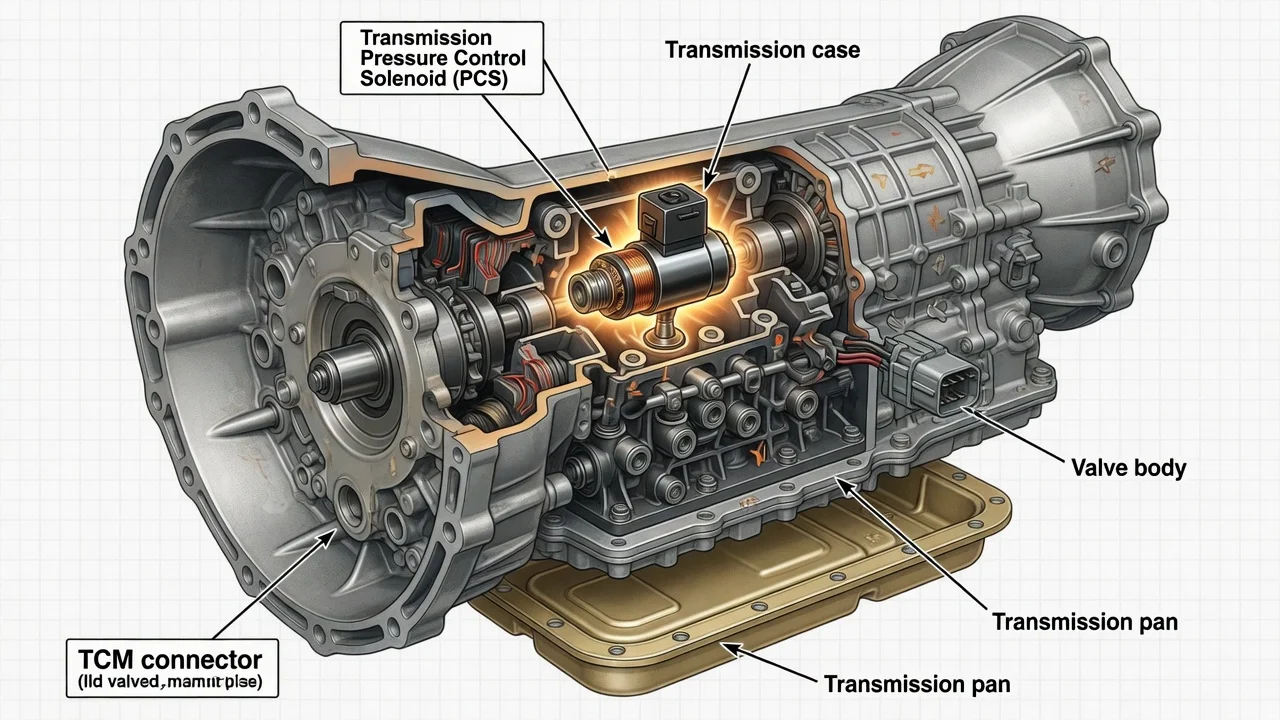
On most automatic transmissions, the pressure control solenoid is inside the transmission. It is mounted on the valve body, so you cannot see it from the engine bay. The exact position depends on the transmission type. Some units put it under the oil pan, some behind a side cover, and some build it into a solenoid pack or an electronic control module. Before you plan any inspection or repair, find out which transmission your vehicle has.
Where the Pressure Control Solenoid Usually Sits
Manufacturers use different names for this part, including line pressure solenoid, EPC solenoid and force motor. In a conventional hydraulic automatic, it is bolted to or seated in the valve body. On many rear-wheel-drive and longitudinal units, the valve body sits at the bottom of the case. To reach the solenoid, you drain the fluid and remove the transmission pan and filter. Older designs such as the GM 4L60-E use this layout. A bracket or retainer holds the solenoid to the valve body, and an internal wiring harness runs from it to a connector on the outside of the case.
That external harness connector is often the only part of the circuit you can reach without opening the transmission. It is not the solenoid itself. It is where the control module's signal enters the case, and it is a common place to find damage, corrosion or fluid seeping into the connector.
How Line Pressure Control Works
Line pressure is the hydraulic pressure the pump delivers to apply the clutches and bands. Too little pressure lets these friction parts slip. Too much makes engagements harsh and adds stress to components. The pressure control solenoid lets the control module adjust line pressure continuously. Older designs relied only on fixed springs and throttle-based linkages.
The module varies the electrical current to the solenoid, usually by changing its duty cycle. It bases this on inputs such as throttle position, engine load, vehicle speed, gear and fluid temperature. The solenoid then moves a regulator valve in the valve body, raising or lowering line pressure to suit conditions. Shift solenoids decide which gear is selected, while the pressure control solenoid largely decides how firmly the shift happens. Many systems default to high pressure if the signal is lost. This protects the clutches, but shifts stay firm until the problem is corrected.
What Changes the Location and Access
Transmission type matters most. On many front-wheel-drive transaxles, the valve body is mounted on the side or top of the case. The solenoid may sit behind a side cover, or you may first need to remove the battery tray, air box or a mount. Some transaxles, including certain older Honda automatics, mount pressure control or linear solenoids on the outside of the case. These can be unbolted without opening the unit.
Newer automatics with more gears often group several pressure control solenoids into one solenoid body. Some integrate them with the transmission control module in a single mechatronic assembly inside the pan. In that layout there may be no separate solenoid to unbolt. The whole assembly may need to be replaced and then programmed or adapted. Many modern transmissions also use several pressure control solenoids, often one per clutch. Diagnostic codes therefore refer to solenoid A, B, C and so on, and each manufacturer assigns these letters for each transmission.
Continuously variable and dual-clutch transmissions also use pressure control solenoids, but their hydraulic layout and access differ again. Even within one model, the engine, drivetrain and model year can change which transmission is installed. Confirm the fitment of any replacement part by VIN or by the transmission identification tag, not by vehicle model alone.
What You Can Check Before Opening Anything
Start by identifying the exact transmission. You can confirm the model and calibration from the VIN, a build label, a tag or stamping on the transmission case, or dealer records. A service manual or repair database for that unit will then show the solenoid location, connector pinout, fluid specification and any special procedures.
Next, read stored diagnostic codes with a scan tool. Codes P0745 to P0749 and P0960 to P0963 generally relate to pressure control solenoid A, and nearby codes cover other solenoids. Each manufacturer defines the exact meaning and the conditions that set each code. A circuit code points to the whole electrical path: the wiring, the case connector, the internal harness and the control module, as well as the solenoid itself.
Check fluid level and condition using the method specified for your transmission. Many sealed units have no dipstick and are checked at a set fluid temperature through a fill plug. Low, burnt or incorrect fluid can cause harsh engagement, delayed shifts or slipping that looks like a solenoid fault. Review the service history as well. A recent fluid change with the wrong specification, a previous valve body repair or a software update can all be relevant. Note when the symptoms appear, such as only when cold, only under heavy throttle, or after the transmission enters limp mode. These details help a technician narrow down the cause.
Repair Options if the Solenoid Is at Fault
If testing points to the solenoid, the repair depends on how it is packaged. A separate solenoid on the valve body is usually replaced after removing the pan, filter and retaining hardware. The transmission is then refilled with the correct fluid and the level checked by the specified procedure. If the solenoid is part of a solenoid pack or mechatronic unit, the usual repair is the whole assembly. The control module may then need programming, solenoid calibration data or a relearn before shifts feel normal.
A new solenoid does not fix contaminated fluid, worn clutches, a sticking regulator valve or a damaged harness. If you find debris in the pan or on the solenoid screen, the source of that debris also needs attention. Confirm the part number for your transmission and calibration. A solenoid that looks similar can have different electrical or hydraulic characteristics.
Limitations and When to Get Vehicle-Specific Help
This article describes common layouts, not the arrangement on any specific vehicle. Some transmissions have several pressure control solenoids with different roles. The name used in one manual may also differ from a parts catalog or scan tool. Firm shifts or a stored code do not by themselves prove that the solenoid has failed. Electrical testing, pressure testing or a comparison of scan data is normally needed to tell a solenoid fault apart from wiring, fluid, mechanical or control module problems.
Before removing the pan or a side cover, get the factory information for your exact transmission, including torque values, fluid type and fill procedure. A transmission specialist or dealer is usually the practical next step in several cases: the vehicle is under warranty, the solenoid is built into the control module, or the job requires pressure testing or programming tools.