Transfer Case Linkage: Identifying the Mechanical Shifting Connection
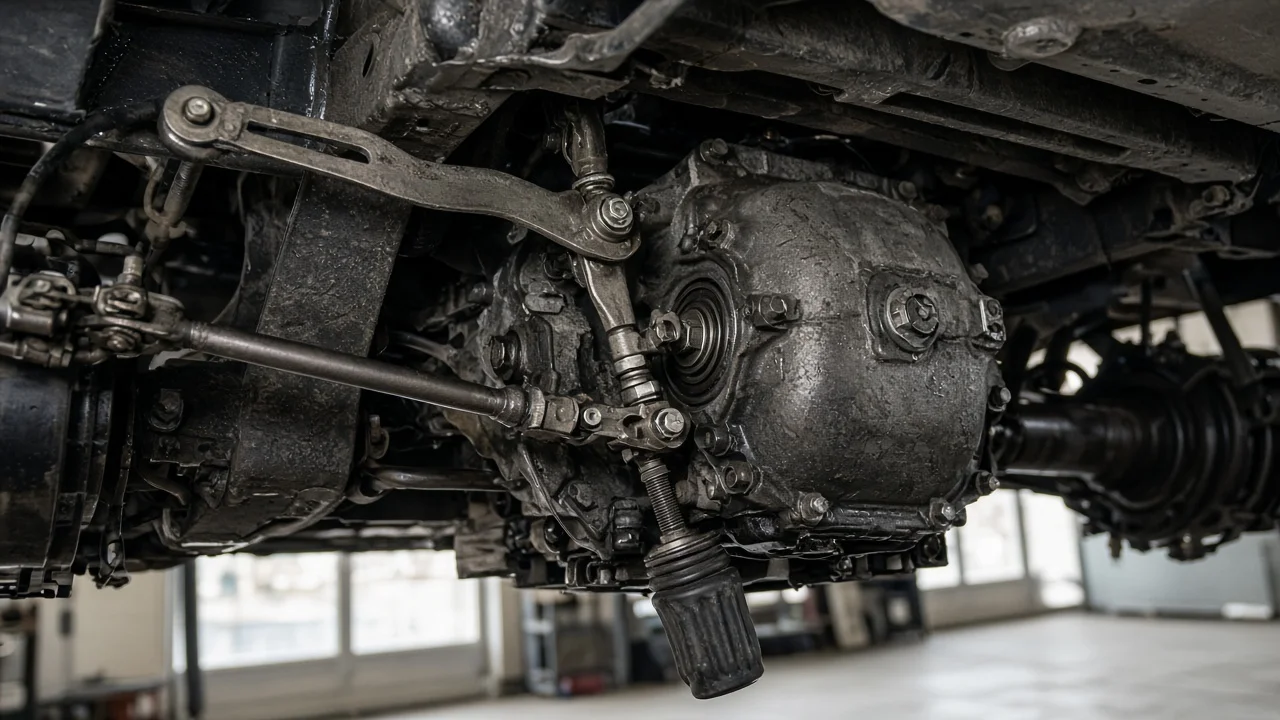
On a four-wheel-drive vehicle with a floor-mounted transfer case lever, the transfer case linkage is the set of rods, pivots and bushings that turns your hand movement into a shift inside the case. Knowing where it sits and what it looks like helps you separate a loose or misadjusted connection from problems inside the transfer case itself. It also tells you when a manual lever is not part of your vehicle configuration at all.
What the transfer case linkage is
The linkage is the mechanical path between the shift lever in the cabin and the shift arm on the outside of the transfer case. On most lever-shifted designs it runs from the base of the lever, through or beneath the floor, to a short arm attached to the selector shaft on the case. Moving the lever rotates that shaft, which moves internal shift forks and selects positions such as two-wheel drive, four-wheel high, neutral and four-wheel low, depending on the case.
Not every four-wheel-drive vehicle has one. Many use a dashboard switch or knob that commands an electric shift motor mounted on the case, and some full-time systems have no driver-selected range at all. If your vehicle has a switch rather than a lever, there is no mechanical linkage to inspect; the shifting connection is electrical and is diagnosed differently.
How the mechanical connection works
A typical linkage includes the lever and its pivot, one or more rods or a rod and bellcrank combination, adjustable rod ends or a clevis with a threaded adjuster, bushings at each pivot, and retaining clips, washers or cotter pins. Some designs mount the lever on the transmission or transfer case so it moves with the drivetrain. Others mount it to the body or floor and rely on the rod to bridge the movement between body and powertrain. A rubber boot seals the opening in the floor.
Inside the case, spring-loaded detents hold each position. The linkage only needs to move the selector shaft far enough to drop into each detent; the detent, not the lever, sets the exact internal position. That is why a correctly adjusted linkage makes the lever feel distinct in each position, while a misadjusted one can stop short of a detent or push past it, leaving a range only partly engaged.
What changes the answer for your vehicle
Layout varies by manufacturer, model year, transmission and transfer case. The order of positions on the shift pattern, whether neutral sits between high and low, whether you must be stopped or rolling slowly to shift, and whether the front axle engages through a separate vacuum or electric actuator all depend on the specific vehicle configuration. A vehicle that has had a transfer case swap or an aftermarket shifter installed may not match the original layout, so the service history matters as much as the model name.
Operating conditions also affect how the linkage behaves. Mud, road salt and gravel can stiffen pivots and corrode rod ends. Worn engine, transmission or body mounts can change the distance between the lever and the case, so a linkage that shifted cleanly before may bind or fall short after mounts sag or after drivetrain work. Some shift effort is not a linkage fault at all: driveline wind-up after driving in four-wheel drive on dry pavement, or mismatched tire sizes, can make the lever hard to move until the stored tension is released.
What the owner can do
Start with a visual inspection on level ground with the engine off, the parking brake set and the wheels chocked. If you need to get under the vehicle, support it on rated stands rather than a jack. Placing the transfer case in neutral disconnects the drivetrain from the transmission, so park does not hold the vehicle in that position; rely on the parking brake and chocks. Follow the lever downward to find where the rod meets the arm on the transfer case.
Look for missing or broken clips and cotter pins, cracked or missing bushings, a bent rod, a rod end rubbing on the exhaust or frame, and heavy corrosion at the pivots. With a helper moving the lever slowly through its range, watch whether the arm on the case follows the lever without visible lost motion and whether the lever reaches each position fully. Note symptoms precisely: a lever that feels loose, a position that will not engage, a range that pops out, grinding during a shift, or a four-wheel-drive indicator that does not match the lever.
Replacing worn bushings or a missing retainer is often a straightforward repair, but adjustment is vehicle-specific. Many procedures place the case and lever in a defined detent before setting rod length, and the reference position differs between designs. Use the procedure and any lubricant recommendations in the manufacturer specifications rather than a generic method, and record what you changed so the service history stays accurate. It is also worth checking whether your maintenance schedule calls for periodic inspection of the four-wheel-drive system under your operating conditions.
Limitations and when to get help
A visual check can confirm a disconnected, worn or bent linkage, but it cannot rule out internal problems. Worn shift forks, weak detent springs, a stretched chain, a leaking selector shaft seal or low or incorrect fluid can produce symptoms that resemble linkage trouble. Front axle engagement faults can also make the system seem not to shift even when the transfer case lever and linkage move correctly.
If the linkage looks intact and moves the case arm through its full travel but the problem persists, or if a range jumps out under load, stop using the affected range and have the vehicle checked by a technician with service information for your exact model. Jumping out of gear or running with partial engagement can damage internal parts. On vehicles with electronic indicators or position sensors, a diagnostic scan may also be needed to confirm what the system reports.