Trailer fire: safe roadside response
The short answer
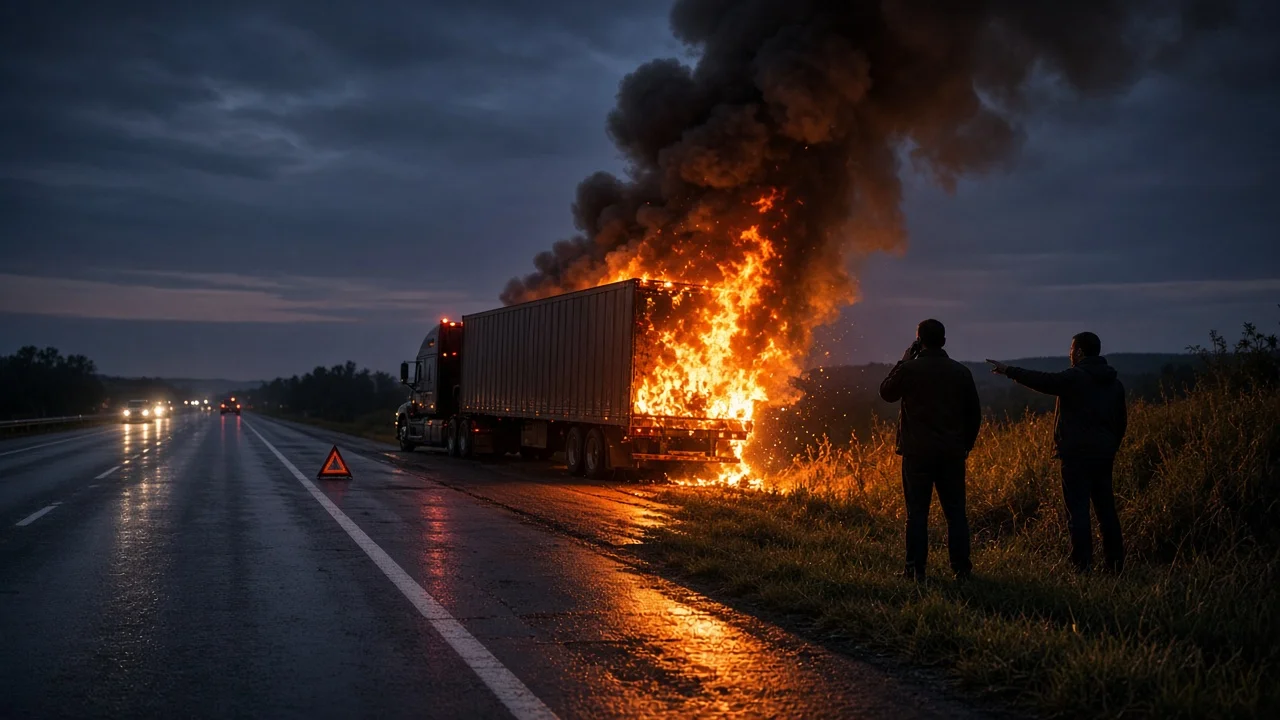
If a trailer catches fire, your job is to protect people, not the trailer or its load. Signal and get off the road as soon as you safely can. Stop away from traffic, buildings, fuel pumps and dry vegetation. Shut off the engine and get everyone out and well away. Call 911, then stay upwind and uphill until firefighters take over. Only try to put the fire out if it is very small, you have the right extinguisher, and you have a clear escape route. Do not open closed trailer doors to look inside.
This applies to commercial truck trailers, travel trailers and RVs, and utility or cargo trailers towed by passenger vehicles. Two factors can change the details: what the trailer is carrying, and whether it has fuel or propane systems on board. Both are covered below.
Warning signs to act on early
Many trailer fires start at the wheel ends, tires, brakes or wiring, not inside the cargo area. Acting on early signs gives you the most time to choose a safe place to stop.
Smoke coming from a wheel, tire or the underside of the trailer; A burning-rubber, hot-metal or electrical smell; A tire that has gone flat or is shredding, especially on a multi-axle trailer where one flat tire can go unnoticed; Brakes that feel like they are dragging, or a wheel hub that is unusually hot at a stop; Flickering trailer lights or other electrical faults alongside a burning smell; Other drivers signaling or pointing at your trailer
Step-by-step roadside response
Signal, turn on hazard lights, and move to the shoulder or an exit. Avoid stopping under overpasses, in tunnels, near structures, or beside tall dry grass. Stop, set the parking brake, and shut off the engine. Get all occupants out of the tow vehicle or cab and away from the trailer. Move them away from traffic, upwind, and uphill if possible. Call 911. Give your location (route, direction, nearest exit or mile marker), the type of trailer, and what it is carrying. If it is safe, take shipping papers or a cargo list with you so you can tell responders exactly what is on board. Warn approaching traffic with warning devices only if you can place them without entering the fire area or traffic lanes. Stay well back and keep others back. Wait for emergency services, and follow their instructions.
Should you try to put it out?
Only during the earliest stage, when the fire is small and contained, such as a smoldering tire or a small wiring fire. Use a portable extinguisher rated for the materials involved. Stand with your back to an escape route and aim at the base of the flames. Many fire-safety programs teach the PASS method: Pull the pin, Aim low, Squeeze the handle, Sweep side to side.
Back away and leave it to firefighters if any of the following is true:
Flames are spreading, or smoke is heavy or black; The fire is inside the trailer body; Hazardous materials, fuel or propane may be involved; The extinguisher empties and the fire is not fully out
Tire and brake fires often reignite after they appear to be out, because the metal and rubber stay hot. A fire that looks extinguished should still be treated as active until responders confirm otherwise.
Why you should not open trailer doors
A fire inside a closed van trailer may be short of oxygen. Opening the doors can let air rush in and cause a sudden flare-up aimed at the person standing there. Burning cargo can also shift and fall out. Leave the doors shut, and tell firefighters the fire may be inside the box.
Truck trailer fires: commercial considerations
In a commercial truck trailer fire, the cargo is the main unknown for responders. Your shipping papers are their best source of information. If the trailer shows hazardous materials placards, tell the 911 dispatcher right away and keep a much wider distance. In the US, emergency responders use the Emergency Response Guidebook to set isolation and evacuation zones for specific materials. Follow their direction rather than guessing a safe distance yourself.
US federal rules require commercial motor vehicles to carry a fire extinguisher. Drivers should check before each trip that it is charged, secured and reachable. Some carriers train drivers to uncouple the tractor from a burning trailer to save the power unit. This should only be done if your carrier's procedure allows it, the fire is clearly confined to the trailer, and you can do it quickly without getting close to flames or smoke. When in doubt, leave the whole rig and move away.
Travel trailers, RVs and utility trailers
Travel trailers and many RVs carry propane cylinders, batteries and sometimes fuel, all of which can make a fire more dangerous. If you can reach the propane cylinder valve without going near the fire, close it. If you can't, leave it alone and tell responders where the tanks are. Do not go back inside for belongings or pets once the fire has grown. For any towed trailer, unhitching it from your vehicle near a fire is generally not worth the risk. Move people away first.
After the fire
Do not drive the tow vehicle or trailer until it has been inspected. Heat can damage tires, brake components, wiring and the hitch or coupling even where there is no visible burn damage. Write down what you observed before and during the fire. Report the incident to your insurer and, for commercial vehicles, to your carrier according to its procedures.
What this guide does not cover
This guide is based on general fire-safety principles and does not include incident statistics, extinguisher size requirements, or set safe distances. Those depend on the vehicle, the cargo and local rules, and no confirmed figures were available to cite. Commercial drivers should follow their carrier's emergency procedures and current federal and state regulations. RV owners should check the manufacturer's guidance for propane and electrical systems on their specific model.