Titan Oil Stop Leak Reviews: How to Judge Whether It Fits Your Leak

The short answer
Reviews of Titan oil stop leak, like reviews of any oil stop leak additive, tend to be mixed. The reason is usually the leak, not the bottle. These additives are designed to recondition aging rubber seals so they seal better again. Owners with slow seepage from hardened seals often report an improvement. Owners with torn gaskets, cracked parts, loose fasteners or leaks that are not from the engine at all usually report that nothing changed. Before you rely on any review, identify what is leaking and why. That tells you far more about your likely result than a star rating does.
This guide does not quote ratings, prices or customer comments, and it does not list specific formula details for any Titan product. It explains how this type of product generally works, how to read reviews critically and what to check before adding a stop leak to your engine oil.
First, confirm which Titan product you mean
Several companies use the Titan name on automotive fluids. Some sell full engine oils under that name, and some may sell additives. Reviews posted under the same search term can therefore describe different products, so start with equipment identification. Read the label and confirm the following:
Whether the product is a concentrated additive poured into existing oil or a complete motor oil with seal conditioners already blended in. Whether it is intended for engine oil only, or for transmissions, power steering or other systems. Products for different systems are not interchangeable. Whether the label says it is compatible with conventional, synthetic blend and full synthetic oils. Any stated limits for diesel engines, turbocharged engines, motorcycles with wet clutches, or vehicles with particulate filters or catalytic converters. The treatment ratio, which is how much product to add per amount of oil.
If a review does not make clear which product the writer used, give it little weight.
How oil stop leak additives generally work
Most engine oil stop leak products rely on seal conditioners, sometimes called seal swell agents or plasticizers. Rubber seals harden and shrink with heat and age. When that happens, they stop pressing tightly against the shaft or surface they seal. A seal conditioner is absorbed into the rubber, softens it and helps it swell back toward its original shape. Some products also raise oil viscosity, meaning they thicken the oil, which can slow seepage through small gaps.
Two practical points follow from this. First, the effect is gradual. Seals need time at operating temperature to absorb the conditioner, so results typically come after a period of normal driving rather than right away. Second, the additive can only help rubber or similar elastomer seals that are intact but tired. It cannot rebuild missing material, close a crack in metal or tighten a loose bolt.
Which leaks a stop leak can and cannot help
Leak source | Can an oil stop leak help? | Why; Hardened or shrunken crankshaft or camshaft seal with slow seepage | Possibly | The rubber is intact but no longer sealing tightly; a conditioner may restore some flexibility. Aging valve cover or oil pan gasket made of rubber, seeping lightly | Possibly | Results depend on the gasket material and condition; cork, paper and liquid-applied sealant joints respond less predictably. Torn, pinched or displaced gasket | Unlikely | The material is damaged or out of position; swelling will not close the gap. Loose oil drain plug, missing drain plug washer or poorly seated oil filter | No | This is a mechanical issue fixed by correct tightening or replacement. Cracked oil pan, timing cover or other metal or plastic part | No | Seal conditioners do not repair rigid materials. Oil escaping because of high crankcase pressure | Not a real fix | A clogged PCV (positive crankcase ventilation) system or engine wear can push oil past healthy seals; the root cause remains. Fluid that is not engine oil | No | Coolant, transmission fluid, power steering fluid and brake fluid each need their own diagnosis.
Checks to make before buying any stop leak
Work through these steps in order. Many leaks are resolved, or ruled out for an additive, before a bottle is ever opened.
Confirm it is engine oil. Engine oil is usually amber to dark brown or black and feels slick. Coolant is often brightly colored with a sweet smell. Automatic transmission fluid is commonly red or pink. Brake fluid is thin and clear to yellowish, and a brake fluid leak is a safety problem that needs prompt repair. Do a level check. Park on level ground, let the engine sit as the owner's manual directs, and read the dipstick or the electronic oil level display. Note how quickly the level drops between checks. A small drip with a stable level is very different from a steady loss. Check the easy items. Look at the drain plug, the oil filter, the oil fill cap and the dipstick tube seal. These are common leak points after an oil change and are fixed mechanically. Find the actual source. Oil runs downward and is spread by airflow, so the wet spot underneath is rarely where the leak starts. Clean the area and recheck after driving, or use a UV dye made for engine oil and a UV light to trace it. Look at crankcase ventilation. A blocked PCV valve or hose can raise pressure inside the engine and force oil out at several seals at once. Decide what failed. If the source is an aged rubber seal with light seepage, an additive is a reasonable thing to try. If it is a torn gasket, a crack or a loose fastener, plan a repair instead.
How to read stop leak reviews usefully
A single review is only as useful as the details behind it. Reviews that help you predict your own result usually mention these points:
The vehicle, engine and approximate mileage. Where the leak was and how the owner identified it. How severe the leak was, such as occasional drops, a small spot overnight or a level drop between oil changes. How long they drove before judging the result. Whether they followed up after several weeks or another oil change.
Be cautious with reviews that say it did nothing after a day, since these products often need longer. Be equally cautious with reviews that report a large leak stopping completely, since that may point to a different cause such as a fastener tightened at the same time. Patterns across many detailed reviews from owners with similar engines and leak locations are more informative than the overall average.
Using an oil stop leak correctly
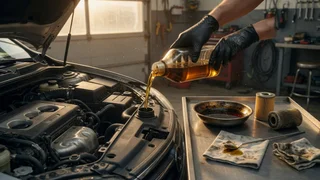
If your checks point to a seeping seal and you decide to try a product, follow its label exactly. The fill quantity depends on the treatment ratio and your engine's oil capacity, which varies by model year, engine and configuration and is listed in the owner's manual. Because the additive takes up space in the crankcase, recheck the oil level after adding it and avoid overfilling. Too much oil can cause foaming and its own leaks.
Keep using motor oil that meets your vehicle's lubricant specification, including the viscosity grade and any industry or manufacturer approval listed in the owner's manual. Many modern engines, especially some European, turbocharged and diesel engines, require oils carrying a specific manufacturer approval. An aftermarket additive is generally not part of that approval. If your vehicle is under warranty, or the manual advises against oil additives, check the warranty terms before adding anything.
Keep to your normal service interval. Continue regular level checks for the next several weeks to see whether the leak slows. When the oil is changed, find out whether the product is meant to be added again, since some seal conditioners are drained out along with the old oil.
When to skip the additive and repair the leak
Oil is dripping onto the exhaust, where it can smoke or present a fire risk. The oil level drops noticeably between checks, or the oil pressure warning light comes on. The leak source is a cracked part, a torn gasket or a damaged seal lip. Oil is reaching the clutch, a drive belt, the alternator or other electrical components. The engine burns oil, shows blue smoke or has known internal wear, since an external stop leak does not address those problems.
For a slow, confirmed seal seep on an older engine, an oil stop leak is a low-effort, low-cost option that some owners find works and others do not. For anything beyond that, a repair is the reliable fix, and the diagnosis above will help a technician quote it accurately.