Tesla Tire Puncture Repair: Options, Foam-Lined Tires and Cost Factors
A Tesla tire puncture warning can appear as a sudden pressure alert, a slow psi drop, or a visible screw in the tread. Because many Teslas carry no spare, the correct response protects both the tire and the wheel. Repair options depend on puncture location, tire construction such as acoustic foam, and vehicle equipment. Understanding these factors before contacting a shop helps owners avoid unnecessary replacement and manage repair costs.
First Steps After a Tesla Tire Puncture Warning
When the tire pressure monitoring system warns of low pressure, the driver should reduce speed gently and find a safe, level place to stop away from traffic. A punctured tire may still hold some air, but driving even a short distance on a badly underinflated or flat tire can crush the sidewall internally and ruin an otherwise repairable tire. Pulling to one side or a thumping sound can also indicate rapid air loss, so activate hazard lights and avoid hard braking or sharp steering until stopped.
Once parked, inspect the tire visually without removing the object. Check whether a nail or screw is embedded in the central tread, the outer shoulder, or the sidewall, and look for bulges, cuts, or exposed cords. Leaving the object in place can slow the leak and preserve the tire for a possible patch-plug repair. The owner's manual and the in-car roadside assistance menu explain what equipment is included, such as a tire sealant kit or portable tire inflator, and which service to contact first.
When a Punctured Tesla Tire Can Be Repaired and When It Must Be Replaced
A punctured Tesla tire is generally repairable only when the damage is in the central tread area, away from the shoulder and sidewall. The shoulder experiences high flex and heat, and the sidewall is structural; industry guidance treats punctures there as non-repairable. Even a small screw near the edge can compromise the tire's casing and lead to a sudden failure, so a shop will usually recommend replacement. The puncture diameter also matters, as holes beyond a certain size or at odd angles cannot be safely sealed.
A proper repair requires demounting the tire from the wheel so the inside can be inspected for hidden damage, such as inner liner cuts or rubber debris from driving while low. Shops that use a combination patch-plug insert a single piece with a rubber stem through the hole and a patch bonded to the inner liner, sealing the injury and preventing moisture from reaching the belts. A plug alone pushed in from the outside does not seal the inner liner and is not a permanent or safe repair. The shop may also refuse if previous repairs are too close together, if the tire shows internal sidewall wear from being run flat, or if remaining tread depth is too low, because a repair cannot restore lost structural integrity or tread life. Before agreeing to any work, ask the technician to show the inside of the tire and explain why repair is safe or why replacement is required.
Foam-Lined Tires: Why the Repair Process Is Different
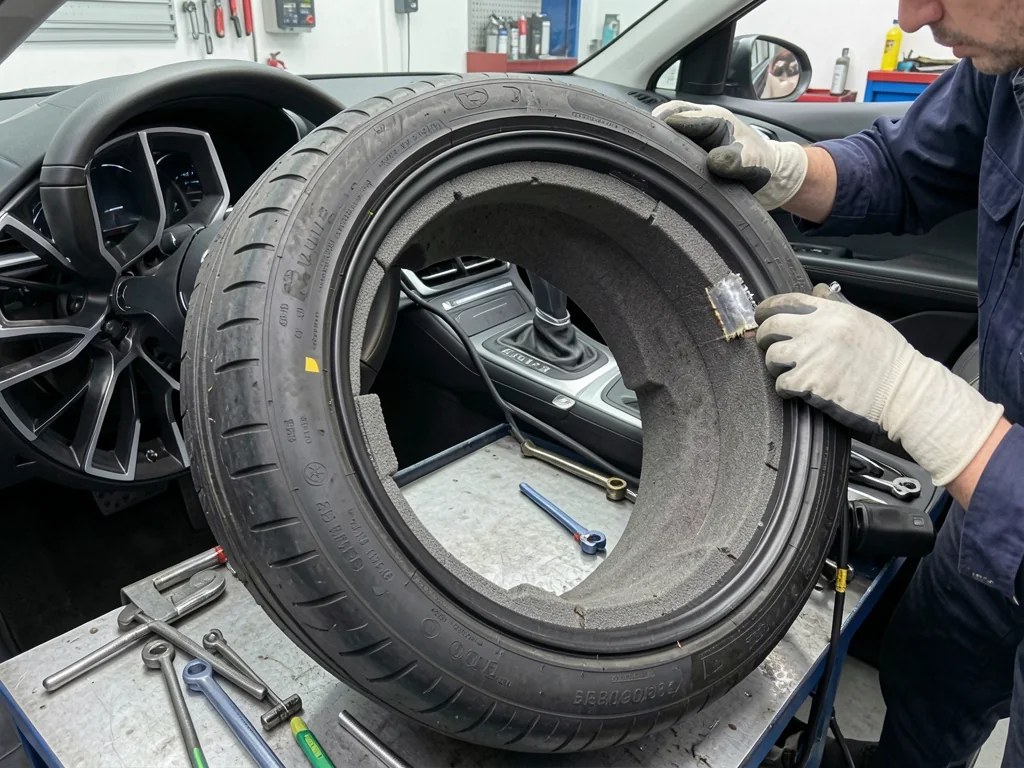
Some tires fitted to Teslas and other EVs include an acoustic foam liner glued to the inner surface to reduce cabin road noise. This foam changes the repair procedure. Owners can check the sidewall markings or the tire documentation for references to sound-absorbing foam or specific model names, though the marking style varies by manufacturer. Not every tire on a Tesla has the liner, so confirming before visiting a shop saves time and avoids a second visit.
During a proper patch-plug repair on a foam-lined tire, the technician must cut and peel back a small area of foam around the puncture to expose clean rubber for the patch to bond. The foam is then re-glued after the patch cures. Some shops do not have the training or materials for this step and may decline the job. Additionally, if a tire sealant kit has already been used, the liquid can soak into the foam and contaminate the repair area, making a lasting bond difficult or impossible. Owners should tell the shop if sealant was injected, and call ahead to confirm the shop repairs foam-lined tires, rather than assuming every location handles them the same way.
Getting Help Without a Spare Tire
Many Tesla configurations do not include a spare tire, instead providing a tire sealant kit and an air compressor under the load floor. Owners should confirm what their specific vehicle carries, because assuming a spare exists can leave them stranded. A portable tire inflator can top off a slow leak enough to reach a shop, but it does not repair the tire. The sealant can temporarily seal small tread punctures, yet it will not fix sidewall damage, large cuts, or a tire that has come off the wheel rim.
When the car cannot be driven safely, the main options are the manufacturer's roadside assistance, an independent mobile tire service, a nearby tire shop with towing, or a flatbed tow. The owner's manual specifies the correct lifting and transport method for the vehicle, which is especially important for EVs with specific jack points and towing eye locations. Some owners choose to carry a compatible spare tire or a more robust plug kit, but any added equipment must match the vehicle's bolt pattern, load rating, and brake clearance. Without exact fitment confirmation, buying a spare or wheel online can introduce a different safety risk.
What Affects Tesla Tire Puncture Repair Cost
Tesla tire puncture repair cost varies primarily by whether the tire can be repaired or must be replaced. A simple patch-plug repair requires less labor and material than a new tire, but if the tire has an acoustic foam liner, the extra step of cutting and re-gluing the foam adds labor time. Mobile tire service often costs more than a shop visit because the technician travels to the vehicle and works without a full bay, but it can save a tow charge. Low-profile tires with stiff sidewalls and large-diameter wheels common on EVs require careful mounting to avoid wheel damage, which can also increase the labor charge.
Additional charges may appear on the final bill. Tire pressure monitoring system service can include a new valve stem or sensor seal, and balancing is always needed after a tire is dismounted and reinstalled. If sealant was used, the shop may charge extra to clean the inside of the tire and the wheel, and a roadside call-out or mobile service fee may not be included in the repair price. Some shops recommend replacing tires in pairs or matching tread depth on the same axle to avoid handling differences, especially on all-wheel-drive vehicles. Ask for an itemized quote and check any tire warranty or road hazard coverage before approving the work, because some policies cover repair costs or a prorated replacement.
After the Repair: Checks and Warning Signs to Watch
After a repair, check the tire pressures when the tires are cold, before driving more than a mile or two. The correct pressure for a Tesla is on the door placard, not the number molded into the tire sidewall. Inflate or deflate as needed, then drive briefly and watch the tire pressure monitoring system. The warning should clear automatically once all four tires read near the recommended value; if the warning remains or returns after a short drive, the system may need a reset procedure from the owner's manual or a sensor may be damaged.
A repaired tire should not leak more than a fraction of a psi per week. If a slow leak returns, or if the driver notices vibration, uneven wear, or a bulge near the repaired area, the tire must be inspected again immediately. A bulge indicates internal separation that cannot be repaired and can fail without warning. Even a successful patch-plug repair does not extend the tire's tread life, and the tire should be included in regular rotation and inspection intervals. Keeping the tire properly inflated and rechecking the repair area at each service helps catch any late-developing problem before it becomes a road hazard.