Do All Cars Come With a Spare Tire?
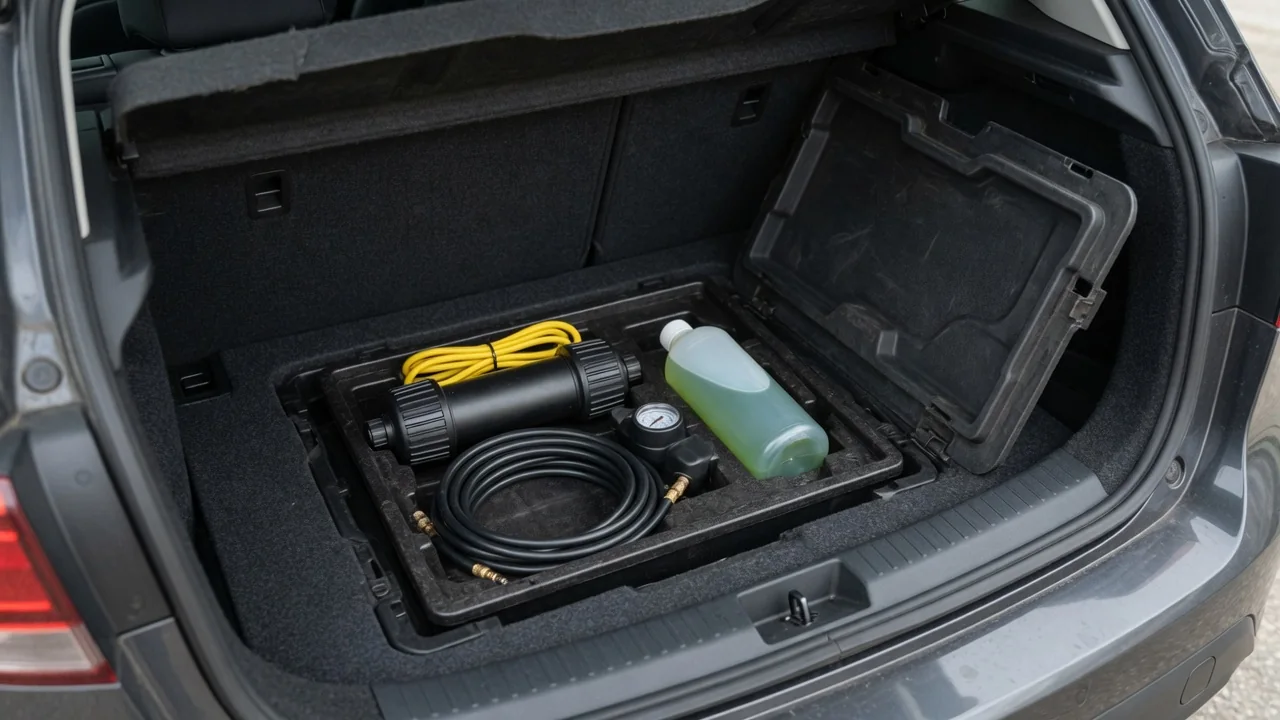
Not every car has a spare tire. Many new cars now ship without one, substituting an inflator kit, sealant, or run-flat tires. A flat is a poor time to discover that the well under the cargo floor is empty, especially if original equipment was later removed. Knowing which setup you have, and what it can and cannot do, is the difference between a managed stop and a long wait for roadside assistance.
Spare Tires Are Not Included With Every New Car
New cars do not all come with a spare tire. Flat-tire equipment can depend on model year, trim, options, and market, so two cars that look alike on the lot can be equipped differently. A factory arrangement may be a spare, an inflator and sealant kit, or run-flat tires. None of those setups is universal, so you cannot assume all cars have a spare tire, or that every car comes with one, just because the model is common.
On a used car, the equipment originally supplied may be missing or changed. A spare can be sold, left at a shop after a puncture, or never put back after someone used the well for cargo. An inflator kit can lose its canister or hose, and run-flat tires can be replaced with conventional tires at the next set. What you find now is the equipment that will have to get you off the road, regardless of how that model was advertised when it was new.
Why a Manufacturer May Leave Out the Spare
Leaving a spare off the build list can reduce curb weight. A wheel, tire, jack, and related hardware add mass that the vehicle must carry every mile, even when the spare is never used. Lower mass can support fuel-efficiency and emissions targets that manufacturers must meet. Cargo packaging also plays a role. A compact crossover, a low-floor hatchback, or a performance model with a tightly packaged trunk may have little room for a full-size spare or even a temporary spare without shrinking usable cargo space.
Manufacturing cost can influence the equipment supplied as well. A spare, jack, and tools are extra parts to source, assemble, and warrant. An inflator kit is smaller and cheaper to include on some builds. Those factors can overlap, so a missing spare is rarely explained by a single cause. Without vehicle-specific documentation, it is not accurate to pin one automaker's choice on weight, packaging, or cost alone. Omission is a design and equipment decision, not a rule that every car follows.
How to Find Your Car’s Flat-Tire Equipment
Start with the owner's manual. It typically lists whether the vehicle was specified with a spare tire, an inflator and sealant kit, or run-flat tires, and it usually shows where that equipment is stored. Common locations include a compartment under the cargo floor, a side bin in the trunk, or a labeled well behind a rear seat. While the vehicle is safely parked, lift the cargo-floor cover and check those accessible storage areas rather than guessing from the body style.
Some spares hang in a carrier under the vehicle. You can confirm that arrangement from the manual, a trunk label, or a visible winch or access point without crawling underneath or releasing the carrier. Compare what you find with vehicle-specific records such as the original window sticker or a dealer build sheet, because an empty spare-tire well does not prove a spare was never included. A foam insert, a subwoofer, or a kit tray can occupy the same space after a change of equipment.
What an Inflator and Sealant Kit Can Handle
A tire inflator kit with sealant is meant for a limited class of damage, not every flat. A compressor and sealant may temporarily address certain tread punctures when the injury stays within the kit's stated limits and the tire can still be seated and inflated. Sidewall damage, major cuts, a bent or cracked wheel, and a tire that has separated from its rim fall outside typical kit capabilities. Those failures need a different recovery path, such as a spare if one is fitted or roadside assistance.
Before you need the kit, confirm every component is present: compressor, power lead, hose, sealant canister, and any adapters the instructions require. Read the labels while they are still legible, and check the sealant expiration date, because aged compound may not seal as intended. If you use the kit on a permitted puncture, follow the kit and vehicle instructions for any allowed driving distance and speed, then have the tire inspected by a professional. Sealant is a temporary measure, not a repaired tire.
What Run-Flat Tires Allow After Pressure Loss
Run-flat tires are built with reinforced sidewalls so they can support limited travel after pressure loss, under the conditions the tire maker and vehicle documentation specify. That capability is not unlimited. Allowable distance and speed depend on the tire, the vehicle's guidance, load, and how the tire was damaged. There is no single mileage or speed that applies to every run-flat. Continuing to drive beyond those limits can destroy the tire and, in some cases, affect the wheel.
Confirm run-flats by reading the tire sidewall markings and the owner's manual, not by assuming the original equipment is still installed. A tire-pressure monitoring system warns of low pressure on vehicles that use ordinary tires as well, so TPMS alone does not mean the car has run-flats. After a pressure-loss event, have the tire assessed professionally. A tire can look intact from the outside while internal structure has been compromised. Appearance is not a reliable measure of whether that tire should remain in service.
Prepare Before a Flat Leaves You Stranded
If the vehicle has a fitted spare, check its inflation and condition using the pressures and inspection guidance in the owner's manual, and confirm that the jack, lug wrench, and any required adapters are present. A temporary spare is not a long-term replacement for a road tire. The sidewall label and the owner's manual show the speed, distance, and other limits that apply to that spare. A full-size spare is less restricted, but it still needs correct pressure and a secure mount so it is usable when a tire fails.
Adding a spare after purchase still requires vehicle-specific fitment checks. An empty storage well does not guarantee that a particular wheel and tire will clear the brakes, match the bolt pattern, or carry the load. Store any added spare so it cannot shift. Keep roadside assistance numbers accessible, and know whether the spare, kit, or run-flats you have actually cover the damage. When a tire fails, get to a safe stopping place first. If traffic, location, or the damage makes continued travel or a roadside change unsafe, request help rather than working beside moving traffic.