Tecumseh HM80 Engine Oil Capacity: How Much Oil It Takes and How to Fill It Correctly
The Tecumseh HM80 is an 8-horsepower, horizontal-shaft, single-cylinder engine found on snow throwers, tillers, generators, pressure washers, go-karts and other outdoor power equipment. Its crankcase is small, so it takes well under one US quart of oil. The exact fill quantity depends on the engine's specification number, which reflects how it was configured for a particular machine. The reliable way to fill an HM80 is to add oil gradually and stop at the full mark on the dipstick or fill plug, rather than pouring in a fixed amount.
The Short Answer
Parts listings and owner discussions commonly quote HM-series engines of this size at roughly 24 US fluid ounces, or about 0.7 liters. Treat that figure as a starting point, not a confirmed specification for your engine. Different HM80 versions use different oil fill arrangements, such as extended fill tubes on snow throwers or a plain fill plug on some other applications. Those differences change how much oil sits in the engine at the full mark and how much drains out at a change.
Expect a capacity of less than one US quart. Buy a quart bottle; you should have some left over. Add roughly three-quarters of the bottle first, then top up in small amounts while checking the level. The full mark on your engine's dipstick or fill plug takes priority over any published number.
Why the Capacity Varies Between HM80 Engines
Tecumseh built engines to order for many equipment makers, so "HM80" names a basic engine family, not one fixed configuration. The specification number identifies the exact build, including the crankshaft, fuel system, mounting and oil fill hardware. Two HM80 engines on different machines can take slightly different amounts of oil to reach the full level.
Several other factors affect how much oil actually goes in during a change:
Residual oil: some oil always stays in the crankcase after draining, so a refill usually takes less than the dry capacity. Equipment angle: a machine parked on a slope, or a snow thrower tipped back on its handles, gives a false reading. Fill arrangement: a dipstick tube, an extended snow-thrower fill tube, and a threaded fill plug each show the full point differently. Previous overfilling: if the engine was overfilled before, oil may drain out faster than expected and give a misleading impression of capacity.
How to Identify Your Exact Engine
Tecumseh engines carry a model number and a specification number, usually stamped into the metal shroud (blower housing) or printed on a tag or decal on the engine. On an HM80 the model number begins with HM80, and the specification number follows it, often separated by a dash. A serial number or date code is usually nearby. Write all of these down before ordering parts or looking up service data, because the specification number determines which parts and fill details apply.
Tecumseh stopped producing small engines in the late 2000s, so the original documentation can be hard to find. Parts suppliers and small-engine shops still cross-reference HM80 engines by model and specification number. Giving them both numbers is the most dependable way to confirm details for your engine.
Checking the Oil Level Correctly
A careful level check matters more than the published capacity. An HM80 has no oil filter and holds only a small amount of oil, so a few ounces too much or too little changes the level noticeably.
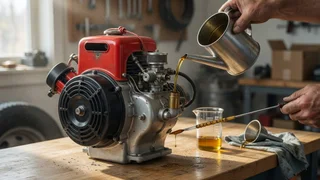
Park the equipment on level ground with the engine stopped and cool enough to handle safely. Clean around the fill cap or plug so dirt doesn't fall into the crankcase. On dipstick engines, remove the dipstick, wipe it, reinsert it fully (or as the cap design requires), then pull it out and read the level. On fill-plug engines without a dipstick, the crankcase is typically full when oil reaches the top of the fill opening. Add oil in small amounts, wait a moment for it to settle, and check again. Stop at the full mark. Do not fill above it.
Overfilling can cause smoking, oil in the air cleaner, foaming, and extra pressure on the crankshaft seals. Underfilling starves the bearings and cylinder of lubrication, and this splash-lubricated engine has no margin for that. If you overfill, drain the excess instead of running the engine to burn it off.
Lubricant Specification
Tecumseh's general guidance for its four-stroke engines was a quality detergent oil carrying a current API service classification, with viscosity chosen for the operating temperature. A detergent oil contains additives that keep contaminants suspended so they drain out at the oil change. The table below reflects that widely followed small-engine practice. If your equipment manual or the engine decal says something different, follow it.
Operating condition | Commonly used viscosity | Notes; Warm weather, above freezing | SAE 30 | Typical choice for tillers, generators and mowers used in summer; Cold weather, below freezing | SAE 5W-30 | Typical choice for snow-thrower HM80 engines; flows more easily at cold start; Wide or variable temperatures | SAE 10W-30 | Common compromise; may increase oil consumption in hot weather
Avoid non-detergent oil and two-stroke oil in this engine. Heavy multigrades not specified for the engine, such as 10W-40, were generally discouraged for Tecumseh air-cooled engines. Synthetic oil of the correct viscosity grade is generally acceptable in small air-cooled engines, but it does not lengthen the service interval for an engine with no filter.
Service Interval
Small air-cooled engines like the HM80 are usually given a short first oil change after break-in, often after the first few hours of running, to remove initial wear particles. After that, changes are commonly recommended every 25 hours of operation or at least once a season, whichever comes first. Dusty work such as tilling, or long sessions under heavy load, justifies changing the oil more often.
Snow throwers are a special case. Many owners change the oil before storing the machine for the off-season, so it doesn't sit for months in used oil that contains moisture and combustion by-products. They then check the level again before the first storm.
Changing the Oil
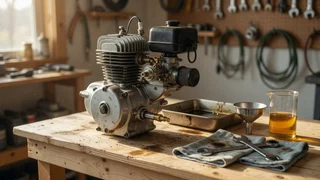
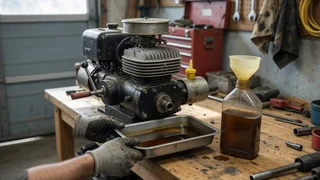
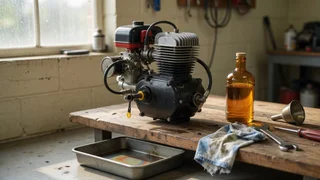
Run the engine briefly so the oil is warm and flows freely, then shut it off and let it cool enough to handle safely. Disconnect the spark plug wire to prevent accidental starting. Place a drain pan under the drain plug on the engine base. On some machines it is easier to drain through the fill opening by tilting the equipment, with the carburetor and air filter side kept up. Remove the drain plug, let the oil drain completely, then refit and tighten the plug. Refill gradually with the correct oil, checking the level as described above. Reconnect the spark plug wire, run the engine briefly, stop it, wait, and recheck the level. Take used oil to a collection point that accepts it.
Key Takeaways
The Tecumseh HM80 holds less than a quart of oil, with figures around 24 fluid ounces commonly quoted for engines of this size. The amount your engine needs depends on its specification number and fill arrangement. Use a detergent oil matched to the temperature you'll run in, fill gradually on level ground, and stop at the full mark. When in doubt, the engine's own dipstick or fill plug is the best guide.