Synthetic and full synthetic oil change intervals
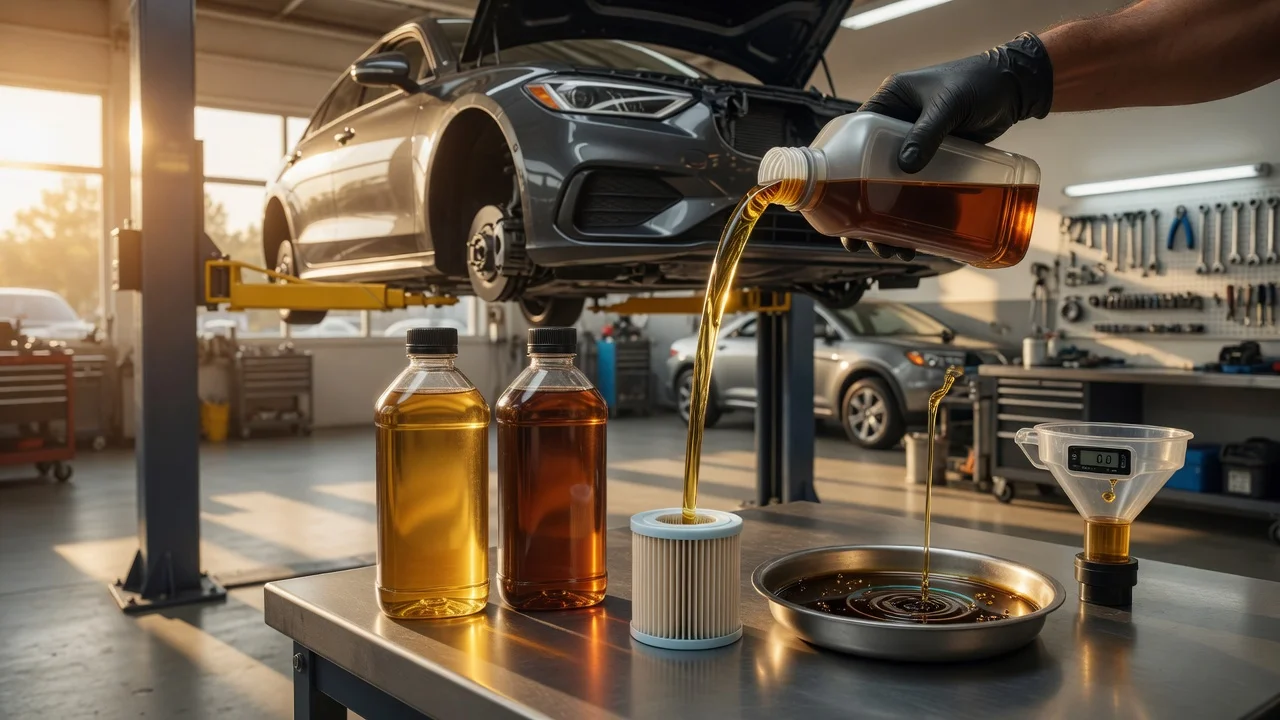
How often full synthetic oil should be changed
The change interval for full synthetic motor oil is the schedule the vehicle manufacturer specifies for that engine, oil specification, model year and service condition. The oil’s “full synthetic” label does not set a universal mileage or time limit. Follow the owner’s manual and, where fitted, the instrument-cluster oil-life monitor; those are the documented requirements for warranty and for the engine’s intended drain interval.
Full synthetic oil is formulated to hold viscosity, resist oxidation and stay cleaner longer than conventional mineral oil under heat and load. That chemistry is why many late-model gasoline and diesel engines are approved for longer drains when the correct specification oil is used. The longer interval still applies only if the oil meets the maker’s required standard (for example an API service category, ILSAC grade, ACEA sequence, or a branded OEM specification) and the vehicle is serviced on the schedule that matches how it is driven.
What “synthetic” and “full synthetic” mean for service
In retail motor-oil labeling, “synthetic” and “full synthetic” are marketing terms, not a single legal formula. Products sold as synthetic may be based on highly refined Group III mineral stocks, polyalphaolefin (PAO) Group IV stocks, esters, or blends of those. Two bottles that both say full synthetic can still differ in additive package, high-temperature deposit control and shear stability. For an oil change, match the viscosity grade (such as 0W-20 or 5W-30) and the performance specification printed in the manual. The specification is the requirement; the word synthetic on the front label is not a substitute for it.
If the manual calls for oil meeting a named OEM spec as well as a viscosity, that named spec governs. Using a full synthetic that lacks the required approval can leave the drain interval unsupported even if the bottle claims a long service life.
Where the interval actually comes from
Manufacturers publish at least one of the following: a mileage and time limit, separate “normal” and “severe” schedules, or an oil-life monitoring system that calculates remaining life from engine operating data. The monitor is the intended interval on vehicles that have one. It typically shortens the remaining percentage after repeated short trips, high load, high temperature or stop-and-go use, and it is not a simple odometer countdown.
Published mileages vary widely by brand, generation, powertrain and market. Some engines are specified around a few thousand miles on a severe-service chart; others are approved for much longer drains on a normal-service chart when full synthetic of the correct spec is used. Time limits still apply when annual mileage is low, because oil ages in the crankcase from fuel dilution, moisture and additive depletion even if the car sits. The exact miles, months and oil-life percentage for a given vehicle are in that vehicle’s manual or maintenance booklet. Those figures are model-year and engine specific; a number taken from another make, a shop’s default sticker or an oil bottle’s “up to” claim is not the specification for your engine.
Independent laboratory drain-interval studies exist for particular oils and duty cycles, but they do not override the OEM schedule unless the manufacturer itself cites them. Treat bottle claims of extremely long drains as marketing unless they match the vehicle’s listed spec and service program.
Conditions that shorten the drain
Use the severe or short-interval schedule, or expect the oil-life monitor to call for earlier service, when any of the following is routine: repeated trips of only a few miles before the engine is fully warm; extensive idling or low-speed traffic; towing, hauling or mountain driving; dusty, very hot or very cold climates; frequent cold starts; track or high-rpm use; or an engine that is turbocharged, supercharged or used as a work vehicle. Fuel dilution in short-trip gasoline engines and soot loading in diesels both degrade oil faster than highway miles at stable temperature.
Turbocharged engines, direct injection and start-stop systems place extra heat and contamination on the oil. Many of those powertrains are designed around full synthetic of a specified grade, and skipping or stretching past the monitor or manual interval raises the risk of varnish, sludge, timing-chain wear and turbo bearing damage. Low oil level also shortens effective life; check the dipstick or electronic level display between changes.
Filter, capacity and reset
Change the oil filter at every oil change unless the manufacturer states a different filter interval. A filter that is undersized, overdue or of unknown quality can bypass and send unfiltered oil through the engine even if the lubricant itself is still within spec. Fill to the specified capacity for that engine and filter combination, confirm the level after the engine has run and been shut down as the manual describes, and reset the oil-life monitor so the next interval is calculated from a known full change.
What to do next
Look up the engine, model year and market in the owner’s manual for required viscosity, OEM or industry specification, mileage/time limit and normal versus severe service. If the vehicle has an oil-life monitor, service when it indicates and reset it after the change; do not ignore a remaining-life warning because the oil is full synthetic. On a severe-use pattern, use the shorter published schedule even if the oil is full synthetic. Match the oil to the listed specification first; treat “full synthetic” as a quality class, not a license to extend past the documented interval. Replace the filter with the oil, set the correct level, and keep the service record for warranty and resale.
A precise mileage that applies to every full-synthetic oil change is not documented as a single industry figure. The supported answer is the manufacturer’s interval for that vehicle, oil spec and duty cycle, with full synthetic enabling the longer published schedule where the maker has approved it. If the manual is missing, the dealer or a parts catalog keyed to the VIN can identify the required oil specification; used-oil analysis can inform a conservative personal interval but does not replace the OEM requirement while the vehicle is under warranty.