Saturn Vue 2008 steering angle sensor location
Locating the steering angle sensor on a 2008 Saturn Vue usually means tracking the signal that tells the stability control system where the driver is pointing the front wheels. Owners often search for this component after a stability warning appears or after steering work changes the relationship between the wheel and the column. The sensor measures rotation and direction, but its exact mounting point depends on the Vue’s steering configuration. Understanding how that position affects diagnosis helps avoid replacing the wrong part or missing a simpler wiring or calibration issue.
Essential answer
On most 2008 Saturn Vue models, the steering angle sensor is integrated into the steering column area rather than being an easily visible external switch near the road wheels. This placement lets the sensor read the driver’s input close to the steering wheel before that motion passes through the column, intermediate shaft, and rack. It may be part of a clock spring assembly behind the wheel or a separate module mounted on the column jacket, depending on the vehicle’s build configuration and options.
The location matters because the sensor does not simply report a fixed position. It converts the steering wheel’s rotation into a signal used by electronic stability control and related chassis systems. When the wheel returns to center, the module must recognize that neutral reference. If the sensor is removed, the column is serviced, or the battery is disconnected, the system may require a relearn procedure before the signal accurately matches the actual road wheel angle and the warning light clears.
Identification and location
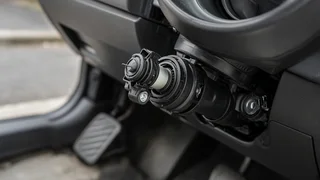
To find the sensor, begin by looking at the upper steering column behind the trim panels below the instrument cluster. The component may be a flat, circular module surrounding the column shaft with a small electrical connector. On some configurations it is combined with the clockspring, which also carries the airbag and horn circuits. Distinguishing the sensor from the clockspring requires checking the connector paths and the module’s function, because the two parts can appear similar when the steering wheel is removed.
Working near the column means the sensor’s position is influenced by tilt-column adjustments and the plastic covers that hide the wiring. The sensor is not located at the tie rods, rack boots, or wheel hubs, where a different type of rotation or suspension movement occurs. If a scan tool or service information shows a steering angle signal that stays frozen while the wheel turns, the module near the column is the likely place to inspect wiring, mounting, and calibration rather than the lower steering linkage.