Saab Turbocharger Problems: Symptoms, Diagnosis, and Replacement
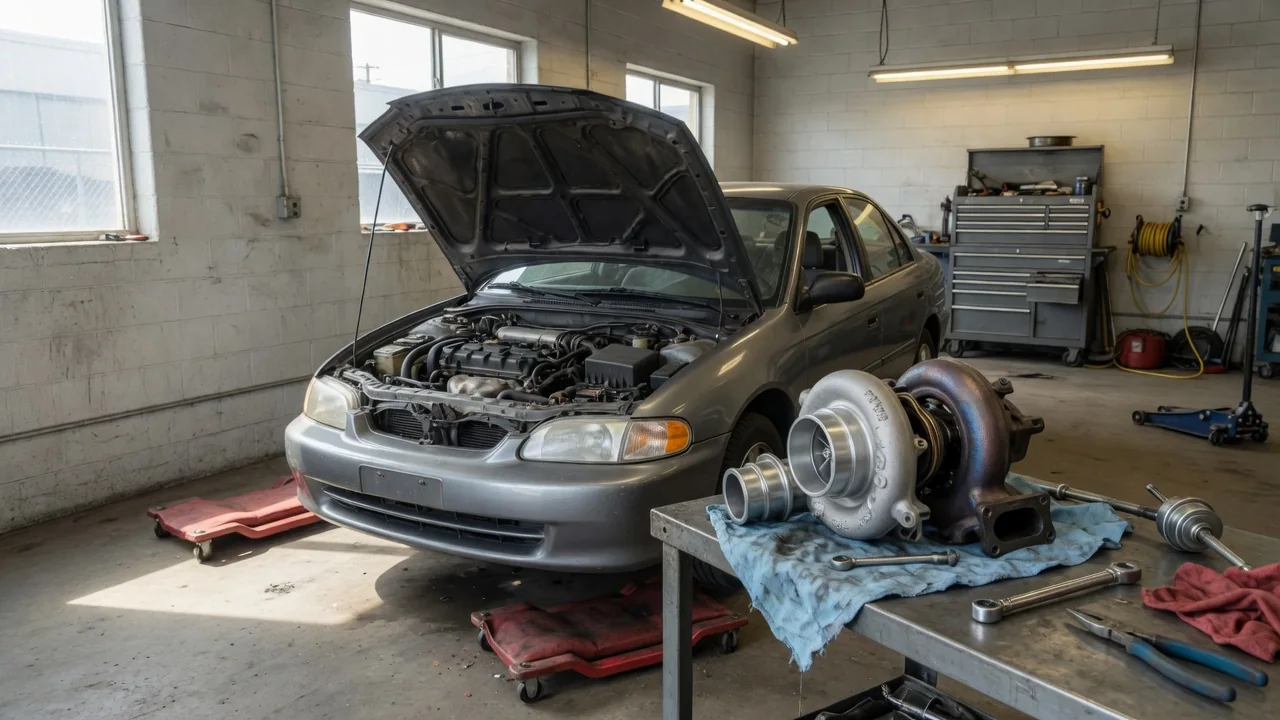
A Saab turbocharger complaint on a 9-3, 9-5, 9-5 Aero, or 900 is often a cluster of drivability changes rather than a single confirmed part failure. Reduced power, exhaust smoke, oil use, and unusual whistling can point toward boost pressure, oil supply, or charge-air issues, but they also overlap with engine and hose faults. Identification of the exact engine and installed unit comes before diagnosis or turbocharger replacement.
Saab Turbocharger Symptoms and Their Diagnostic Limits
Reduced power, a high-pitched whistle, visible exhaust smoke, and rising oil consumption can reasonably prompt a Saab turbocharger inspection, yet none of those signs prove the turbocharger itself has failed. Bearing wear can allow shaft play that disturbs boost pressure and oil control. Internal oil leakage may let lubricant enter the intake or exhaust path. Wastegate and boost control faults can leave the engine short of expected boost or overshoot it. Each of those modes is possible on older Saab models, but frequency cannot be assumed from symptoms alone.
Charge-air hoses, the intercooler, and crankcase ventilation can leak, restrict, or contaminate the intake path and mimic turbocharger trouble. Engine faults that affect combustion, oil control, or exhaust flow can produce the same smoke, lag, and oil-use pattern. Heavy smoke, rapid oil loss, an oil-pressure warning, or a sudden mechanical noise is a reason to stop safely, shut the engine off, and arrange professional assessment. Continuing to drive in that condition can turn a boost complaint into broader engine damage.
Identify the Saab 9-3 Engine Before Diagnosing or Ordering
A Saab 9-3 turbocharger cannot be identified from the model badge. Model year, engine designation, fuel type, and VIN determine which turbocharger was originally fitted and which replacement unit can be ordered. Different 9-3 engines can use different housings, flanges, and boost-control hardware, and mid-cycle changes can alter those details. A 9-3 badge only confirms the body style. Fitment and the cause of a boost complaint still require the engine identity and confirmation of the original equipment specification.
Owners should note when power loss occurs, whether it is sudden or progressive, and whether warning lights, exhaust smoke, or unusual sounds accompany it. That timeline helps a technician separate a charge-air leak from a boost-control problem or an oil-related turbocharger fault. Any previous modifications, chip changes, or earlier turbocharger work must be disclosed before a replacement is recommended. Ordering against the original equipment specification without checking what is actually installed can produce a unit that will not match the manifolds, oil feed, or wastegate arrangement on that 9-3.
Saab 9-5 and Aero Turbocharger Identification
A Saab 9-5 turbocharger discussion should start with the exact model year and engine specification, not with the trim name. The 9-5 range covered multiple engines and boost packages across its production life, so year and engine code are required before anyone can discuss the unit that belongs on that car. A Saab 9-5 Aero turbocharger request is equally incomplete if only the Aero badge is supplied. Aero identified a performance-oriented 9-5 variant, not a single turbocharger part number that can be ordered by badge alone.
A specialist can confirm the installed Saab 9-5 or 9-5 Aero turbocharger from vehicle records, accessible identification markings on the housing, and applicable parts information for that VIN and engine. Those sources together are more reliable than a sales brochure or a previous owner's description. Tuning history and any earlier engine or turbocharger replacements must be disclosed during diagnosis and parts selection. An aftermarket housing, a different wastegate, or a prior non-original unit can change oil-feed fittings, boost-control hardware, and the correct replacement choice even when the car still wears Aero badging.
Saab 900 Turbocharger Checks for an Older Vehicle
A Saab 900 turbocharger complaint needs the generation, model year, and engine identity before anyone gives component-specific guidance. Different 900 generations and engines can use different turbocharger housings, oil return routing, or boost-control hardware. On an older 900, aging charge-air hoses, oil-return seals, and vacuum or electrical control connections can leak, collapse, or stick and produce a boost complaint that is not a failed turbocharger. Those deteriorated connections should be part of the inspection picture rather than assumed to be sound because the engine still runs.
Owners should gather service history, oil-use notes, and any record of prior modifications or turbocharger work. Repeated oil top-offs, neglected oil-change intervals, or a history of overheating can matter because oil supply and oil return condition strongly affect turbocharger life. If records are missing or the installed turbocharger looks unfamiliar, a professional should identify the unit from markings and vehicle data before parts are ordered. Guessing a 900 turbocharger from appearance alone risks a mismatch at the exhaust flange, oil feed, or wastegate.
Safe Owner Observations and Professional Testing
With the engine off and cool, an owner can check the oil level according to the owner's manual and look for obvious damage on charge-air hoses or fluid traces around the turbocharger, intercooler, and oil-return area. Those observations are visual only. Do not probe rotating parts, loosen fittings, or inspect anything with the engine running. Record when smoke appears, what warning messages show, and the driving conditions at the time. Do not deliberately recreate the fault under heavy load, because that can worsen oil loss or mechanical damage.
Oil traces, smoke color, or a stored fault code cannot independently establish Saab turbocharger failure. A code is evidence to interpret in context, not proof that a part has failed, and manufacturer-dependent definitions require vehicle-specific confirmation before they are treated as meaningful. Professional testing can include boost-leak checks, comparison of commanded and actual boost, wastegate and boost-control evaluation, and inspection of oil supply, oil return, and crankcase ventilation. Owners should not disassemble the turbocharger or perform running-engine inspections of the rotating assembly.
What Saab Turbocharger Replacement Should Include
Turbocharger replacement on a Saab should not begin until the underlying cause is identified and corrected. Restricted oil supply, a blocked oil return, contaminated lubricant, a failed crankcase ventilation path, or a charge-air leak can destroy a new unit if they remain in place. A professional removal includes inspection of associated oil lines, intake components, and the intercooler path, plus a contamination assessment of the lubrication and intake systems. Installation should follow vehicle-specific procedures for sealing, oil priming, and torque, without owner disassembly of hot or pressurized components.
An estimate should identify the confirmed replacement unit, labor, required seals and fluids, associated repairs such as hoses or oil lines, and warranty terms. Part sourcing, access around the exhaust manifold, damaged connections, and additional faults found during removal can widen the scope and extend the timeline; those variables should be explained without treating any figure as a standard price. After installation, the repair is not complete until leak checks, proper boost operation, warning-light status, and any continuing oil consumption or exhaust smoke have been reassessed under normal driving.