Renault Clio: What the Car Is, How Its Generations Differ, and What It Means for US Readers
The Short Answer: What Is the Renault Clio?
The Renault Clio is a small front-wheel-drive car from the French manufacturer Renault, sold mainly as a hatchback. In Europe this size is called a supermini, roughly the class of subcompacts such as the Honda Fit or Toyota Yaris hatchback. Since its 1990 launch the Clio has been one of Renault's core models and one of the best-known small cars in Europe.
The main qualification for US readers is that Renault has never officially sold the Clio in the United States. You cannot buy one new from a US dealer, and parts, service and federal compliance are not set up for it here. Most of what follows describes the car as sold in Europe and other markets where Renault operates.
Where the Clio Fits in Renault's Range
The Clio replaced the Renault 5 and sits near the bottom of Renault's range. It sits above city cars and below compact hatchbacks and crossovers. Its job is to be an affordable, easy-to-park everyday car that can still handle highway trips. It has twice been named European Car of the Year, for the first generation and again for the third. That shows how central it has been to Renault's reputation.
How the Generations Differ
Each new Clio generation has grown in size, refinement and safety equipment. The broad character of each one is outlined below. Exact engines, trims and dates varied by country, so treat these as general descriptions rather than specifications.
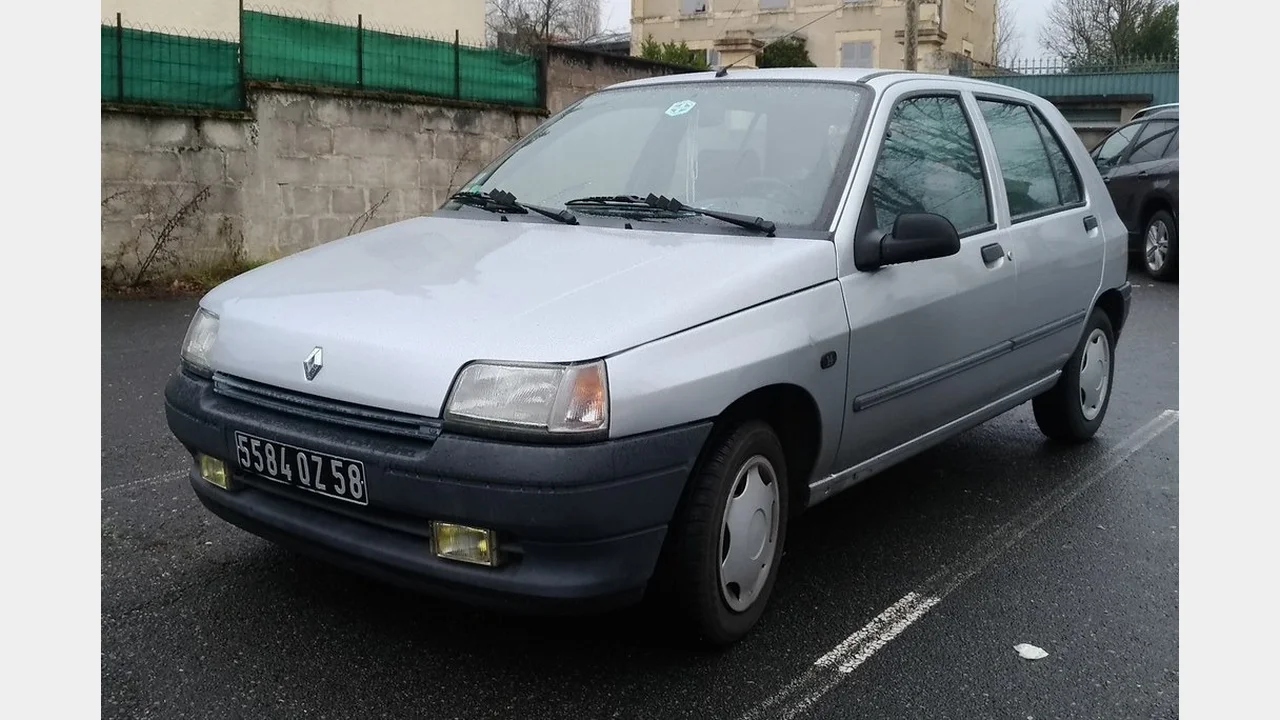
Clio I (from 1990): The original model succeeded the Renault 5 with a more modern, rounded design and won European Car of the Year. It is remembered among enthusiasts for the Clio Williams, a performance version. Clio II (from 1998): A larger, curvier car that stayed in production for many years in some markets alongside its successor. This generation spawned the Clio V6, a mid-engined rear-wheel-drive special. It also produced sedan derivatives sold in certain markets, including the Nissan Platina in Mexico. Clio III (from 2005): Bigger and more refined, with a stronger focus on crash safety. It won Renault's second European Car of the Year title for the Clio and added a small estate version in some markets. Clio IV (from 2012): Brought a more expressive design and a five-door-focused lineup, with the rear door handles disguised near the window line. It also introduced smaller turbocharged petrol engines and an estate variant in some markets. Clio V (from 2019): Moved to the Renault-Nissan Alliance's CMF-B platform, which it shares with other small cars, and brought a substantially upgraded interior. It introduced the E-Tech full hybrid powertrain to the Clio range. Clio VI: Renault has revealed a sixth generation. Specifications and availability depend on market and should be checked against current Renault information for the relevant country.
Body Styles
The Clio is primarily a hatchback, offered over the years in three-door and five-door forms. Recent generations have concentrated on the five-door. Some generations added a small estate (station wagon). Sedan versions based on the Clio were built for certain markets, sometimes under different names. There has never been a mainstream Clio coupe. The closest things are three-door hatchbacks and special editions such as the Clio V6.
Powertrains in General Terms
Over its history the Clio has offered small gasoline engines, small diesel engines and, more recently, hybrid power. The mix depends heavily on generation and market. Diesels were once common in Europe but have become less prominent. Turbocharged three- and four-cylinder gasoline engines became the norm from the fourth generation onward.
The E-Tech hybrid introduced with the Clio V is a full hybrid. That means it can move short distances on electric power alone and charges its battery while driving and braking. It is not a plug-in hybrid. Some markets also offered versions running on LPG (liquefied petroleum gas) alongside gasoline.
Renault Sport, Renault's former performance division, built several high-performance Clio models over the years. These included versions badged RS in several generations. Their engines, gearboxes and chassis tuning differed considerably from regular Clios.
What Sets the Clio Apart From Rivals
In Europe the Clio competes with cars such as the Peugeot 208, Volkswagen Polo, Toyota Yaris and Ford Fiesta, the last of which has since been discontinued. Its reputation rests on a few recurring themes in how the car has been positioned and reviewed:
Styling: Recent generations have been known for distinctive, design-led looks within a conservative class. Ride and handling balance: Renault has long tuned the Clio to be comfortable on rough roads while still feeling agile. Breadth of range: Over its life the Clio has spanned basic economy versions, a full hybrid and dedicated performance models. Platform sharing: Recent Clios share engineering with other Renault-Nissan Alliance and Dacia models, which helps keep costs down.
Judgments about which rival is better depend on the specific generation, engine and trim being compared. Ownership costs, reliability and equipment also vary by market.
Can You Get a Clio in the United States?
Not new, and not easily. Renault does not have a US dealer network for passenger cars, and the Clio was never certified for US sale. Vehicles not originally built for the US market must generally meet federal safety and emissions rules before they can be imported and registered. Older vehicles get a major exception: under federal rules, a car at least 25 years old can generally be imported without meeting US safety standards. Emissions and state registration rules still apply separately and differ by state.
In practice, early Clios become eligible as they pass the age threshold, and some enthusiasts import collectible versions. Anyone considering this should check current federal and state requirements and confirm the eligibility of a specific vehicle. They should also plan for limited local parts and service support.
Bottom Line
The Renault Clio is Renault's long-running supermini: a practical, stylish small hatchback that has evolved through several generations. It has moved from simple gasoline and diesel versions to a full hybrid, with performance models along the way. For US readers it is mainly a car to understand rather than buy, because it is not sold here new. If you want a comparable car in the US, look at American-market subcompact hatchbacks and small crossovers. If you are interested in a Clio itself, older models imported under the age-based exemption are the realistic route.