Ram 5.7 Hemi Engine Problems: What Owners Report and How to Check Your Truck
The short answer
The 5.7-liter Hemi V8 in Ram pickups is widely regarded as a durable engine, but owners and repair shops have repeatedly reported a few specific problems. The most serious is wear or failure of the valve lifters and camshaft, often first noticed as a ticking noise and later as a misfire. Other frequently discussed issues are broken exhaust manifold bolts, misfires tied to ignition parts, concerns about the cylinder deactivation system, and oil consumption on some trucks. None of these affects every engine, and how likely each one is depends on model year, mileage, maintenance history and how the truck has been driven.
This guide does not draw on supplied test data, failure-rate statistics or official recall and service bulletin records. It describes problems that are commonly reported for this engine and explains how to investigate symptoms. For any specific truck, check the vehicle identification number (VIN) against open recalls and technical service bulletins through a Ram dealer before relying on general patterns.
Which trucks this applies to
The 5.7 Hemi has been offered in the Ram 1500 since the 2003 model year and has also been used in gasoline versions of the heavy-duty Ram 2500 and 3500. Over that time the engine received important changes, including variable valve timing and, on many versions, the Multi-Displacement System (MDS). MDS is Ram's name for cylinder deactivation, which shuts off four of the eight cylinders under light load to save fuel. Some later Ram 1500 trucks also pair the 5.7 with eTorque, a mild-hybrid system that adds a belt-driven motor-generator and a small battery pack.
Because of these changes, a problem reported for one generation does not necessarily apply to another. Engine availability has also changed in recent model years, so confirm which engine and which equipment a specific truck has. The VIN, window sticker or dealer build sheet will show this.
Commonly reported 5.7 Hemi problems
Problem | Typical symptoms | Severity; Lifter and camshaft wear | Ticking or tapping that gets louder over time, rough idle, misfire codes, metal in the oil | High; can lead to major engine repair if ignored; Broken exhaust manifold bolts | Ticking or puffing noise that is loudest on a cold start and fades as the engine warms | Moderate; an exhaust leak rather than internal damage; Ignition-related misfires | Rough running, flashing check engine light, cylinder-specific misfire codes | Varies; ranges from a simple plug or coil fix to a symptom of lifter failure; Cylinder deactivation (MDS) concerns | Rough transitions between four- and eight-cylinder mode, vibration, related fault codes | Varies; may involve solenoids, lifters or oil condition; Oil consumption | Oil level dropping between changes, low-oil warnings | Varies; needs measurement to confirm
Lifter and camshaft wear
The 5.7 Hemi uses roller lifters. These are small followers with a roller at the bottom that rides on the camshaft lobes. The most widely reported serious failure involves the lifter roller seizing or its internal needle bearings breaking down. A lifter that no longer rolls freely can scrape the cam lobe and flatten it, which reduces valve opening on that cylinder and spreads metal debris through the oil.
Commentators frequently point to long idle periods, extended oil change intervals and the extra lifter hardware used by cylinder deactivation as possible contributors. These are plausible explanations, but no supplied evidence establishes a confirmed root cause or failure rate. Repairs typically involve replacing lifters and the camshaft, and sometimes more if debris has spread. That makes early diagnosis important.
The "Hemi tick"
"Hemi tick" is an informal label owners use for several different noises, so it is not a diagnosis in itself. A tick can come from a normal sound such as the fuel injectors or valvetrain, from an exhaust leak at the manifold, or from a failing lifter. The checks below help tell these apart.
Exhaust manifold bolts
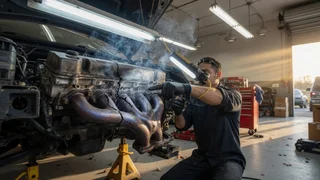
Repeated heating and cooling can cause exhaust manifold bolts to break, especially at the rear of the cylinder heads. Exhaust then escapes at the joint and makes a ticking sound. The noise is usually loudest on a cold start and quieter once the manifold expands and partly seals. This failure is generally less serious than lifter wear, but it is often confused with it. Extracting broken bolts can be labor-intensive.
Misfires and ignition parts
The Hemi uses two spark plugs per cylinder, so ignition service involves more parts than on many V8s. Worn plugs, failing coils and damaged wiring can all cause misfires. A misfire that keeps returning on the same cylinder after ignition parts have been checked is a reason to look at mechanical causes, including the lifters and camshaft.
Cylinder deactivation (MDS)
MDS relies on oil-pressure-controlled solenoids and special lifters on the cylinders it deactivates. Oil that is low, degraded or the wrong viscosity can affect how well the system works. Owners report rough or noticeable transitions, and some link MDS to lifter problems. The available information does not establish how much MDS actually contributes to lifter failure, so treat claims either way with caution.
Oil consumption
Some owners report the oil level dropping between changes. Before treating this as an engine fault, record the oil level and mileage over a set distance and check for external leaks. Measured consumption is more useful to a technician, or for a warranty claim, than an impression.
Diagnosing a symptom: what to check next
Fault codes and noises are clues, not proof that a particular part has failed. The steps below narrow down the likely cause on a 5.7 Hemi. A qualified technician should confirm the diagnosis before major parts are replaced.
If you hear ticking
Note when the noise occurs. A tick that is loudest on a cold start and fades within minutes points toward an exhaust manifold leak. A tick that stays the same or grows louder as the engine warms points more toward the valvetrain. Try to locate the noise. Exhaust leaks are usually heard low at the rear of the cylinder heads, near the manifold joints. Lifter noise tends to come from the top or center of the engine. A mechanic's stethoscope helps isolate the source. Look for soot or black streaks around the manifold joints, and for bolt heads that are missing or loose. Either supports an exhaust leak. Check the oil level and condition. Low or sludgy oil can cause or worsen valvetrain noise. Note whether the noise changes with MDS operation, such as when cruising lightly compared with accelerating.
If the check engine light is on or the engine misfires
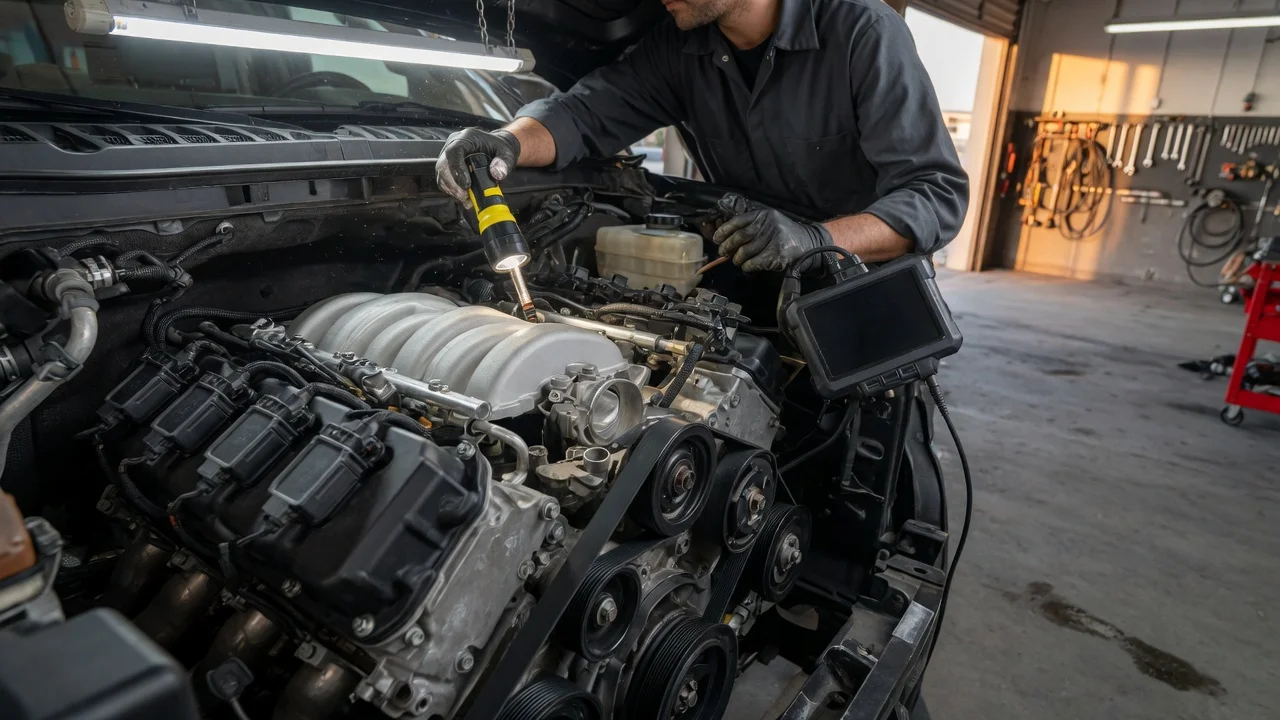
Read the stored codes with an OBD-II scanner. Generic codes P0301 through P0308 identify a misfire on a specific cylinder, and P0300 indicates random or multiple-cylinder misfires. If the misfire stays on one cylinder, inspect that cylinder's spark plugs, coils and wiring. Swapping a coil to another cylinder and seeing whether the misfire follows it is a common way to test the coil. If ignition parts check out and the misfire persists, mechanical causes become more likely. A compression test, a check of valve lift, or an inspection with a borescope (a small camera inserted into the engine) can reveal a worn cam lobe or a failed lifter. A flashing check engine light indicates a severe misfire that can overheat and damage the catalytic converter. Reduce load and arrange diagnosis promptly.
If you suspect internal wear
Check the oil filter and drained oil for metallic particles or glitter. Their presence suggests internal wear and warrants prompt professional inspection. An oil analysis from a laboratory can show elevated wear metals, although it cannot pinpoint which part is wearing. Ask a technician to check whether any recalls, technical service bulletins or extended warranty coverage apply to the truck's VIN before you pay for repairs.
When to stop driving and get professional help
The oil pressure warning comes on or the gauge reads abnormally low. The check engine light is flashing. A ticking noise turns into heavy knocking or clattering. The engine loses power noticeably or runs very roughly. Metal debris is found in the oil or filter. The engine overheats.
In any of these situations, continuing to drive risks turning a repairable fault into a much more expensive one. Have the truck towed or driven only the minimum distance needed to reach a repair facility.
Ownership and buying considerations
In editorial terms, the steps most within an owner's control are using the oil grade and change interval listed in the owner's manual for the specific model year, avoiding unnecessarily long idling, and investigating new noises early. These are general good practice. No supplied evidence shows they prevent lifter failure.
If you are buying a used Ram with the 5.7 Hemi, ask for maintenance records, listen to a cold start before the engine has been warmed up, scan for stored codes, and consider a pre-purchase inspection by a technician familiar with these engines. A cold-start tick is not automatically a deal-breaker, but its cause should be identified before purchase.
What this guide cannot tell you
No failure-rate data, repair cost figures, recall numbers or service bulletin details were available for this article. As a result, it does not rank model years by reliability, estimate how common each problem is, or quote repair prices. For those answers, check the VIN-specific recall and bulletin history through a Ram dealer and get written repair estimates from qualified shops.