P1001 Code: Verify Its Meaning and an Incomplete KOER Self-Test
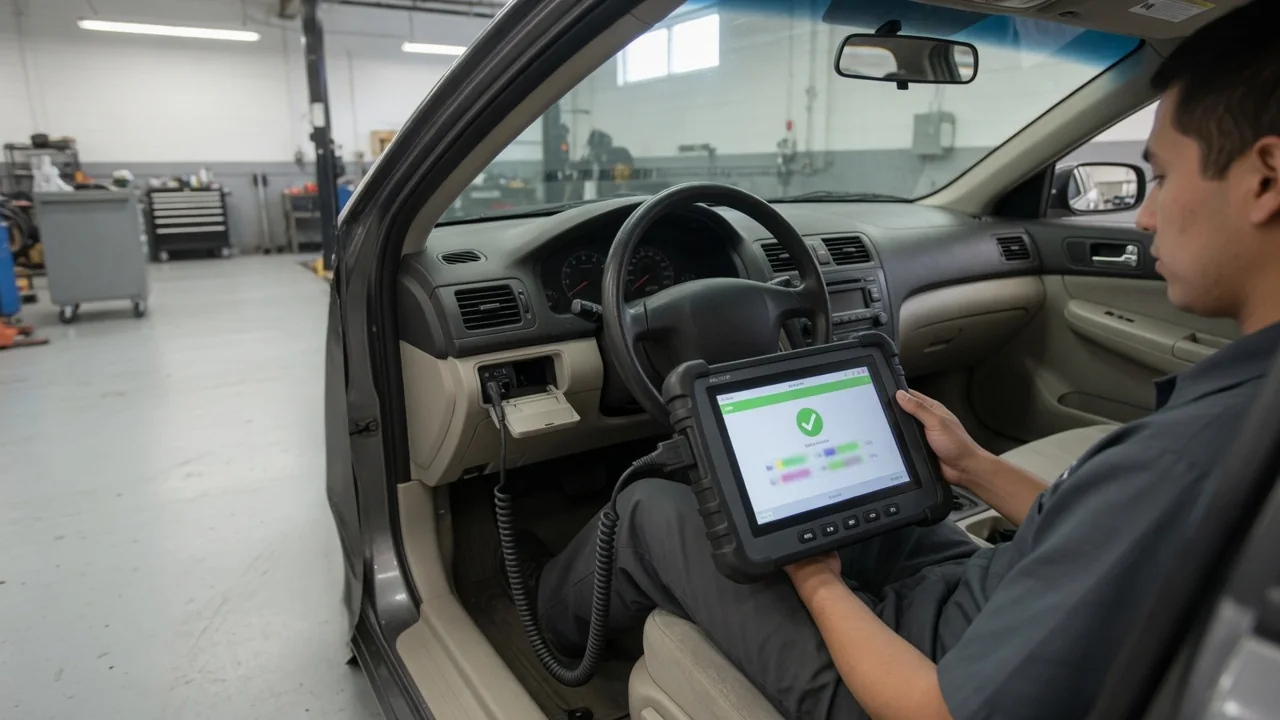
When the scan tool reports P1001, treat it as a manufacturer-specific trouble code that must be confirmed against the vehicle's service information rather than assumed to name a failed part. On many vehicles that definition describes a key-on engine-running self-test that did not finish. Verifying the meaning, the test conditions, and any companion trouble codes before clearing data keeps the diagnosis grounded.
Verify What P1001 Means for the Vehicle
P1001 is not a universal definition that applies the same way on every make. Before interpreting the stored result, confirm the code description in service information matched to the vehicle's year, make, model, engine, and the control module that reported it. Manufacturer-specific trouble codes can share a number while describing different conditions, so a printed chart or a generic scanner label is not enough. The reporting module matters because more than one controller can store similar identifiers, and only the documented meaning for that module belongs in the next diagnostic step.
Where the vehicle documentation confirms it, P1001 indicates that a key-on engine-running self-test was not completed. Key-on engine-running, often abbreviated KOER, is a commanded diagnostic routine run with the ignition on and the engine actually running so the control module can evaluate sensors, actuators, and operating strategy under live conditions. Subsequent checks should stay inside that confirmed context. If the service information assigns a different meaning to P1001 on that vehicle, follow that definition instead of assuming an incomplete KOER event.
What an Incomplete Self-Test Can Tell You
An incomplete KOER result reports that a diagnostic process did not finish. It is a test-status message, not a verdict that a sensor, actuator, or wiring assembly has failed. P1001 can appear when a technician or owner requests a self-test through a diagnostic scan tool and the routine stops short of a completed pass. How the code was retrieved matters: a freeze-frame snapshot, a pending versus stored status, and whether the request was active when the interruption occurred all change what the result can support.
Keep observed drivability separate from that test status. Rough idle, stalling, or a warning lamp may exist at the same time as P1001, but the incomplete self-test does not, by itself, prove those symptoms or identify their cause. Companion trouble codes stored with the incomplete result deserve more weight as clues to an actual circuit or system concern. If the only finding is an aborted KOER run, treat it as unfinished diagnostics rather than a reason to replace parts or to assume the engine is mechanically at fault.
Why the Engine-Running Self-Test May Stop
A key-on engine-running self-test can stop for reasons that have nothing to do with a failed component. Unmet KOER test prerequisites, an interrupted test sequence, or a missed operator prompt are common possibilities that must be checked against the vehicle-specific procedure. Many routines expect the engine to remain running, the operator to answer on-screen requests, and the scan tool session to stay connected. If any of those conditions drop out, the control module may store P1001 as a self-test interruption rather than as a completed system evaluation.
Engine operating conditions and scan-tool support also affect whether the routine can finish. Coolant temperature, idle quality, transmission range, and related live inputs can matter, but the required values are vehicle-specific and should come from the procedure, not from assumed universal thresholds. An existing engine fault or a communication problem between the diagnostic scan tool and the reporting module can prevent completion as well. Those possibilities still need supporting evidence, such as additional codes, failed communication screens, or a documented abort message, before they are treated as the reason P1001 was stored.
Prepare for a Retest Without Losing Diagnostic Evidence
Before clearing anything, record every retrieved code, available status information, freeze-frame or test-mode data, reported symptoms, and the sequence that led to the incomplete KOER run. That record is the only way to compare a later retest with the original event. Confirm that the diagnostic scan tool actually supports the prescribed self-test for this vehicle and obtain the exact KOER test prerequisites and operator prompts from service information. A generic OBD menu that cannot command the manufacturer routine will not complete the test the control module expects.
Limit owner checks to safe observations: dashboard warning lamps, whether the engine starts and maintains normal operation, and whether the scan tool can communicate without dropping the session. Engine-running tests belong in a well-ventilated location with the vehicle in park or neutral, the parking brake set, and the area clear of people and objects. Procedures that involve moving parts, unfamiliar controls, or commanded actuator tests should be referred to a qualified technician. Do not clear codes solely to make P1001 disappear if companion trouble codes or symptoms still need investigation.
Rerun the Supported Test and Interpret the Outcome
When the tool and the vehicle documentation agree on the routine, follow the documented sequence and the scan-tool prompts exactly. Do not substitute a universal pedal, steering, jumper, or timing routine borrowed from another make. Watch the tool for a completion message rather than assuming the test finished because the engine kept running. Record any codes that appear after a completed KOER pass. Completion means the requested self-test ran to the end; it does not prove that every related system is fault-free, especially if companion trouble codes remain.
If the test aborts again, document the stopping point, any on-screen abort reason, and which prerequisites still appear unmet instead of repeatedly clearing codes or replacing parts. Repeated interruptions, a scan tool that cannot command the manufacturer self-test, or significant running problems are reasons to stop and seek professional testing. End the attempt immediately if the engine becomes unstable, warning lamps indicate a new concern, or the work area is no longer safe. P1001 remains a status to interpret with vehicle-specific information, not a parts list.