On-Car Brake Lathe: What It Does and When It Is the Right Choice
The short answer
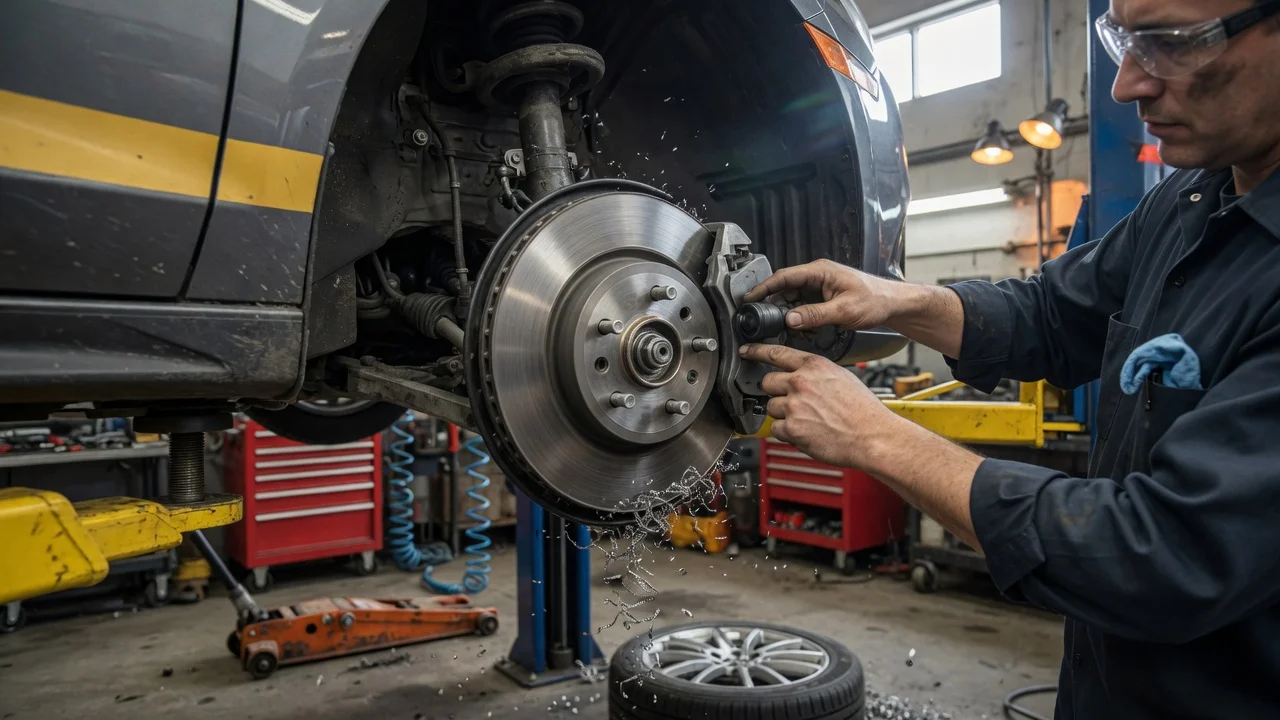
An on-car brake lathe machines a brake rotor while the rotor is still bolted to the vehicle's hub. Because it cuts the rotor in place, it corrects the rotor surface relative to the hub and bearing it actually spins on. This can remove lateral runout, the side-to-side wobble that often shows up as pedal pulsation, including runout that comes from the hub and rotor combined rather than from the rotor alone.
That makes on-car machining a sound choice when a rotor is still usable but has runout or uneven surfaces, and especially when the rotor is difficult to remove or the service information calls for on-vehicle resurfacing. It is not the right choice if the rotor would fall below its minimum allowed thickness after cutting, or if it is cracked, heat-damaged or otherwise worn out. In those cases, replacement is the correct next step.
Conditions that change the answer
Minimum thickness: Rotors are marked with a minimum or discard thickness, and the vehicle's service information also lists it. If machining would take the rotor below that figure, replace the rotor instead. Rotor condition: Cracks, deep scoring, heat spots or hard spots usually mean replacement rather than resurfacing. Rotor design: On some vehicles the rotor is captured behind the hub or is hard to remove. On-car machining avoids that disassembly. Manufacturer guidance: Some manufacturers' service procedures specify or prefer on-car resurfacing for certain models. Others recommend replacement. Check the procedure for the exact model year, trim and axle. Source of the runout: If the hub flange or wheel bearing is damaged or worn, machining the rotor does not fix the underlying fault. A worn bearing should be found and corrected first.
How it compares with bench machining and replacement
Option | What it references | Typical strength | Main limitation; On-car lathe | The vehicle's own hub and bearing | Corrects combined hub and rotor runout, and the rotor does not need to be removed | Needs the lathe set up on each wheel position, and it cannot restore a rotor that is under minimum thickness; Bench (off-car) lathe | The lathe's arbor and adapters | Common in shops and works well when the rotor removes easily | Does not account for hub runout, and remounting can reintroduce stack-up error; New rotor | Not machined, or already finished at the factory | Restores full thickness and removes wear and heat damage | A new rotor can still show runout if the hub surface is dirty, corroded or damaged
What to check before deciding
Measure rotor thickness and compare it with the minimum specification for your vehicle. Measure lateral runout with a dial indicator, and compare the result with the service specification for your vehicle. Inspect the hub mounting face for rust or debris, and check the wheel bearing for play. Confirm whether the service information for your model year, trim and powertrain specifies on-car machining, bench machining or replacement.
What this guidance cannot tell you
No vehicle-specific data was available for this article, so it does not state minimum thickness values, runout tolerances, labor times or costs. Those figures vary by vehicle and by shop, and they need to come from the service information for your exact vehicle and from a shop quote. The same limit applies to particular lathe brands or models: no evaluation of their accuracy or suitability was available here.
Suggested next step
If you have brake pulsation and the rotors still have usable thickness, ask the shop whether it uses an on-car lathe and whether the vehicle's service procedure supports it. If the rotors are near or below minimum thickness, or show cracks or heat damage, plan on replacement. Either way, have the hub face cleaned and runout checked once the work is done.