Muffler Repair Options: When a Damaged Muffler Can Be Repaired
What is the essential answer to my question?
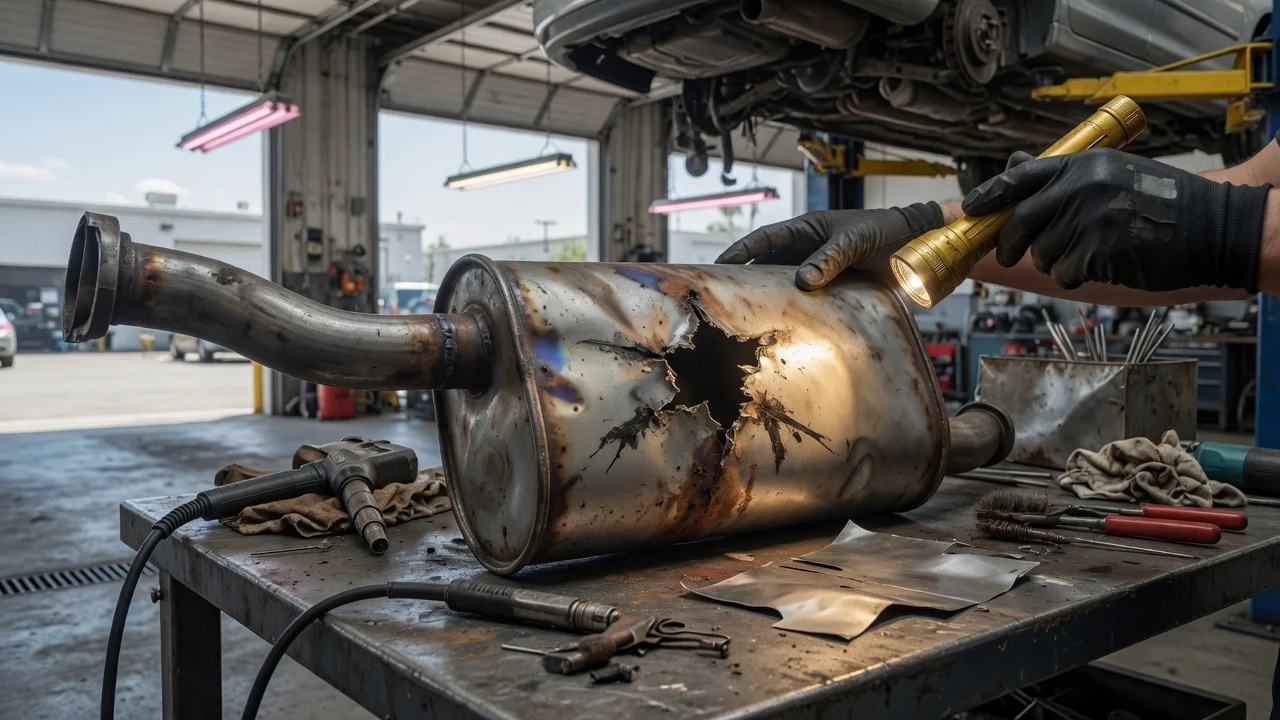
A damaged muffler can often be repaired when the failure is a small, accessible hole, a corroded seam, or localized surface rust that has not weakened the surrounding shell or the internal baffles. Repair is practical if the damage is isolated and the rest of the muffler, pipes, hangers, and flanges remain structurally sound. A muffler with widespread rust, cracked internal components, loose baffles, or damage near a welded joint may still be patched temporarily, but replacement is usually the more durable choice.
The key qualification is the condition of the metal next to the defect. Exhaust repair products and welding require clean, solid material to bond to. If the area around a hole is thin, flaking, or crumbles when tapped, a repair is unlikely to hold for long. A small patch can also pressure another weak area of the case, so the repair decision should be based on the condition of the entire muffler, not only the visible hole.
Which option better fits my priorities?
The main alternatives are a patch-style repair, a welded repair, or full muffler replacement. They differ in cost, durability, and the amount of disassembly required.
Option|Best for|Typical durability|Practical limits; Exhaust tape or bandage|Temporary fix on a small round hole or joint leak|Short term; often weeks to a few months|Needs a clean, dry surface and usually works poorly on flex joints or large holes; Epoxy or paste patch|Small pinholes or surface cracks|Limited; depends on surface preparation|Metal must be sound; heat and moisture can weaken the bond; Clamp-on patch or sleeve|A hole in a straight section or accessible seam|Moderate when the surrounding metal is solid|Case must stay rigid enough for the clamp to seal; Welded patch|Localized damage with enough sound metal nearby|Best repair durability when done correctly|Requires welding skill and may be impractical on thin, rust-thinned shells; Replacement muffler|Widespread rust, internal baffle failure, or repeated repairs|Longest; returns the system to a known condition|Higher initial cost and may involve cutting or replacing adjacent pipe
A patch makes sense when the goal is a low-cost, temporary fix, and the surrounding metal is strong. A welded repair is preferable for a discrete hole on a muffler that is otherwise in good condition. Replacement is the better choice when the case is generally thin, the baffles rattle, multiple areas are failing, or the vehicle must pass an inspection that checks exhaust integrity.
What could explain this symptom, and what should I check next?
A louder or deeper exhaust note, a visible hole, rust staining, black soot around a seam, or a rattling sound from the muffler area can all point to muffler damage. Before choosing a repair, the cause and extent should be checked while the exhaust is cool and the vehicle is safely supported.
A localized stain or small hole usually indicates a rust perforation; tap lightly around it to see whether the shell is still firm. If the steel gives way or flakes, the repair area is too weak for a lasting patch. A rattle when tapping the muffler may indicate a loose internal baffle. A patch on the outside will not fix internal separation, so replacement is more appropriate. A leak at a seam or near a welded joint can sometimes be repaired if the surrounding material is solid, but a failed factory weld may signal advanced corrosion in that area. Moisture dripping from a small drain hole is often normal condensed water. Do not seal the drain hole, because it is designed to let moisture escape and reduce internal corrosion.
If the exhaust is loud inside the cabin, if exhaust fume odor is noticeable, if the muffler is loose, or if damage extends into the pipes, hangers, or mounting flanges, continued driving should be avoided and a professional inspection should be considered. Exhaust leaks can allow gases to enter the passenger area and can also affect how the vehicle runs and how it is measured during inspection.
Basic muffler damage check after the exhaust has fully cooled: 1) Safely raise and support the vehicle by the manufacturer's jacking points. 2) Look for holes, rust blooms, soot trails, cracks, and corroded seams. 3) Tap around a suspected hole with a small tool. Solid metal gives a consistent ring; weak metal sounds dull or flakes away. 4) Tap the muffler body and listen for a loose internal baffle. 5) Check the inlet and outlet pipes, hangers, and flanges for movement, cracks, or erosion. 6) Do not cover the drain hole, if present, and do not start the vehicle with your face near the suspected leak.