Miata turbo intercooler
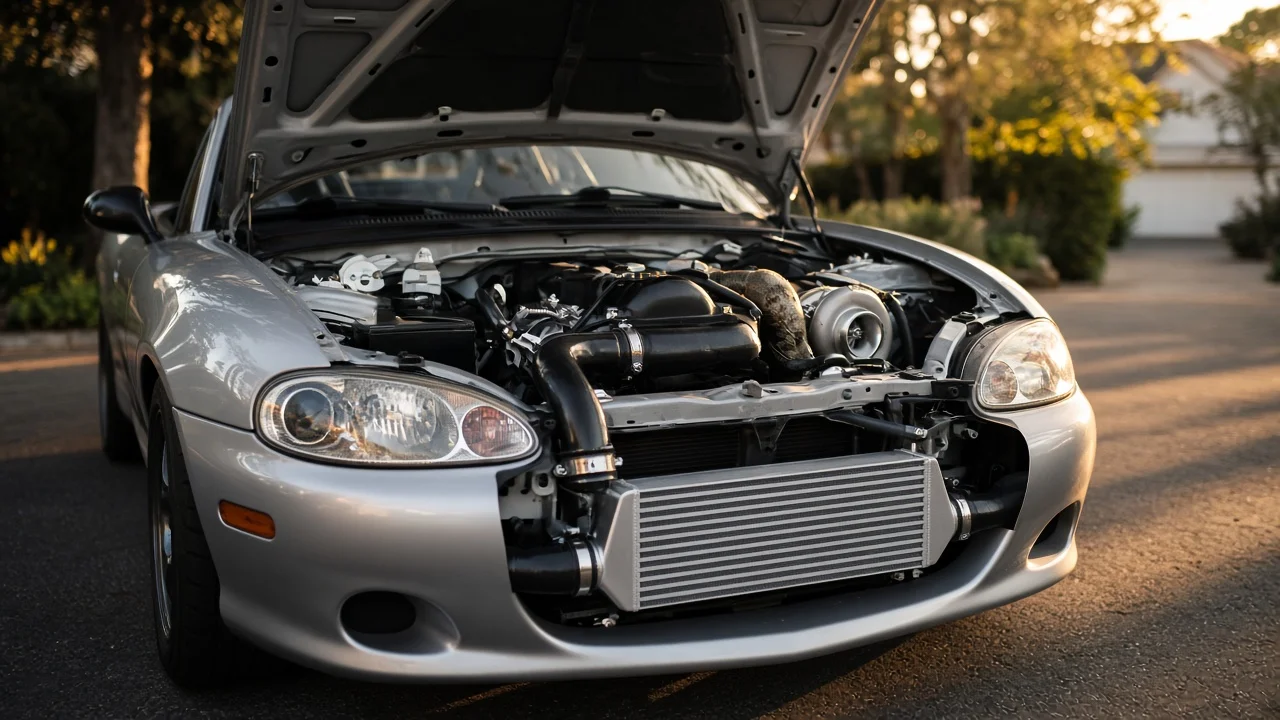
Choosing a Miata turbo intercooler often comes down to how the car is actually driven, not just how much boost it makes. A turbocharger heats the air leaving the compressor outlet, and that heat reduces charge density, encourages knock, and makes consistent power harder to tune. An intercooler sits between that hot compressor outlet and the throttle body, lowering charge-air temperature before it reaches the cylinders. For street cars, tight engine bays, airflow through the nose, and pressure loss across the core all shape which design fits and works. The right heat exchanger should support the boost pressure and hose connection layout without hurting throttle response or blocking the radiator.
The direct answer
For most Miata turbo owners, the most suitable intercooler is a front-mounted air-to-air bar-and-plate core with short, smooth piping that matches the compressor outlet and throttle body routing. The core should be large enough to pull heat out of the charge air but not so thick or wide that it becomes a restriction or blocks coolant airflow to the radiator. Fitment changes depending on bumper structure, power steering lines, air conditioning plumbing, and whether the car retains the factory crash bar. Vehicles seeing repeated hard pulls or track sessions benefit from more thermal mass and cleaner ducted airflow.
Boost pressure alone does not determine whether an intercooler works. A small core may show an impressive pressure reading while leaving charge-air temperature high, and a poorly shaped end tank can create pressure loss even when the core looks large. Oil contamination inside a used or poorly maintained system can coat internal fins, reduce heat transfer, and hide a richer-than-expected intake condition. Because intercooler sizing is a balance of cooling capacity, flow, and available space, the practical choice for a daily driver is often a smaller but efficient core with quality couplers and a clean hose connection at every joint rather than the largest unit that can be wedged behind the bumper.













